
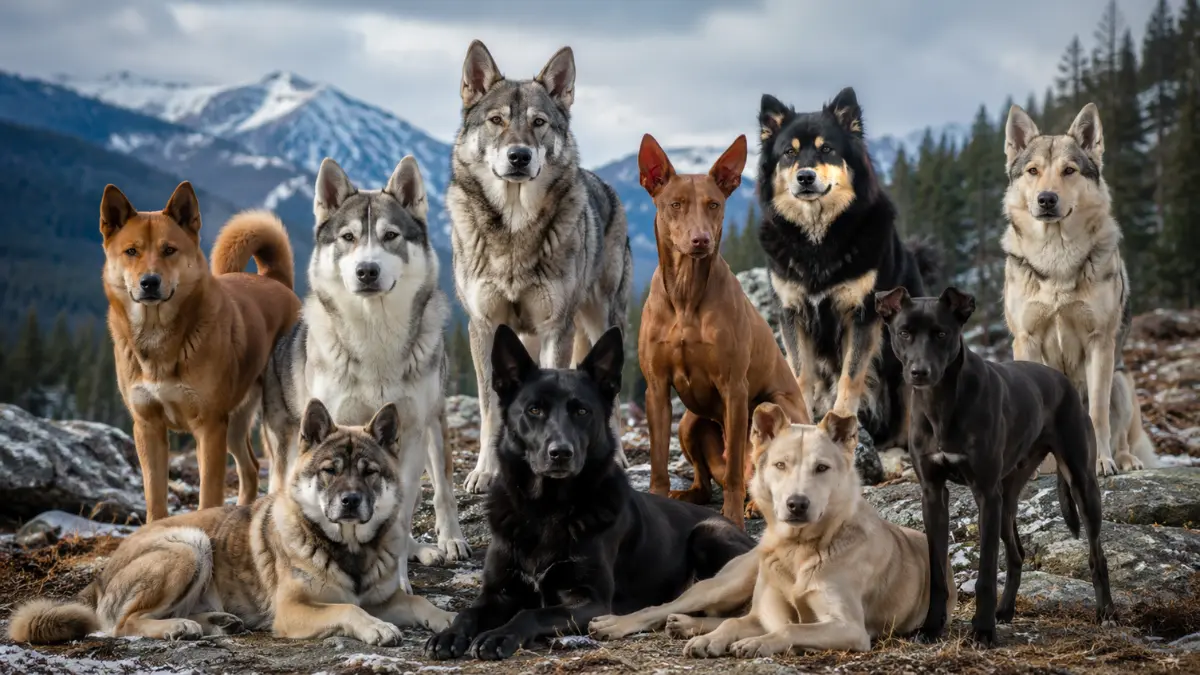
Some dogs do not simply look different.
They feel different.
You notice it before you know the breed name. The upright ears. The sharp expression. The dense coat. The quiet, watchful posture. The way the dog seems to study the world before reacting to it.
That older presence is exactly why primitive dog breeds attract so much attention.
Many of them resemble wolves at first glance, and that visual similarity is powerful. It creates curiosity, admiration, and sometimes the wrong expectations.
A dog can look incredibly wolf-like and still be completely domestic.
This is the first thing many people misunderstand.
A wolf-like face does not automatically mean wolf-like behavior. Some of these breeds are playful and social. Some are serious and reserved. Some bond closely with family but still prefer making their own decisions instead of following commands without question.
That is what makes primitive breeds so interesting.
Their story is not only about how they look.
It is about how they think.
Many primitive dogs retain sharper environmental awareness, stronger instincts, and a more independent decision-making style than many modern companion breeds. They may pause before responding. They may evaluate a command. They may notice a sound, movement, scent, or stranger long before a softer companion breed reacts.
That does not make them wild.
It makes them different.
And for the right owner, that difference is exactly what makes them unforgettable.
In this guide, you will learn:
- what primitive dog breeds actually are
- why several still look similar to wolves
- how primitive breeds differ from modern companion dogs
- which wolf-like primitive breeds are easiest and hardest to live with
- why appearance alone is a poor way to choose a dog
- how to understand these breeds from a real ownership point of view
The wild look gets attention. The primitive mindset is what matters in daily life.
What Is a Primitive Dog Breed?
The word primitive can sound misleading if you are hearing it for the first time.
It does not mean backward.
It does not mean dangerous.
It does not mean less valuable.
In dog breed discussions, primitive usually refers to domestic dogs that retained more ancestral characteristics than heavily modern, selectively bred breeds.
In simple terms, these dogs changed less under modern human breeding pressure.
Many developed in isolated regions, harsh climates, or early working environments where survival mattered more than appearance. Instead of being refined mainly for show rings, soft companion behavior, or handler-focused obedience, these dogs often kept traits that helped them function with more independence.
Common primitive-type traits include:
- independent decision-making
- strong environmental awareness
- higher prey drive
- efficient movement
- cautious behavior with strangers
- problem-solving without constant human direction
Some primitive breeds are also described as ancient or basal breeds because genetic research places them on older branches of the domestic dog family tree.
For a deeper foundation on this topic, you can read our full guide on primitive dog breeds.
Primitive dogs are domestic dogs. They are not wolves, and they are not automatically dangerous.
The real difference is not whether they can live with humans.
They can.
The difference is how they relate to humans.
Many modern companion breeds look quickly toward people for direction. Primitive breeds often observe first, think first, and then respond.
That small difference changes almost everything about ownership.
Primitive Does Not Mean Wolf, Hybrid, or Aggressive
This is where online dog content often becomes misleading.
A primitive breed is not automatically:
- part wolf
- a wolf hybrid
- naturally aggressive
- untrainable
- unsafe around families
- less domesticated in daily life
Those assumptions are too simple.
Primitive is about ancestry, behavior patterns, and retained traits. It is not a warning label.
A primitive dog may be loving, loyal, calm, and deeply bonded to its household. At the same time, it may not be as eager to please as a Labrador Retriever or as handler-focused as a Border Collie.
That does not make the dog bad.
It means the owner needs realistic expectations.
A retriever often responds as if asking:
“What do you want me to do?”
A primitive breed may respond more like:
“Why does this make sense right now?”
That difference is not a flaw.
It is the result of a different history.
If you want to understand this contrast in more depth, our guide on primitive dogs vs modern dogs explains the behavior gap in a broader way.
Why Do Some Primitive Dogs Still Look Like Wolves?
The wolf-like appearance in primitive breeds is not random.
Many of these physical traits were useful long before modern breed standards existed.
Dogs living in demanding environments benefited from bodies that were efficient, durable, and alert. Features such as upright ears, thick weather-resistant coats, wedge-shaped heads, lean frames, and balanced movement helped dogs survive and work in difficult conditions.
Over time, those traits remained because they worked.
That is why many spitz-type and Arctic breeds still look close to wolves at first glance.
Common wolf-like features include:
- upright ears
- wedge-shaped head
- sharp facial expression
- dense double coat
- athletic body
- bushy tail
- efficient endurance movement
Two dogs can both look wolf-like and still behave completely differently.
A Siberian Husky may look wild but behave like a friendly, vocal escape artist.
An Akita may look calm and powerful but behave like a serious guardian.
A Basenji may not look much like a wolf at all, yet its independent mindset can feel more primitive than many larger wolf-looking breeds.
This is why the phrase “wolf-like dog” needs careful handling.
Looks and behavior are not the same thing.
Are Primitive Dogs the Closest Dogs to Wolves?
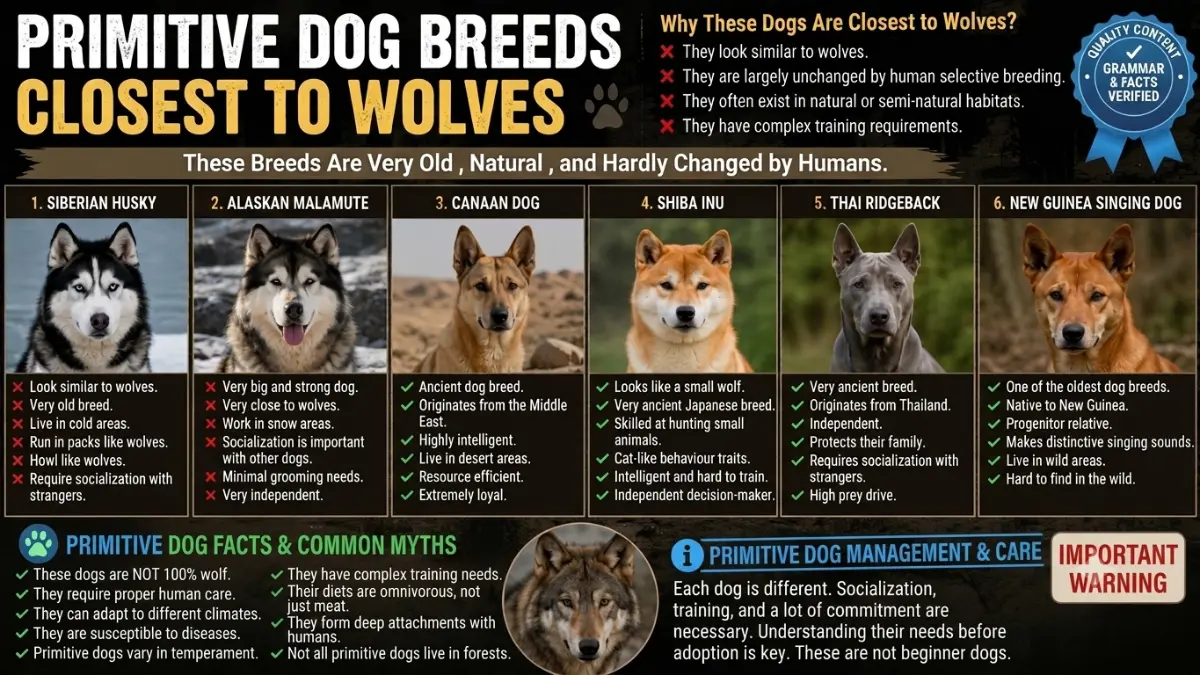
This question comes up often, but the answer is more complicated than most people expect.
All domestic dogs share ancient ancestry with wolf populations. That includes tiny companion breeds, giant working breeds, and primitive breeds.
No modern breed is simply “the closest to wolves” in a straight, simple line.
What canine genetics suggests is that some breeds belong to older branching lineages within domestic dog history. These are often described as basal, ancient, or primitive-type breeds.
Research published through NIH / PubMed Central discusses genomic relationships among modern dog breeds and helps explain why some lineages are often treated as older branches of domestic dog ancestry.
Still, even these breeds are dogs.
They have been shaped by thousands of years of life with humans.
They are not wolves in disguise.
Important note: Not every breed in this list is classified as a strict primitive breed by every academic or kennel-club source. A few are included because of their ancient lineage, primitive-type behavior, or exceptionally wolf-like appearance.
That gives this guide a useful balance: practical for readers, but still honest from a breed classification point of view.
Primitive Dogs vs Modern Dogs: Quick Comparison
| Trait | Primitive Breeds | Modern Companion Breeds |
|---|---|---|
| Independence | Usually high | Moderate to low |
| Trainability | Possible but often motivation-based | Usually easier and more repetitive |
| Recall Reliability | Variable | Often more consistent |
| Prey Drive | Often strong | Varies widely |
| Stranger Behavior | Often cautious | Often more openly friendly |
| Human Focus | Lower to moderate | Often high |
| Problem Solving | Strong and self-directed | Often handler-guided |
The simplest way to understand the difference is this:
Modern breeds were often shaped for cooperation. Primitive breeds were often shaped for adaptability.
Neither is better.
They are built around different expectations.
Why This Matters Before Choosing One
Primitive breeds often attract people for emotional reasons.
The look is powerful.
The posture is impressive.
The connection to ancient dog history feels special.
But living with one is not the same as admiring one in a photo.
A primitive dog may:
- understand a command but choose not to respond immediately
- notice small environmental changes before you do
- become bored with repetitive training
- need more mental stimulation than expected
- struggle with weak boundaries
- show caution around unfamiliar people
This is why primitive breed ownership rewards preparation.
A bored Siberian Husky may not simply chew a shoe. It may study the gate, test the latch, escape the yard, and turn the neighborhood into its own adventure route.
That is not just bad behavior. That is intelligence without enough structure.
For owners interested in the care side of these dogs, our primitive dog diet guide covers nutrition and feeding considerations for active, instinct-driven breeds.
Primitive Breed Scorecard
This scorecard is not meant to declare one breed better than another.
It is a practical ownership snapshot.
| Breed | Wolf Look | Primitive Instinct | Trainability | Beginner Friendly? |
|---|---|---|---|---|
| Alaskan Malamute | 9/10 | 8/10 | 5/10 | No |
| Siberian Husky | 9/10 | 7/10 | 6/10 | No |
| Akita | 8/10 | 8.5/10 | 5/10 | No |
| Shiba Inu | 6/10 | 9/10 | 4/10 | No |
| Basenji | 5/10 | 9.5/10 | 4/10 | No |
| Thai Ridgeback | 8/10 | 9/10 | 5/10 | No |
| Chow Chow | 7/10 | 8/10 | 4/10 | No |
| Czechoslovakian Wolfdog | 10/10 | 9/10 | 4/10 | No |
| Carolina Dog | 6.5/10 | 8.5/10 | 6/10 | Moderate |
| New Guinea Singing Dog | 8/10 | 10/10 | 2/10 | No |
A high primitive score does not mean a better dog. It means a dog that usually needs more experienced ownership, clearer structure, and more realistic expectations.
The 10 Primitive Dog Breeds That Still Look Like Wolves
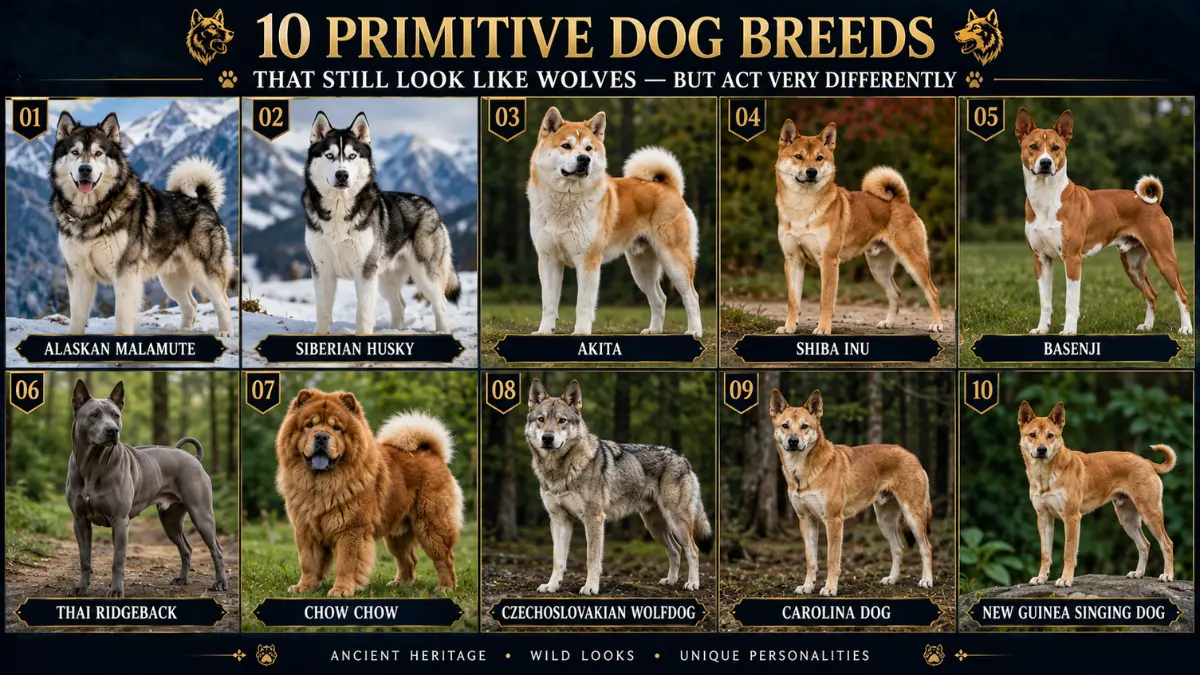
Now let us move into the breeds themselves.
This is where the topic becomes more interesting, because wolf-like appearance does not create one single personality type.
Some breeds on this list are social and playful.
Some are serious and protective.
Some are rare, difficult, and not realistic for most homes.
Others can live well with experienced owners who understand their instincts.
Same wild-looking outline. Very different minds.
That difference is the real point of this guide.
1. Alaskan Malamute
If raw power had a canine form, it would probably look like the Alaskan Malamute.
This is one of the most powerful Arctic working breeds ever developed. It is also one of the easiest dogs for people to mistake for a wolf at first glance.
The broad skull, dense coat, deep chest, and heavy frame all create a dramatic impression.
But the Malamute is not a wolf in dog form.
It is a domestic working dog shaped for endurance, strength, and survival in harsh northern conditions.
What Makes It Look Wolf-Like
- broad skull and powerful jaw
- dense double coat for extreme cold
- deep chest and heavy bone structure
- muscular body built for pulling
- bushy tail carried over the back
Unlike faster sled dogs, Malamutes were not built primarily for speed.
They were built to move heavy loads across brutal Arctic terrain over long distances.
That job shaped their body and also shaped their attitude.
Personality Snapshot
A Malamute usually feels confident rather than frantic.
Its energy is powerful, but not always frantic in the same way as some lighter sled breeds.
Malamutes are often:
- affectionate with family
- physically strong
- social but independent
- strong-willed
- not naturally submissive
This is not a breed that blindly obeys because a person raises their voice.
Force-based handling can make things worse.
The Malamute responds better to calm consistency, clear boundaries, and an owner who understands large working dogs.
Biggest owner challenge: power plus independence. A stubborn small dog is inconvenient. A stubborn Malamute can be physically difficult to manage.
Without structure, a Malamute may start making its own rules.
That does not mean the breed is bad.
It means the owner needs to be prepared.
Best for: experienced, active owners who understand large working breeds.
2. Siberian Husky
The Siberian Husky may be the most famous wolf-like dog in the world.
It is also one of the most misunderstood.
People see the sharp face, athletic body, thick coat, and intense eyes. Then they assume the Husky must be serious, protective, and intimidating.
Then they actually meet one.
Many Huskies are social, dramatic, playful, vocal, and almost comically energetic.
That contrast is exactly why the breed belongs in this article.
Why People Confuse It With Wolves
- lean athletic build
- sharp facial structure
- intense eyes and expression
- efficient endurance movement
- dense Arctic coat
Everything about the Husky says movement.
This breed was developed for endurance, not brute strength. Compared with Malamutes, Huskies are usually lighter, faster, and more agile.
The Personality Surprise
Here is what many new owners get wrong:
“This dog looks serious and wolf-like, so it must be protective.”
Usually, no.
Many Huskies are poor guard dogs because they are naturally friendly with people, including strangers.
Some may alert you with noise.
But many are more likely to greet visitors than guard the house.
This makes the Husky one of the clearest examples of why appearance can mislead owners.
Behavior Pattern
Huskies are often:
- highly energetic
- playful
- social with people
- vocal
- clever escape artists
A bored Husky can become a serious problem.
Not because the dog is unintelligent.
Because it is very intelligent.
And bored intelligence often turns into creative destruction.
A Husky may dig under a fence, test a latch, climb, chew, howl, or invent its own entertainment if the home does not provide enough structure and stimulation.
For broader breed research, explore our full dog breeds section.
Training Reality
Many beginners assume a Husky refusing recall is trying to dominate them.
Often, the simpler truth is this:
The Husky found something more interesting.
Harsh training rarely solves that problem.
Engagement, consistency, and better motivation are much more effective.
With Huskies, the goal is not to crush independence. It is to make cooperation worth choosing.
Best for: highly active households with time for exercise, enrichment, and secure management.
3. Akita
Where the Husky feels expressive and playful, the Akita feels serious.
Very serious.
This breed carries a quiet intensity that many people notice immediately.
It does not bounce around seeking attention.
It watches.
It evaluates.
Then it decides.
That alone gives the Akita a primitive feel.
First Impression of an Akita
Many owners describe the same feeling when they meet a mature Akita:
It feels like the dog is studying you.
That may sound dramatic, but it fits the breed.
Akitas tend to be observant, controlled, and selective with trust.
They are not usually the type of dog that greets every stranger like an old friend.
Physical Traits Behind the Wolf-Like Presence
- thick insulating coat
- broad head
- strong bone structure
- deep-set eyes
- upright confident posture
The Akita’s wolf-like presence does not come from speed or constant motion.
It comes from stillness.
From power that does not need to announce itself.
Temperament
Akitas are commonly:
- loyal to family
- protective
- calm but alert
- reserved with strangers
- highly aware of their surroundings
They bond deeply with their people, but trust is not handed out freely.
That can be a strength in the right home.
It can become a problem in the wrong one.
Important ownership warning: Akitas need early socialization. Without it, natural protectiveness can become excessive.
Training an Akita is not about overpowering it.
It is about earning respect, building consistency, and teaching the dog how to behave in a modern world.
Best for: experienced owners who want a calm guardian-type companion and understand serious breeds.
4. Shiba Inu
At first glance, the Shiba Inu does not look as intimidating as an Arctic breed.
It is smaller.
Lighter.
Almost fox-like.
But do not let the size fool you.
Many experienced owners consider the Shiba Inu one of the most primitive-minded dogs a person can bring home.
Its personality often surprises people far more than its appearance.
What Gives It a Primitive Look
- wedge-shaped head
- upright triangular ears
- tightly curled tail
- compact athletic body
- sharp, alert expression
Rather than resembling a large wolf, the Shiba looks more like a small wild canid: efficient, agile, sharp, and constantly aware.
Every movement feels precise.
Nothing looks wasted.
What Living With a Shiba Actually Feels Like
This breed does not constantly look for approval.
Instead, it evaluates situations independently.
That is why first-time owners often say something like:
“My dog understands me perfectly. It just does not always agree with me.”
Surprisingly, they are often right.
Shibas are usually:
- highly intelligent
- emotionally subtle
- independent
- very clean
- reserved around unfamiliar people
Many also display cat-like habits, including self-grooming, personal space preferences, and selective affection.
Training Reality
Trying to force a Shiba into obedience usually backfires.
Repetition alone does not impress this breed.
Consistency, trust, timing, and patience matter much more.
A Shiba may know exactly what you want and still decide whether it is worth doing.
That can frustrate owners who expect automatic compliance.
But for people who appreciate independent personalities, the breed can be deeply rewarding.
Best for: owners who respect independent dogs rather than expecting constant people-pleasing behavior.
5. Basenji
Few breeds feel as ancient as the Basenji.
This breed is often called the barkless dog, but that nickname only tells a small part of the story.
The Basenji does not simply look different from many modern companion breeds.
It behaves differently.
That is what makes it important in any serious discussion about primitive dogs.
Why It Looks Primitive
- elegant athletic frame
- upright ears
- tightly curled tail
- balanced proportions
- alert, intelligent expression
Unlike heavier wolf-like breeds, the Basenji does not create its primitive impression through size or coat volume.
It creates it through efficiency.
The body looks clean, quick, and functional.
Nothing feels exaggerated.
That gives the breed an older, more natural appearance.
The Barkless Dog Myth
Basenjis are famous for rarely barking, but that does not mean they are silent.
Instead, they produce unusual vocalizations often described as yodel-like sounds.
This unusual voice is one of the breed’s most recognizable traits.
Behaviorally, the more important point is this:
The Basenji is not quiet because it is simple. It is quiet because it communicates differently.
That difference often surprises people who expect all dogs to express themselves in the same way.
Temperament and Behavior
Basenjis are often:
- highly observant
- intelligent
- independent
- naturally curious
- strong prey-driven hunters
This is a breed that notices details.
A new object in the room.
A movement outside the window.
A gap in the fence.
A weak spot in your routine.
Basenjis are excellent problem-solvers, and sometimes that intelligence feels inconvenient for the owner.
If a Basenji wants to reach something, escape something, or investigate something, it often finds a way.
Ownership Reality
Mental stimulation is not optional with this breed.
Without it, boredom arrives quickly.
An intelligent, bored Basenji will usually invent its own entertainment.
That may mean climbing, stealing, chewing, escaping, or turning ordinary household objects into puzzles.
For owners who enjoy a quiet, clean, independent dog, the Basenji can be fascinating.
For owners expecting easy obedience, it can be frustrating.
Best for: owners who appreciate intelligent, low-noise, independent dogs and do not expect automatic obedience.
6. Thai Ridgeback
Among all primitive breeds, the Thai Ridgeback remains one of the most underrated.
Outside Thailand, many people have never seen one in person.
That low visibility is exactly why the breed deserves more attention.
It is not just rare.
It is a powerful example of how primitive traits can survive in a modern dog without needing a heavy Arctic coat or dramatic wolf-like coloring.
What Makes It Stand Out
- lean muscular body
- wedge-shaped head
- erect ears
- alert almond-shaped eyes
- distinctive ridge of hair along the spine
The ridge grows in the opposite direction from the rest of the coat, giving the breed its name and making it instantly recognizable.
But the ridge is not the most important thing about this dog.
The real story is behavior.
Why It Feels Primitive
Thai Ridgebacks often carry themselves with watchful, self-contained confidence.
They do not usually rush into unfamiliar situations.
They observe first.
Then they decide.
That pause matters.
Many modern companion dogs look quickly to their owner for direction.
A Thai Ridgeback may evaluate the room before deciding how to respond.
That is one reason experienced owners find the breed fascinating.
It does not feel robotic.
It feels like a dog with its own judgment.
Temperament Snapshot
Thai Ridgebacks are typically:
- highly intelligent
- naturally protective
- emotionally sensitive
- independent
- cautious around strangers
This breed can become very bonded to its family, but trust is not usually given away casually.
That does not mean the dog is unstable.
It means socialization and structure matter from the beginning.
The biggest mistake with Thai Ridgebacks is confusing independence with stubbornness.
A Thai Ridgeback may understand exactly what you want.
It may simply decide whether your request makes sense in that moment.
That is a different mindset from breeds developed mainly for handler-focused obedience.
Training Reality
Training works best through consistency, trust, and positive reinforcement.
Harsh corrections usually damage the relationship instead of improving it.
This is not a breed that responds well to chaotic handling.
It needs an owner who is calm, clear, and fair.
Because behavior and lifestyle are closely connected in primitive breeds, readers may also find your primitive dog diet guide useful when researching long-term care.
Best for: experienced owners who enjoy intelligent, self-reliant, athletic dogs with strong guardian instincts.
7. Chow Chow
The Chow Chow is often remembered for its lion-like coat and blue-black tongue.
But beneath that dramatic appearance is one of the oldest and most distinctive dog breeds in the world.
Many people expect the Chow Chow to behave like a giant teddy bear.
That expectation is usually wrong.
This breed is calm, dignified, independent, and often deeply reserved.
In other words, the Chow Chow may not look exactly like a wolf, but its mindset can feel very primitive.
Primitive Features
- thick double coat
- broad skull
- compact muscular body
- deep-set eyes
- naturally dignified posture
The Chow’s body language is often controlled rather than expressive.
It does not usually bounce through life trying to entertain everyone.
It watches.
It decides who belongs in its circle.
Then it bonds deeply with the people it accepts.
For additional breed background, the American Kennel Club Chow Chow profile is a useful external reference.
Personality Overview
Chow Chows are commonly:
- loyal to family
- naturally reserved
- cautious with strangers
- independent thinkers
- calm rather than overly energetic
This is not the type of dog that greets every visitor with excitement.
Trust develops gradually.
Once earned, it is usually strong.
That emotional reserve is one reason Chows are often misunderstood.
People see the coat and expect softness.
Then they meet the personality and realize this is a serious dog.
The Chow Chow is not difficult because it is dramatic. It is difficult because it is independent, reserved, and easy to underestimate.
Living With a Chow Chow
Early socialization is essential.
Without it, natural caution can become excessive suspicion.
With patient handling, realistic expectations, and clear boundaries, Chow Chows can become deeply devoted companions.
But they are not ideal for owners who want a constantly affectionate, people-pleasing dog.
This is a breed that respects calm leadership.
It does not respond well to pressure, chaos, or inconsistent rules.
Best for: owners who appreciate calm, confident, self-contained breeds and understand the importance of early socialization.
8. Czechoslovakian Wolfdog
Few domestic dogs resemble a wild wolf as closely as the Czechoslovakian Wolfdog.
One glance is usually enough to understand why this breed attracts so much attention.
The body proportions, movement, facial expression, and coat all create one of the strongest wolf-like appearances found in any domestic dog.
But this breed needs careful explanation.
Unlike most breeds in this article, the Czechoslovakian Wolfdog was developed through a controlled breeding program involving German Shepherds and Carpathian wolves. Because of that history, many canine experts classify it separately from traditional primitive landrace breeds.
It is included here because of its remarkable wolf-like appearance and instinct-driven behavior — not because every organization considers it a strict primitive breed.
Why It Looks So Much Like a Wolf
- lean athletic frame
- amber or light-colored eyes
- narrow chest with long legs
- dense weather-resistant coat
- fluid, ground-covering movement
Everything about this breed favors endurance.
Its movement often appears effortless, even across rough terrain.
What Living With One Is Really Like
This is one of the most demanding breeds on this list.
Not because it is automatically aggressive.
Because it is incredibly intelligent, physically capable, emotionally sensitive, and easily under-stimulated.
Owners often describe these dogs as constantly analyzing their surroundings.
They notice patterns.
They notice weak routines.
They notice inconsistent rules.
And they need meaningful work.
Common traits include:
- high intelligence
- intense activity needs
- strong bonding potential
- emotional sensitivity
- low tolerance for boredom
This is not a dog that thrives in a sedentary lifestyle.
Without enough structure, exercise, and mental work, behavioral issues can appear quickly.
Ownership Reality
The Czechoslovakian Wolfdog is not recommended for first-time owners.
It performs best with experienced handlers who understand working breeds, structured training, containment, socialization, and consistent routines.
For the right person, it can be extraordinary.
For the wrong owner, it can become overwhelming.
Best for: highly experienced handlers with strong working-dog experience and realistic expectations.
9. Carolina Dog
Sometimes called the American Dingo, the Carolina Dog occupies a unique place in canine history.
Unlike many modern breeds created through intensive selective breeding, Carolina Dogs are believed to have developed largely through natural selection over long periods.
That gives them a distinctly primitive feel.
They do not look exaggerated.
They do not look overly refined.
They look practical.
And that is part of their appeal.
Why It Looks Primitive
- lean, balanced body
- upright ears
- fox-like face
- medium athletic build
- short sandy or reddish coat
Everything about the Carolina Dog appears functional.
The frame is not heavy.
The movement is not flashy.
The expression is alert without being dramatic.
Behavior That Reflects Ancient Survival
Carolina Dogs often display:
- cautious curiosity
- strong environmental awareness
- independent thinking
- excellent problem-solving ability
- deep loyalty to family
Many owners notice that these dogs spend more time observing before reacting.
They do not always rush into unfamiliar situations.
They prefer to assess first.
That quiet confidence can surprise people who expect every dog to behave like a modern social companion.
Carolina Dogs also connect naturally with your broader United States dog breeds topic cluster.
Ownership Reality
Early socialization makes a significant difference.
A well-socialized Carolina Dog can adapt comfortably to modern family life while still retaining its alert, self-reliant personality.
Without socialization, natural caution may become fearfulness.
This is not usually an overly demanding breed in the same way as a wolfdog or a Thai Ridgeback, but it still needs an owner who respects its natural instincts.
Best for: owners who appreciate intelligent, naturally developed dogs rather than heavily manufactured companion breeds.
10. New Guinea Singing Dog
Among all the dogs discussed here, the New Guinea Singing Dog may be the most unusual.
It is exceptionally rare.
It is incredibly agile.
And its vocalizations sound unlike almost any other domestic dog.
Many researchers consider it one of the closest living representatives of ancient dog populations in terms of structure and behavior.
What Makes It So Unique
- compact athletic body
- erect ears
- curled tail
- fox-like face
- remarkable climbing ability
Unlike many domestic breeds, these dogs can climb steep surfaces with surprising ease.
Watching one move often feels more like observing a wild canid than a typical household pet.
The breed’s rare status and taxonomic history are also discussed by organizations such as FCI.
Temperament Overview
New Guinea Singing Dogs are generally:
- highly independent
- extremely intelligent
- naturally cautious
- exceptional escape artists
- curious problem-solvers
They are also famous for their distinctive singing vocalizations, which include rising and falling harmonic sounds rarely heard in other breeds.
That single trait made the breed famous worldwide.
But the voice is not the only unusual thing about them.
Their movement, problem-solving, caution, and independence all make them feel far removed from the average companion dog.
Ownership Reality
This is not a breed suited to the average pet owner.
Their intelligence, athleticism, independence, and escape ability require specialized care and secure environments.
Even experienced owners often describe them as one of the most challenging dogs they have ever worked with.
The New Guinea Singing Dog is fascinating to study, but it is not a casual pet choice.
Best for: advanced owners with rare, primitive, or exotic breed experience.
Primitive Dogs vs Wolves: The Difference Most People Miss
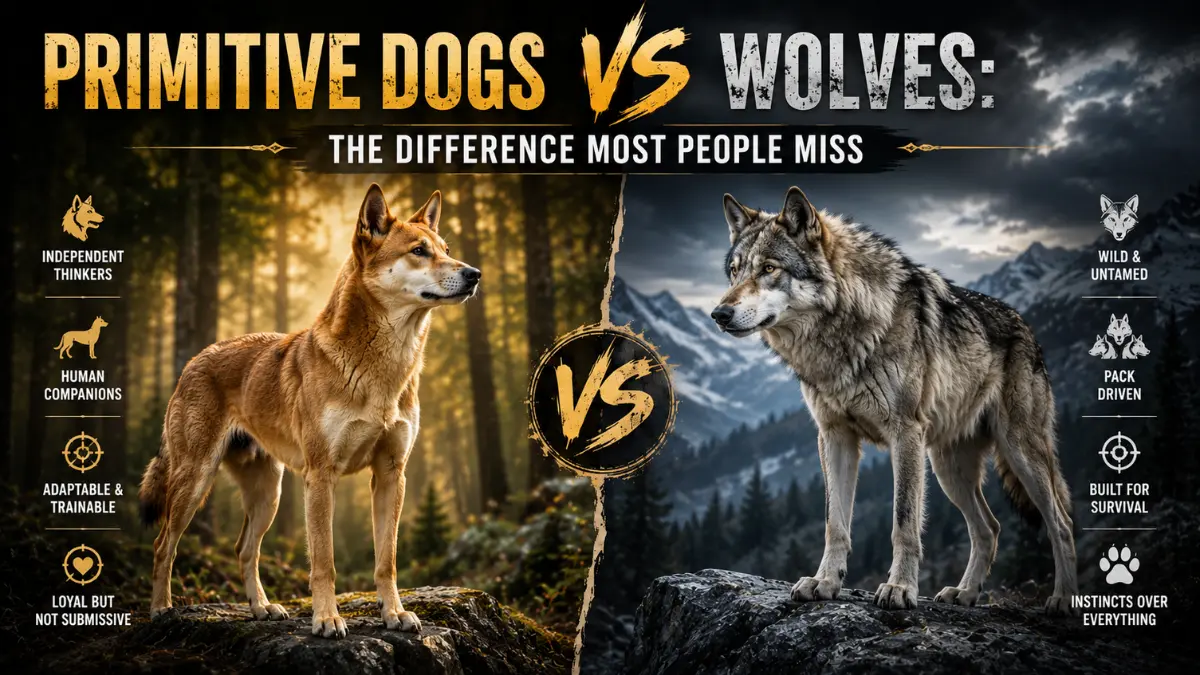
Looking like a wolf does not make a dog behave like one.
That is the biggest takeaway from this entire article.
Wolves evolved to survive without humans.
Primitive dogs evolved alongside humans, just under different conditions than many modern companion breeds.
That distinction changes everything.
| Wolves | Primitive Dogs |
|---|---|
| Wild animals | Domestic dogs |
| Hunt for survival | Depend on human care |
| Naturally avoid people | Can form strong human bonds |
| Live by wild survival pressures | Adapt to domestic life |
| Not suitable as pets | Can thrive in experienced homes |
The similarities are mostly physical.
Behavior tells a very different story.
Common Mistakes People Make With Primitive Breeds
Even experienced dog owners sometimes misunderstand primitive breeds.
Most problems come from mismatched expectations rather than from the dog being “bad.”
Expecting Instant Obedience
Primitive breeds usually understand commands.
That does not mean they will always respond immediately.
Many prefer to assess a situation before acting.
This can look like stubbornness, but often it is simply independent processing.
Focusing Only on Physical Exercise
A long walk is not always enough.
These breeds also need:
- problem-solving activities
- enrichment games
- training sessions
- environmental exploration
- clear daily structure
A tired body without mental stimulation often creates a frustrated dog.
Mistaking Independence for Defiance
Independent thinking is not the same as rebellion.
Many primitive breeds were historically expected to make decisions without constant human direction.
That trait still appears today.
The goal is not to remove independence.
The goal is to guide it.
Choosing One Only for Its Appearance
This is perhaps the biggest mistake of all.
A wolf-like face can be captivating.
Living with an intelligent, independent dog is something entirely different.
Always choose temperament before appearance.
Myth vs Reality
| Myth | Reality |
|---|---|
| Primitive dogs are aggressive. | Temperament depends far more on genetics, training, socialization, and environment than appearance. |
| They are half-wild. | They are fully domestic dogs, although some retain strong ancestral traits. |
| They are impossible to train. | They are intelligent, but often less motivated by blind obedience. |
| Wolf-like appearance means wolf-like behavior. | Physical resemblance and behavior are two completely different things. |
Which Primitive Breed Fits Your Lifestyle?
Choosing a primitive breed should never be based on appearance alone.
Lifestyle match matters far more.
Best for active, experienced owners
- Siberian Husky
- Alaskan Malamute
- Thai Ridgeback
Best for people who appreciate independent personalities
- Shiba Inu
- Basenji
- Chow Chow
Best for highly experienced handlers
- Czechoslovakian Wolfdog
- New Guinea Singing Dog
Best balance of primitive traits and family companionship
- Akita
- Carolina Dog
Frequently Asked Questions
Are primitive dog breeds dangerous?
No. Primitive dog breeds are not automatically dangerous. They are domestic dogs, but many have stronger independence, prey drive, or caution with strangers. Training, socialization, genetics, and owner expectations matter far more than appearance.
Which primitive dog looks most like a wolf?
The Czechoslovakian Wolfdog, Siberian Husky, and Alaskan Malamute are among the most wolf-like in appearance. However, their behavior can be very different from wolves.
Are primitive dogs good for beginners?
Most primitive breeds are not ideal for first-time dog owners. They often require more structure, mental stimulation, patience, and realistic expectations than many modern companion breeds.
What is the most primitive dog breed?
There is no single answer accepted by everyone. Breeds such as the Basenji, New Guinea Singing Dog, Shiba Inu, Carolina Dog, and Thai Ridgeback are often discussed because they retain strong ancestral or primitive-type traits.
Do primitive dogs need a special diet?
They do not need a “wild” diet, but some owners prefer feeding plans that support high activity, lean muscle, and digestive health. You can explore this topic further in our primitive dog diet guide.
Final Expert Verdict
Primitive dog breeds are not fascinating simply because they resemble wolves.
They are fascinating because they remind us that not every domestic dog was shaped in the same way.
Some retained stronger instincts.
Some developed greater independence.
Some still approach the world with a level of caution and self-reliance rarely seen in modern companion breeds.
That does not make them better.
It does not make them worse.
It simply makes them different.
For the right owner, that difference is exactly what makes these dogs unforgettable.
The most successful primitive dog owners do not try to change these breeds into something they are not. They learn to understand how they naturally think.
Final Thoughts
Primitive breeds offer something many modern dogs no longer do.
A glimpse into the earlier history of domestic dogs.
They combine intelligence with independence.
Loyalty with self-confidence.
Beauty with purpose.
If you are willing to respect those qualities instead of fighting against them, you may discover companions unlike any others.
They may look a little closer to wolves.
But what truly sets them apart is the remarkable way they think.
If you want to continue exploring native and ancient dog lineages, start with our main Native Dogs homepage or browse more guides in the primitive dog breeds category.
Frequently Asked Questions
Are primitive dog breeds good family pets?
Yes, many primitive dog breeds can be excellent family pets with proper training, early socialization, and an active lifestyle. However, they are usually more independent than modern companion breeds.
Which primitive dog looks most like a wolf?
The Czechoslovakian Wolfdog, Alaskan Malamute, and Siberian Husky are among the most wolf-like dog breeds. Despite their appearance, they are domestic dogs with different personalities from wolves.
Are primitive dog breeds harder to train?
Not necessarily. Primitive breeds are highly intelligent but often more independent. They respond best to patient, consistent, reward-based training rather than repetitive obedience drills.
Are primitive dogs closer to wolves?
No. Primitive dogs are fully domesticated dogs. Some belong to older genetic lineages and retain more ancestral traits, but they are not wolves or wolf hybrids.