
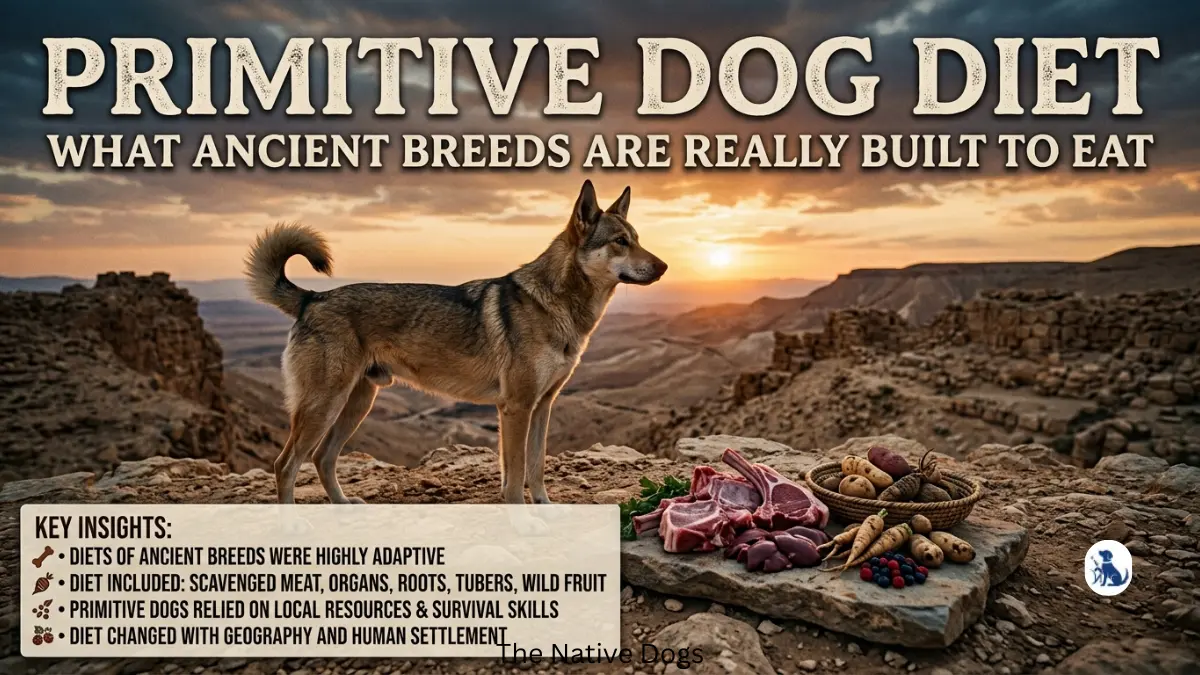
Primitive Dog Diet- Introduction
A Basenji skips breakfast for the second day in a row.
Its owner panics.
The food bowl gets upgraded immediately—extra chicken, richer toppers, freeze-dried liver, maybe a spoonful of fatty broth for “better nutrition.” The logic feels reasonable: if the dog is eating less, the food must not be appealing enough.
A few weeks later, that same dog has softer stool, a thicker waist, intermittent itching, and noticeably lower energy.
I’ve seen versions of this scenario repeatedly with primitive breeds. In most cases, the problem isn’t starvation. It’s expectation.
Modern owners often judge primitive dogs using standards built around highly food-motivated companion breeds such as Labradors, Golden Retrievers, and Beagles. That comparison creates major nutritional misunderstandings because primitive dogs often regulate appetite, calories, and feeding behavior very differently from modern companion lines.
Many naturally eat less, remain leaner, and maintain ideal body composition on fewer calories than owners expect. Feeding them correctly requires understanding something deeper than ingredient labels or diet trends.
It requires understanding evolutionary biology, metabolic adaptation, and breed-specific pathology.
That does not mean primitive dogs need a wolf diet.
It does not mean kibble is automatically harmful.
And it certainly does not mean raw food is inherently superior.
What matters is feeding in a way that respects both ancestral physiology and modern veterinary nutritional science.
What Is a Primitive Dog?
A primitive dog is a breed—or naturally developed landrace population—that retains more ancestral traits than heavily modified modern breeds.
These dogs are fully domesticated. They are not wild animals.
What separates them from many modern breeds is that they experienced less aggressive artificial selection for appearance, body exaggeration, or extreme temperament shaping. In many cases, natural selection continued to influence survival, reproduction, movement efficiency, and metabolism.
Common examples include:
- Basenji
- Carolina Dog
- Canaan Dog
- Thai Ridgeback
- Shiba Inu
- New Guinea Singing Dog
- Dingoes and primitive village-dog populations
These dogs were often shaped by geographic isolation, food scarcity, natural mate selection, and environmental survival pressure. That evolutionary background still shows up in the food bowl.
Common Feeding Behaviors in Primitive Dogs
Primitive breeds often behave very differently around food. Common patterns include skipping meals without distress, strong calorie self-regulation, low food obsession, selective eating, scavenging instincts, and a high prey drive.
This is where owners frequently misread normal behavior as pathology. A healthy primitive dog skipping breakfast is not automatically a medical emergency. Context matters.
Reduced appetite becomes concerning when paired with:
- vomiting
- diarrhea
- lethargy
- visible weight loss
- abdominal discomfort
- pain behaviors
A Basenji refusing breakfast while remaining athletic and alert is very different from a dog refusing food while becoming weak or withdrawn. That distinction matters clinically.
The Biggest Feeding Mistake: Treating Primitive Dogs Like Wolves
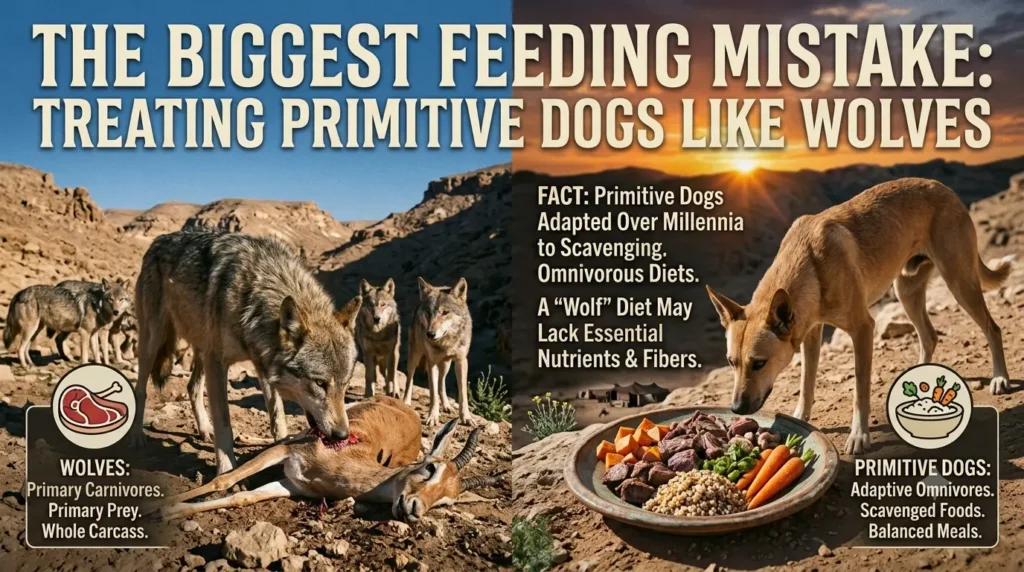
Internet nutrition advice often romanticizes primitive breeds as “wolf-like.” It sounds appealing. Biologically, it oversimplifies reality.
Yes, dogs and wolves share ancestry. But domestic dogs diverged from wolves thousands of years ago and adapted to human food systems. One of the clearest examples is the AMY2B gene, which controls pancreatic amylase production—an enzyme essential for starch digestion.
Wild wolves typically carry 2 copies of the AMY2B gene. Modern agricultural dog breeds often carry 10 to 30 copies, dramatically improving their ability to digest starch-heavy diets.
Primitive lineages such as Basenjis, Shibas, and Dingoes typically carry only 2 to 4 copies, according to Genomic Studies on Canine Starch Adaptation examining starch adaptation across canine populations.
That matters. It means primitive breeds are not wolves—but many also lack the full starch-processing capacity seen in highly domesticated agricultural breeds.
This creates an important metabolic reality: many primitive dogs can tolerate moderate amounts of digestible starch, but high-starch ultra-processed commercial diets may exceed their ancestral enzymatic comfort zone.
That destroys one of the internet’s most repeated myths from both extremes.
Myth 1: Primitive dogs should eat exactly like wolves. (False)
Myth 2: All dogs process large amounts of starch equally well. (Also false)
The most common “natural feeding” mistakes I see include feeding mostly muscle meat, removing all carbohydrates, and assuming raw automatically means biologically correct. Ironically, owners trying to feed more naturally often create diets that are less biologically appropriate.
What Primitive Dogs Actually Evolved to Eat
There was never one universal primitive dog diet. Diet depended heavily on geography. A Basenji in Central Africa did not eat like a Dingo in Australia. A coastal village dog did not eat like a desert scavenger. Environment dictated food access.
Coastal and Marine-Adjacent Populations
Dogs in fish-rich coastal environments commonly consumed fish, marine lipids, scavenged carcasses, connective tissue, and organ tissue. These foods supplied highly bioavailable protein, EPA and DHA omega-3 fats, and dense but metabolically clean calories.
Tropical and Village Populations
Primitive village dogs in Africa and Asia often ate highly variable mixed diets containing rodents, birds, eggs, reptiles, insects, fish scraps, roots, tubers, cooked grains, and human leftovers.
This is the part many ancestral-diet articles ignore. Primitive dogs were not strict carnivores. They were opportunistic scavenger-hunters with adaptive metabolic flexibility. Animal foods mattered. Flexibility mattered even more.
What Ancestral Feeding Usually Shared
Despite regional differences, ancestral feeding patterns consistently shared four traits:
- High Nutrient Density: Whole prey supplied muscle, fat, organs, minerals, collagen, and connective tissue.
- Dietary Variation: Dogs rarely consumed identical meals daily.
- Intermittent Feeding: Feast-and-famine cycles were normal.
- Minimal Industrial Processing: Food came from biological sources rather than engineered pellets.
That is the real ancestral lesson. Not wolf cosplay.
How Primitive Dog Metabolism Often Differs
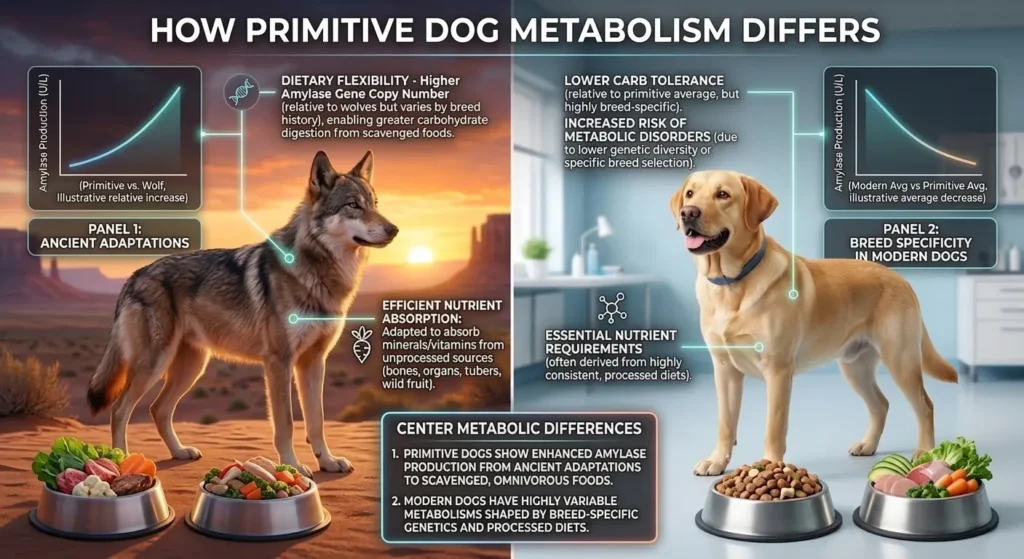
Primitive dogs still follow standard canine nutrient requirements. However, many show distinct metabolic tendencies that influence feeding strategy.
Lower Calorie Requirement Than Owners Expect
This is one of the most common overfeeding errors. Owners see visible waist definition and assume underfeeding. Often, the dog is ideal. Healthy primitive dogs commonly maintain low body fat, a visible waist, a strong abdominal tuck, and lean muscle definition.
Body condition score matters far more than appetite. Most healthy primitive breeds sit around 4–5/9 on the Body Condition Score scale. You should be able to feel ribs easily without a thick fat cover, observe a waist from above, and see an abdominal tuck from the side. Lean does not mean unhealthy. For many primitive breeds, lean is normal.
Strong Lean Mass Retention
When protein quality is high, primitive breeds usually preserve muscle extremely well. Protein quality matters more than crude percentage. A 34% protein formula is not automatically superior to a 27% formula.
Better questions include: Is digestibility high? Is amino acid balance complete? Is animal protein primary? Those answers matter more than marketing.
Fat Metabolism: The Saturated Fat Trap
This is one of the biggest missing conversations in dog nutrition. Many primitive dogs did not evolve consuming large amounts of heavy domestic mammalian fat from modern cattle or pork production.
Their ancestral fat exposure more commonly came from lean prey animals, marine lipids, or small scavenged tissue portions. That distinction matters metabolically. Modern domestic beef and pork often contain significantly higher saturated fat loads than ancestral prey.
Frequent feeding of heavy saturated fat sources can increase the risk of obesity, chronic GI stress, hyperlipidemia, and acute pancreatitis. This is especially relevant in calorie-efficient breeds.
I generally favor lower-saturation animal proteins such as sardines, salmon, rabbit, turkey, and lean lamb cuts. Marine omega-3 fats are particularly beneficial because they support inflammatory balance without the metabolic burden of excessive saturated fat.
Breed-Specific Pathologies Owners Must Understand
This is where generic dog diet advice fails. Primitive breeds are not metabolically identical. Breed pathology matters.
Basenji Enteropathy (Immunoproliferative Enteropathy)
Basenjis carry an elevated risk for Basenji Enteropathy, also called Immunoproliferative Enteropathy, a severe gastrointestinal disorder involving intestinal inflammation, malabsorption, and protein loss. Clinically, this can progress into protein-losing enteropathy (PLE).
Early signs may include intermittent diarrhea, chronic soft stool, weight loss despite eating, poor coat quality, and reduced muscle mass.
Dietary instability can worsen GI stress in vulnerable Basenjis. Frequent protein rotation, excessive toppers, and aggressive high-fat additions—common owner behaviors—can trigger major digestive disruption in susceptible dogs. For these dogs, nutritional consistency often matters more than novelty. A “better” diet introduced too aggressively can become disastrous.
Clinical warning: In Basenjis with chronic GI sensitivity, repeated food changes should never be treated casually.
Zinc-Responsive Dermatosis in Nordic Primitive Lines
Northern primitive and spitz-type breeds—including Huskies and Malamutes—show an increased predisposition to zinc-responsive dermatosis. These dogs may possess a genetic defect impairing efficient intestinal zinc absorption. This means standard maintenance zinc intake may not be sufficient.
Clinical signs often include crusting around the mouth or eyes, poor coat quality, skin thickening, chronic scaling, and delayed wound healing.
These dogs often benefit from diets containing highly bioavailable zinc sources, not merely higher total zinc numbers on labels. Bioavailability matters. Zinc oxide on paper is not the same as highly absorbable chelated zinc in practice.
How Much Should a Primitive Dog Eat?
Generic calorie tables are often misleading. Veterinary nutrition uses Resting Energy Requirement (RER).
RER Formula
RER=70×(Body Weight in kg)0.75
This estimates calories needed for basic physiological maintenance at rest. Daily Energy Requirement (DER) then adjusts for activity, age, and metabolism.
For many modern active dogs, DER multipliers may range higher. Primitive breeds often require lower multipliers because of superior calorie efficiency. A practical DER range for many adult primitive dogs is 1.2 to 1.4 × RER.
Example for a 10 kg primitive dog:
RER=70×(10)0.75≈393 kcal/day
Estimated DER:
- Low activity: ~472 kcal
- Moderate activity: ~550 kcal
These are starting points—not rules. Body condition always overrides formulas.
What Veterinary Nutrition Actually Measures
Veterinary nutrition does not begin with ideology. It begins with outcomes. Good clinicians ask:
- Is body condition ideal?
- Is stool consistent?
- Is muscle preserved?
- Is coat quality strong?
- Is energy stable?
Only after those answers do we evaluate the diet. A food marketed as ancestral can still be nutritionally poor. A plain-looking food can produce excellent clinical results. Biology does not care about branding.
Core Nutritional Requirements for Primitive Dogs
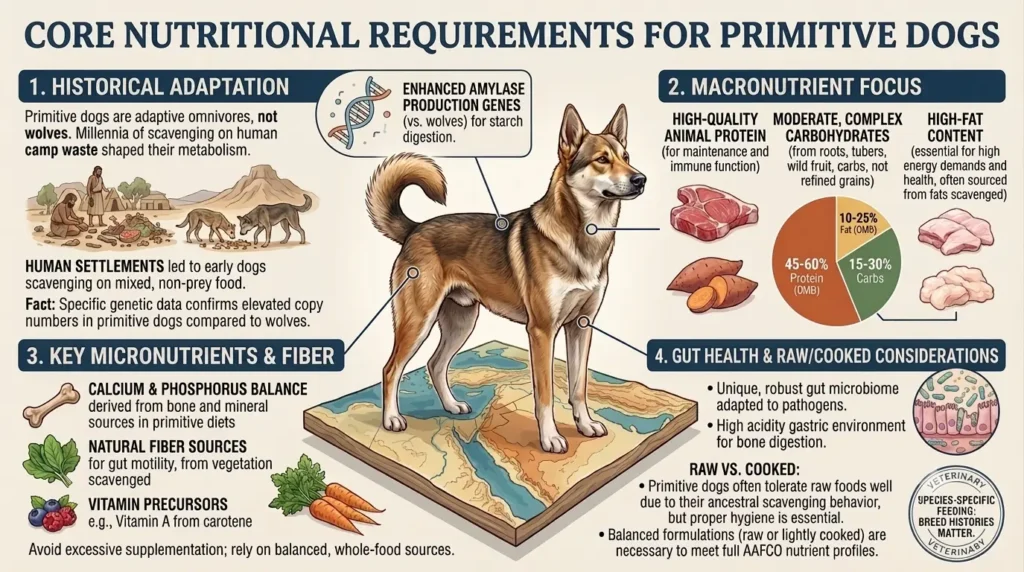
Every effective primitive dog diet should deliver four foundational pillars: digestible protein, appropriate fat quality, micronutrient completeness, and calorie precision.
Protein: Structural Foundation
Protein supports muscle, tissue repair, immune function, hormones, and enzymes. High-value protein choices include sardines, salmon, rabbit, turkey, eggs, and lean lamb.
Fat: Energy Without Overload
Fat supports endurance metabolism, hormone production, neurological tissue, and vitamin absorption. The goal is not maximum fat. The goal is appropriate fat quality. Favor marine omega-3s and lighter animal fats.
Carbohydrates: Optional, But Context Matters
Dogs do not require carbohydrates as essential nutrients. That does not make carbohydrates harmful. Appropriate carbohydrates may support stool quality, glycogen replenishment, satiety, and microbiome diversity.
Better options include pumpkin, oats, rice, and sweet potato. Highly refined starch-heavy formulas may be less ideal for primitive lineages with lower AMY2B adaptation.
Micronutrients: Where Homemade Diets Fail
Most homemade diet failures are not protein failures. They are micronutrient failures. Common deficiencies include calcium, iodine, zinc, copper, vitamin D, and manganese.
Muscle meat alone is never complete nutrition. A dog may appear healthy for months while deficiencies develop silently.
Which Feeding Style Works Best?
There is no single perfect feeding model. The best diet consistently delivers complete nutrition, stable digestion, reliable energy, and ideal body composition.
Raw Feeding
Raw feeding attracts primitive-dog owners because it feels ancestral. But raw alone guarantees nothing. Common failures include excessive muscle meat, low calcium, excess liver, missing trace minerals, and bacterial contamination. A properly formulated raw diet can work. An imbalanced raw diet can create deficiencies long before symptoms become obvious.
Commercial Kibble
Kibble gets oversimplified. Not all kibble is poor quality. Evaluate formulation quality, compressibility, ingredient sourcing, nutrition expertise, and quality control. Good formulation beats branding.
Fresh Cooked Diets
Fresh cooked diets work well for many primitive dogs, especially those with poor appetite, GI sensitivity, aging-related appetite decline, or elimination diet needs. Cooking improves compressibility and reduces pathogen risk. But homemade cooked diets frequently lack nutritional completeness.
Best Functional Additions for Primitive Dogs
Not every trendy addition belongs in a primitive dog diet.
Remove Generic Dairy-Based Probiotics
Kefir is widely recommended online. That advice is too generic. Many primitive lines likely have poor lactose tolerance due to zero historical adaptation to pastoral dairy consumption. For these dogs, dairy-based probiotic additions may trigger gas, loose stool, and GI irritation. Dairy is not automatically beneficial.
Better Functional Additions
- Wild berries (blueberries, bilberries): Rich in anthocyanins associated with antioxidant and cognitive support.
- Pumpkin: Useful for soluble fiber and stool consistency.
- Green-lipped mussel: May support joint function and inflammatory balance.
- Fish oil: Supports skin, joints, and neurological aging.
Foods Primitive Dogs Should Avoid
Avoid completely: chocolate, grapes, raisins, xylitol, and macadamia nuts.
Limit chronic exposure to: sugary treats, fried foods, heavily salted snacks, processed deli meats, and fatty pork scraps. The danger isn’t only toxicity. Low-quality calories gradually degrade metabolic health.
Feeding by Life Stage
Puppies
Key priorities include calcium-phosphorus balance, DHA, controlled growth, and complete growth nutrition. Fast growth is not healthy growth. Proper growth is.
Active Adults
Priorities include digestible protein, appropriate fat quality, hydration, and recovery support.
Seniors
Older primitive dogs often need additional support for muscle preservation, joint comfort, digestive tolerance, and hydration. Moisture-rich meals often improve appetite in aging dogs.
How Primitive Dogs Show You the Diet Is Working
Primitive dogs rarely show dramatic warning signs early. The first clues are usually subtle.
Good signs include:
- firm stool
- dense coat quality
- stable energy
- lean muscle
- consistent waist definition
Warning signs include:
- dull coat
- muscle loss
- chronic itching
- repeated ear irritation
- recurring soft stool
- reduced endurance
These physical changes often appear before laboratory abnormalities.
Final Clinical Perspective
After years of observing lean, high-efficiency breeds, one pattern keeps repeating. Primitive dogs do best when owners stop chasing trends. These dogs do not care about labels. They respond to physiology.
The best long-term outcomes consistently come from diets that provide complete micronutrient coverage, digestible animal protein, high-quality fat, controlled starch exposure, and calories matched to activity. For more foundational information on standard updates, see the AKC Canine Nutrition Resources and the global standards outlined in the WSAVA Global Nutrition Guidelines.
A strong primitive dog diet respects ancient biology while meeting modern veterinary nutritional standards. That balance—not ideology—is what supports long-term health.
Medical Disclaimer
This article is for educational purposes only and does not replace individualized veterinary advice. Dogs with kidney disease, pancreatitis, endocrine disease, gastrointestinal disease, chronic diarrhea, food allergies, or growth abnormalities should receive veterinary-supervised nutrition planning before major dietary changes.
Frequently Asked Questions
1- Do primitive dogs need a raw diet?
No, primitive dogs do not require a raw diet to stay healthy. What matters most is complete nutrition, digestible protein, appropriate fat quality, and calorie control. A properly formulated kibble or fresh cooked diet can work just as well as raw feeding.
2- Can primitive dogs eat kibble?
Yes, many primitive dogs do well on high-quality kibble. The key is choosing formulas with strong animal protein, moderate starch levels, and good digestibility, since some primitive breeds process high-starch diets less efficiently than modern agricultural breeds.
3- Why does my primitive dog skip meals?
Meal skipping is often normal in primitive breeds. Dogs like Basenjis or Shibas commonly self-regulate food intake and may eat less frequently than Labradors or Beagles. It becomes concerning only when appetite loss comes with lethargy, vomiting, diarrhea, or weight loss.
What is the best protein for primitive dogs?
Lean, highly digestible animal proteins are usually best. Good options include sardines, salmon, rabbit, turkey, and eggs because they provide strong amino acid quality without excessive saturated fat.