

Most dogs bark. Some howl.
The New Guinea Singing Dog (NGSD) does neither in the way you’d expect.
Its voice rises and falls in layered tones—part wolf-like howl, part yodel, part haunting chorus. The first time most people hear one, they don’t think dog at all.
They stop.
And listen again.
That reaction makes sense because the New Guinea Singing Dog is not just rare—it’s one of the most unusual canids alive today.
Compact but highly athletic. Intelligent but deeply independent. Fascinating, yet notoriously difficult to manage.
This is not a typical companion breed.
For canine researchers, conservationists, and primitive-breed specialists, the NGSD offers something extraordinary: a living glimpse into ancient dog evolution. For the average pet owner, though, admiration from a distance is often the safer choice.
Reality Check:
Owning a New Guinea Singing Dog is nothing like owning a Labrador, Golden Retriever, or even a Husky. Primitive dogs operate on a very different behavioral blueprint.
If you’re researching this breed because you’re considering ownership, here’s the answer most websites avoid saying clearly:
The New Guinea Singing Dog is not beginner-friendly and is unsuitable for most households.
That doesn’t make it a bad dog.
It simply means this breed demands exceptional understanding, secure containment, advanced handling, and realistic expectations.

Quick Breed Overview
| Trait | Details |
|---|---|
| Breed Name | New Guinea Singing Dog |
| Breed Type | Primitive / Rare Canid |
| Height | 12–18 inches |
| Weight | 20–35 lbs |
| Lifespan | 12–15 years |
| Energy Level | Very High |
| Trainability | Moderate to Difficult |
| Barking | Low |
| Vocalization | Extremely High (Singing / Howling) |
| Good for Beginners? | No |
| Apartment Friendly? | No |
| Rarity | Extremely Rare |
What Is a New Guinea Singing Dog?
The New Guinea Singing Dog is a rare primitive canid native to the remote highlands of Papua New Guinea.
Its defining feature is obvious the moment you hear it: the voice.
Unlike a normal bark—which is short, repetitive, and abrupt—NGSD vocalizations are long, tonal, and harmonically layered. When several vocalize together, the sound can feel eerily musical.
That “singing” trait made the breed famous.
But the vocalization is only half the story.
Behaviorally, these dogs differ sharply from most modern pet breeds. They usually show:
- intense environmental awareness
- strong prey instincts
- exceptional problem-solving ability
- lower dependence on humans
- powerful escape drive
In practical terms, they behave less like a typical family dog and more like a semi-wild primitive canid shaped by survival.
Cute? Yes.
Easy to own? Not remotely.
Are New Guinea Singing Dogs Actually Dogs?
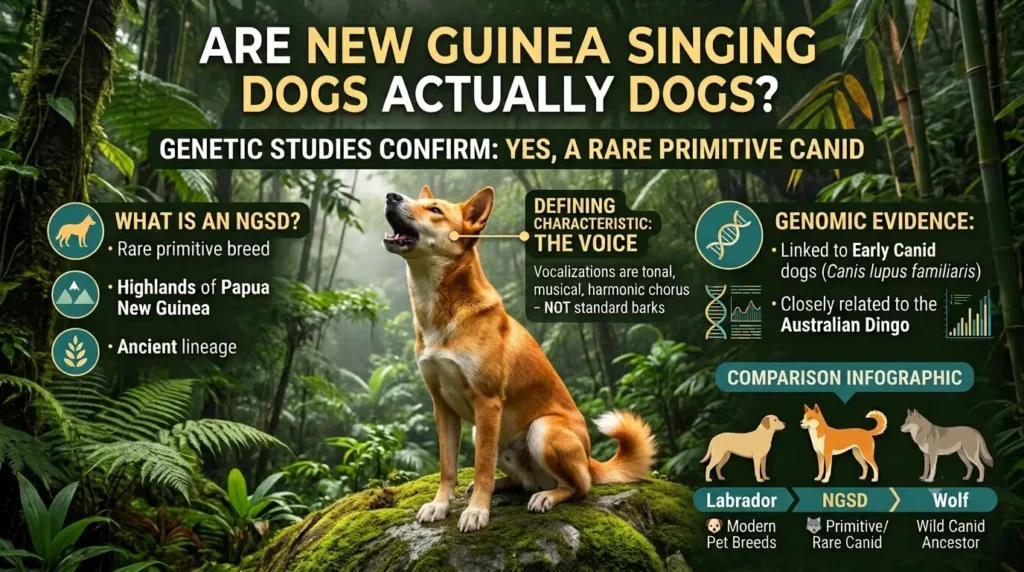
Short answer: Yes—but classification has long been debated.
Scientists have variously described them as:
- a primitive domestic dog
- a wild canid population
- a close relative of the dingo
Modern genomic studies on ancient Oceanic dog lineages suggest New Guinea Singing Dogs retain genetic markers closely linked to early Asia-Pacific dogs.
That’s a big deal.
Why?
Because many modern breeds have been heavily shaped by selective breeding over hundreds of years.
The NGSD appears to preserve traits much closer to early canine ancestry.
That makes the breed valuable far beyond pet ownership.
Researchers study them to better understand:
- canine domestication
- primitive behavior
- genetic lineage preservation
- evolutionary adaptation
Very few living breeds offer that kind of scientific relevance.
Breed History
The exact origin of the New Guinea Singing Dog remains partially unresolved, but most researchers believe their ancestors reached Papua New Guinea thousands of years ago alongside early human migration into the region.
Then geography took over.
Isolation in steep mountain environments shaped the breed into something highly specialized.
Survival in that terrain favored dogs that were:
- agile
- flexible
- efficient climbers
- highly coordinated
- intensely alert
Those traits remain obvious today.
This is one reason NGSD behavior feels so different from modern domestic breeds.
Most familiar breeds were developed for specific human roles:
- herding
- retrieving
- guarding
- companionship
The New Guinea Singing Dog retained much more of its primitive behavioral architecture.
That changes everything—from social bonding to trainability.
Why Were They Thought to Be Extinct?
For many years, wild New Guinea Singing Dogs were widely believed to be functionally extinct.
Most captive individuals came from a very small founder population collected decades ago.
That created a major conservation problem.
Small founder populations increase the risk of:
- inbreeding
- reduced genetic diversity
- inherited disorders
- long-term population weakness
Then researchers made an important discovery.
Remote highland expeditions identified wild mountain dogs showing strong genetic similarity to captive New Guinea Singing Dogs.
That changed the conversation.
Suddenly, conservation efforts had renewed hope.
Expert Insight:
In rare canine populations, preserving genetic diversity often matters more than simply increasing population numbers. A larger population with poor diversity can still face long-term health decline.
This is why the NGSD matters beyond the exotic pet niche.
It may represent one of the oldest surviving dog lineages on Earth.
Why Do New Guinea Singing Dogs “Sing”?
This is the question nearly everyone asks first.
Why do New Guinea Singing Dogs make unusual sounds?
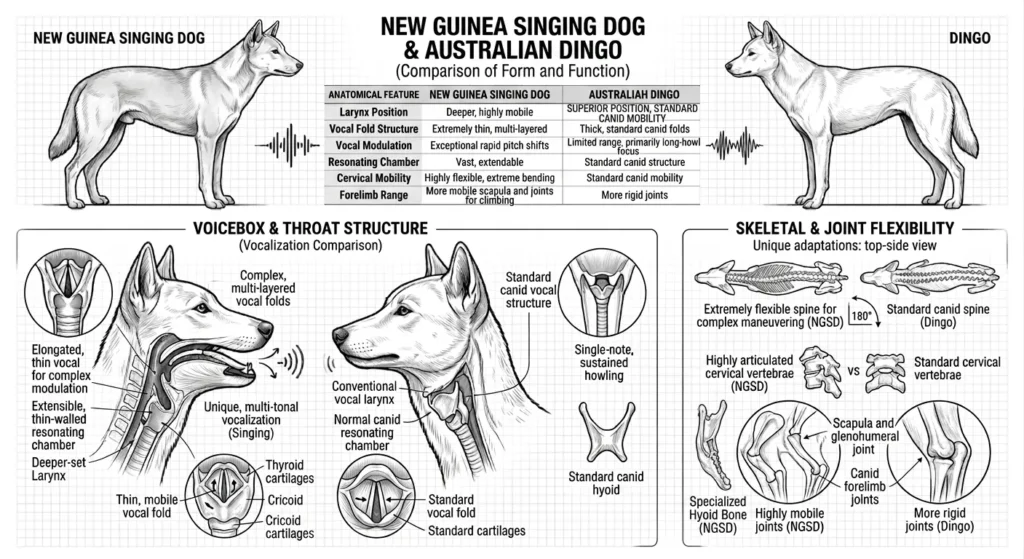
New Guinea Singing Dogs vocalize using long, harmonic, pitch-shifting howls rather than standard repetitive barking. That creates the “singing” sound they are famous for.
Their vocalizations are typically:
- longer than barks
- smoother in tone
- pitch-shifting
- harmonically layered
The result sounds surprisingly musical.
Some recordings resemble:
- rising wolf-like howls
- yodels
- eerie whistles
- overlapping harmonic choruses
When multiple NGSDs vocalize together, the sound becomes even more striking.
That’s where the breed name comes from.
Can New Guinea Singing Dogs Bark?
Yes.
This is a common misconception.
They can bark, but they generally bark less often than most domestic dogs.
Instead, they rely more heavily on:
- howls
- whines
- tonal vocalizations
- harmonic calls
So the myth that they “cannot bark” isn’t accurate.
They can.
They just communicate differently.
Why Their Vocalization Is So Unique
The most unusual aspect isn’t simply the sound.
It’s the control.
Compared with most domestic dogs, NGSDs often demonstrate greater tonal variation during a single vocal sequence. The pitch may rise, dip, stretch, and overlap in ways that feel unusually deliberate.
Researchers still do not fully understand the evolutionary reason.
Some behavioral specialists suspect this vocal flexibility may have helped long-distance communication in isolated mountain terrain.
Research is ongoing.
That uncertainty is part of what makes the breed so compelling.
The New Guinea Singing Dog sits at a rare intersection of:
- canine evolution
- behavioral science
- conservation biology
- primitive breed research
Very few breeds occupy that space.
Physical Appearance
At first glance, the New Guinea Singing Dog doesn’t look intimidating.
It looks compact. Lean. Almost fox-like.
But don’t let the modest size fool you.
This is an exceptionally athletic canid built for movement, balance, and terrain control—not brute force. Every physical trait serves function.
Typical characteristics include:
- wedge-shaped head
- erect triangular ears
- almond-shaped eyes
- narrow muzzle
- lean muscular frame
- bushy tail
Their coat is usually short to medium in length with decent density for weather protection.
Common coat colors include:
- golden red
- tan
- sable
- black and tan
- reddish brown
White markings on the chest, paws, or tail tip are also seen.
Size
Most adults fall within this range:
| Measurement | Range |
|---|---|
| Height | 12–18 inches |
| Weight | 20–35 lbs |
Smaller than expected? Usually yes.
Less capable because of that? Absolutely not.
Expert Observation:
Small primitive dogs often compensate with speed, flexibility, and explosive movement rather than raw power. The NGSD is a textbook example.
Their Flexibility Is Unusual
This is one of the most overlooked traits of the breed.
Compared with most domestic dogs, New Guinea Singing Dogs often display noticeably greater spinal and joint flexibility. That increased mobility likely helped them navigate steep mountain environments for generations.
In real-world handling, that flexibility shows up fast.
They can:
- twist sharply
- pivot with startling speed
- squeeze through narrow gaps
- climb better than most owners expect
Some even move in ways that feel almost cat-like.
And yes—this creates a major ownership challenge.
Containment.
A fence that works perfectly for a Labrador may fail badly with an NGSD.
Reality Check:
Never assume “my yard is secure” until you evaluate it like an escape artist would.
Experienced primitive-breed handlers often reinforce fencing with:
- climb-resistant barriers
- anti-dig protection
- added height
- regular perimeter inspection
This isn’t paranoia.
It’s practical ownership.
Temperament
This is where most people misjudge the breed.
They see a medium-small dog and assume manageable behavior.
That assumption causes problems.
The New Guinea Singing Dog is typically intelligent, highly observant, cautious, curious, and deeply independent.
The independence part matters most.
Unlike breeds selectively developed for close human cooperation—such as retrievers, spaniels, or herders—NGSDs often show much lower handler dependency.
They don’t automatically seek approval.
They assess first.
Then decide.
That behavior is frequently mislabeled as stubbornness.
Not always fair.
In many cases, the dog understands exactly what you want—it simply evaluates whether compliance benefits it.
That isn’t low intelligence.
If anything, it suggests the opposite.
Intelligence: A Common Misunderstanding
Many owners judge intelligence using obedience.
That’s incomplete.
There are different kinds of canine intelligence.
Obedience Intelligence
How quickly a dog learns and repeats commands.
Adaptive Intelligence
How effectively a dog solves problems independently.
The New Guinea Singing Dog may not rank exceptionally high in obedience-style trainability.
Adaptive intelligence?
Very high.
This breed notices patterns, routines, weaknesses in containment, and opportunities remarkably fast.
That’s why primitive breeds often frustrate inexperienced owners.
They are smart—but not cooperative in the way people expect.
Are They Good Family Dogs?
For most households, no.
That may sound harsh, but it’s the most honest answer.
Are New Guinea Singing Dogs good pets?
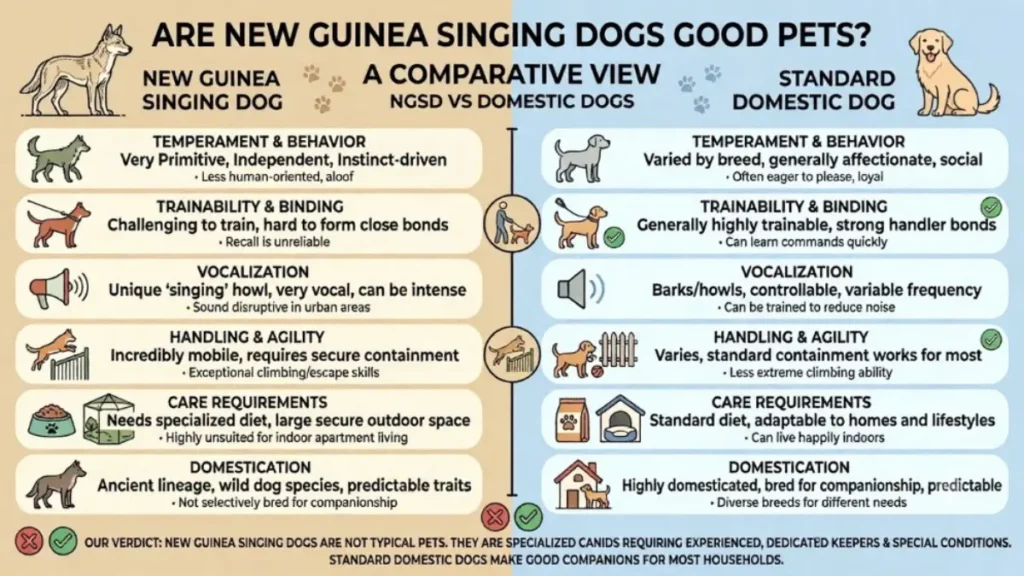
For most families, no. New Guinea Singing Dogs are usually too independent, high-drive, and difficult to manage for average pet owners. They are better suited to experienced primitive-breed handlers.
They are generally not ideal for:
- first-time owners
- homes with small pets
- low-activity households
- families expecting easy obedience
- people wanting highly social companion dogs
Can they bond deeply with humans?
Yes.
But that bond often looks different from what people expect.
Primitive breeds may show attachment through:
- staying nearby
- observing constantly
- selective engagement
- quiet trust
Not always through cuddling or constant affection.
If someone expects a Golden Retriever personality, disappointment is likely.
Are They Aggressive?
Not inherently.
A more accurate description would be: wary, reactive, and highly instinct-driven.
Potential issues usually arise from:
- poor socialization
- chronic stress
- fear responses
- prey triggers
- improper handling
That distinction matters.
Aggression and reactivity are not the same thing.
Primitive breeds often react defensively when they feel pressured, trapped, or overstimulated.
Proper early socialization dramatically improves stability.
That includes controlled exposure to:
- people
- sounds
- handling
- routine changes
- unfamiliar environments
Without this foundation, suspicion can intensify.
Prey Drive
This is non-negotiable.
Most New Guinea Singing Dogs possess a strong prey drive.
Small moving animals can trigger immediate chase instincts, including:
- birds
- rabbits
- rodents
- cats
Training helps.
Instinct still matters more.
Even well-managed primitive dogs may ignore commands once prey drive activates.
That’s not training failure.
That’s biology.
Owners need to respect instinct instead of assuming obedience can erase it.
Training Difficulty
Can they be trained?
Yes.
Easy to train?
No.
Training this breed requires a mindset shift.
Forget dominance myths.
Forget force-heavy methods.
What works best is motivation.
Expert Insight:
Primitive breeds rarely respond well to repetitive drilling or harsh corrections. Pressure often reduces cooperation instead of improving it.
Effective training usually includes:
- short sessions
- high-value rewards
- consistency
- environmental control
- patience
Mental engagement matters just as much as repetition.
Boredom kills progress.
If training feels repetitive, many NGSDs simply disengage.
Fast.
Exercise Needs
This is a high-energy breed with high mental demands.
A short walk around the block won’t cut it.
Most healthy adults need substantial daily stimulation through both movement and problem-solving.
Good enrichment may include:
- long structured walks
- scent work
- climbing-safe exploration
- puzzle feeding
- interactive play
Without enough stimulation, problems often follow:
- escape attempts
- destructive behavior
- frustration
- excessive vocalization
Here’s the real issue:
It’s not just energy.
It’s intelligence plus energy.
That combination can overwhelm unprepared owners.
A bored smart dog becomes creative.
Usually in expensive ways.
Apartment Living
Can a New Guinea Singing Dog live in an apartment?
Technically, yes.
Recommended? Almost never.
Most apartments create multiple challenges:
- limited movement
- weak enrichment options
- shared walls
- reduced containment control
And then there’s the vocalization.
A singing dog plus apartment walls is rarely a peaceful combination.
For most owners, a secure property with ample enrichment space is far more realistic.
Diet and Nutrition
Despite the breed’s primitive origins, the New Guinea Singing Dog does not require a mysterious or exotic diet.
It needs what every high-drive canid needs: balanced nutrition matched to age, activity level, metabolism, and body condition.
That means focusing less on trendy feeding philosophies and more on nutritional adequacy.
A quality diet should provide:
- high-quality animal protein
- healthy fats
- digestible carbohydrates
- complete vitamins and minerals
Because this breed is naturally lean and athletic, owners should monitor more than body weight alone.
Pay attention to:
- body condition score
- muscle definition
- stool quality
- coat condition
- energy consistency
A dog can sit at a “normal” weight and still lose muscle mass if nutrition is poor.
That detail gets overlooked often.
Raw Diet vs Kibble
Primitive breeds attract raw-feeding discussions almost immediately.
Many people assume:
Primitive dog = raw diet only
That’s not accurate.
A New Guinea Singing Dog can thrive on:
- premium commercial kibble
- properly balanced cooked diets
- professionally formulated raw diets
The important phrase is properly formulated.
Expert Insight:
Raw feeding is not automatically superior. Poorly balanced homemade diets can create calcium-phosphorus imbalances, vitamin deficiencies, and long-term orthopedic issues.
The problem usually isn’t raw food.
It’s nutritional imbalance.
If feeding homemade or raw long term, consultation with a veterinary nutrition specialist is strongly recommended.
Common Health Concerns
Because the New Guinea Singing Dog is exceptionally rare, large-scale health data remains limited.
That said, rarity should never be confused with genetic invincibility.
This is one of the biggest myths around primitive breeds.
Some people assume:
“Ancient breed means healthier breed.”
Not necessarily.
A small breeding population can increase genetic bottleneck risk over time.
Potential concerns may include:
- orthopedic issues
- dental disease
- injury from jumping or climbing
- inherited genetic disorders from limited breeding pools
The biggest concern isn’t always a specific disease.
Often, it’s restricted genetic diversity.
That matters for long-term population health.
Lifespan
Most healthy New Guinea Singing Dogs live around:
12–15 years
With excellent care, some may live longer.
Lifespan depends heavily on:
- genetic quality
- diet quality
- injury prevention
- preventive veterinary care
- healthy body composition
For such an agile breed, injury prevention matters more than many owners expect.
Grooming Needs
Good news—grooming is relatively simple.
Compared with many popular companion breeds, coat maintenance is refreshingly low effort.
Basic care includes:
- weekly brushing
- nail trimming
- ear checks
- dental hygiene
Shedding varies by climate and individual coat type but is usually moderate.
The coat doesn’t demand heavy maintenance.
That’s one of the easier parts of ownership.
New Guinea Singing Dog Price
This is where misinformation spreads fast.
How much does a New Guinea Singing Dog cost?
A verified New Guinea Singing Dog may cost anywhere from $3,000 to $8,000+, though pricing varies heavily based on lineage authenticity, breeder reputation, legal restrictions, and availability.
But there’s a catch.
Public price estimates are often unreliable.
Why?
Because many listings online are not selling verified New Guinea Singing Dogs at all.
They may involve:
- unverified lineage
- primitive-breed mixes
- wolfdog hybrids
- misleading marketing labels
That creates major buyer risk.
Buyer Warning:
Be extremely cautious of sellers advertising “100% pure New Guinea Singing Dog puppies” without verifiable pedigree or conservation-backed lineage documentation.
Rarity alone proves nothing.
In fact, “rare” is one of the most abused sales words in exotic dog markets.
What affects price?
Pricing usually depends on four major factors:
- lineage authenticity
- breeder credibility
- permit requirements
- transport and legal compliance costs
The rarer and more regulated the dog, the higher the total ownership cost usually becomes.
And purchase price is only the beginning.
Secure containment, enrichment, veterinary care, and specialized handling can significantly increase lifetime cost.
Can You Buy a New Guinea Singing Dog?
Technically?
Sometimes.
Realistically?
Very difficult.
You are unlikely to find a legitimate New Guinea Singing Dog through normal pet marketplaces.
Potential sources may include:
- specialized breeding programs
- conservation-linked placements
- rare private breeders
That limited availability is exactly why scams are common.
If someone is casually selling multiple NGSD puppies online with no serious verification, skepticism is warranted.
Always verify:
- lineage documentation
- breeding records
- health records
- legal ownership eligibility
Trust documentation, not marketing.
Are New Guinea Singing Dogs Legal?
This depends entirely on where you live.
Can you legally own a New Guinea Singing Dog?
Ownership legality varies by country, state, and local regulations. Some areas classify them as domestic dogs, while others treat them as restricted exotic canids or hybrid-adjacent animals.
This classification can affect:
- ownership rights
- permits
- transport
- breeding restrictions
- housing regulations
That matters more than many buyers realize.
Never rely solely on breeder claims about legality.
Always verify local laws yourself.
New Guinea Singing Dog vs Basenji vs Dingo
These three are often compared because all share primitive characteristics.
But they are not equally suitable as companion animals.
| Trait | New Guinea Singing Dog | Basenji | Dingo |
|---|---|---|---|
| Domestication | Primitive | Domestic Breed | Wild Canid |
| Vocal Style | Singing / Harmonic Howls | Yodel-like | Howls |
| Trainability | Difficult | Moderate | Very Difficult |
| Family Suitability | Low | Moderate | Very Low |
| Rarity | Extremely Rare | Moderate | Rare as Pet |
The Basenji is often called the “barkless dog,” but compared with the NGSD, it is still far more manageable in a household setting.
A Dingo remains much closer to a wild canid.
The New Guinea Singing Dog sits somewhere in between.
That middle ground is exactly what makes it fascinating—and challenging.
Should You Own a New Guinea Singing Dog?
This is the question that matters most.
Is the New Guinea Singing Dog a good pet for most people?
No. The New Guinea Singing Dog is not a suitable pet for most households due to its primitive instincts, strong prey drive, escape ability, and demanding behavioral needs.
That isn’t criticism.
It’s compatibility.
This breed is best suited to owners who understand primitive canid behavior and can realistically provide:
- advanced handling
- secure containment
- daily enrichment
- consistent training
- long-term commitment
If your ideal dog is:
- highly obedient
- beginner-friendly
- easygoing
- socially flexible
This is probably not your breed.
And that’s okay.
Responsible ownership starts with honest self-assessment.
Reality Check:
Admiring a New Guinea Singing Dog and successfully living with one are two very different things.
Final Verdict
The New Guinea Singing Dog is one of the most unusual canids on Earth.
Its voice is unforgettable. Its history is remarkable. Its behavior offers a rare window into traits that modern domestic breeds have largely softened through generations of selective breeding.
But fascination alone should never drive ownership.
This is not a casual pet.
It is a rare, highly intelligent, physically capable primitive canid that demands experienced handling, secure management, and realistic expectations.
For conservationists, researchers, and serious primitive-breed enthusiasts, the New Guinea Singing Dog remains deeply compelling.
For the average pet owner?
Admiration from a respectful distance is often the wiser choice.
Frequently Asked Questions
1- Is the New Guinea Singing Dog a real dog or a wild animal?
Yes, the New Guinea Singing Dog is considered a real canid closely related to ancient domestic dogs, though its classification has been debated. It retains many wild and primitive traits, which is why it behaves very differently from most pet breeds.
2- Why is it called a Singing Dog?
It’s called a Singing Dog because of its unusual vocalizations. Instead of standard barking, it produces long, harmonic howls with changing pitch that can sound like singing, yodeling, or layered whistles.
3- How rare is the New Guinea Singing Dog?
The New Guinea Singing Dog is extremely rare. It is considered one of the rarest canine populations in the world, with limited captive breeding lines and a very small genetically verified population.
4- Are New Guinea Singing Dogs good pets?
For most people, no. They are highly intelligent, independent, and difficult to manage, making them unsuitable for beginner dog owners or typical family households.