
A Siberian Husky sleeping all day in a small apartment in Miami.
An Alaskan Malamute living on processed kibble and walking just 15 minutes a day .
An Akita developing anxiety around strangers despite being bred for confidence and control.
To many pet parents, these look like isolated issues.
They’re not.
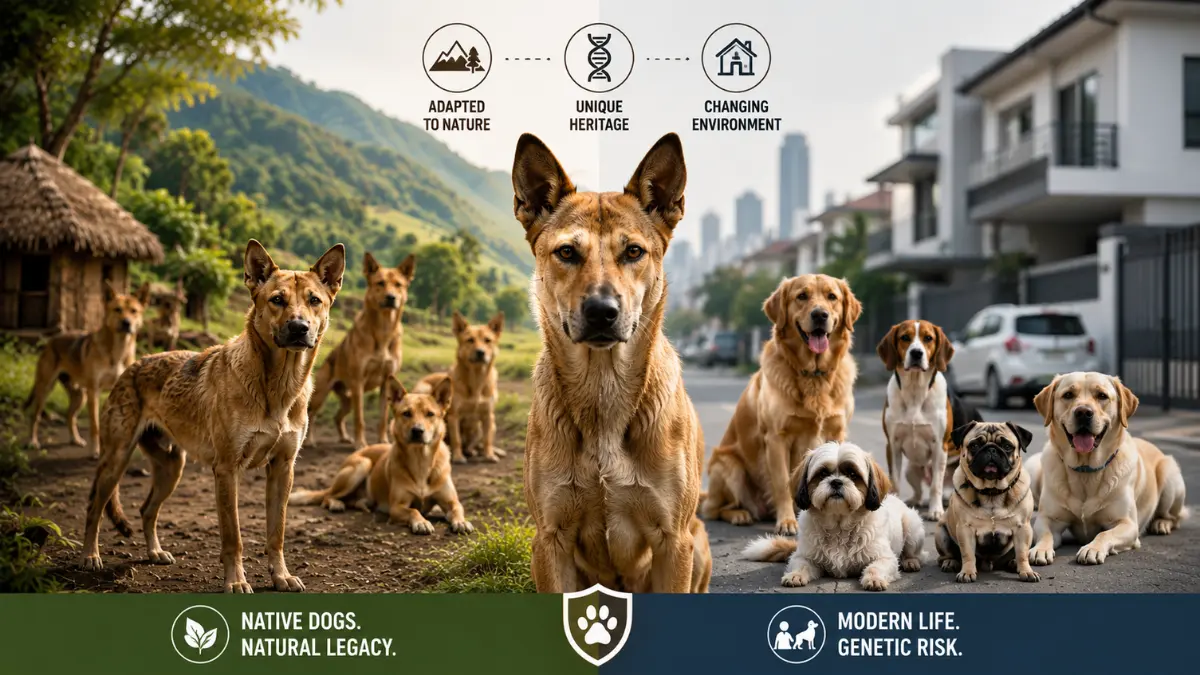
They’re signs of a deeper biological conflict: ancient canine genetics colliding with modern human lifestyles.
For thousands of years, native dog breeds evolved in environments that shaped every part of their biology—muscles, metabolism, stress response, social behavior, hunting drive, even how efficiently they stored fat. Nature selected the strongest survivors.
Then, within just a few generations, humans changed everything.
We moved dogs from mountains to condos, from farms to city blocks, from raw survival to climate-controlled comfort. The result is becoming impossible to ignore: rising obesity, chronic inflammation, behavioral instability, and metabolic disease in breeds that once thrived in harsh conditions.
Many of today’s canine health problems aren’t random.
They’re evolutionary mismatch.
The DNA of a Survivor: Why Native Dog Breeds Were Built Differently
Native breeds weren’t engineered for appearance.
They were shaped by survival.
That distinction matters.
A dog breed that evolved in the Himalayas faced freezing temperatures, steep terrain, and scarce food. A desert breed survived brutal heat and long distances. A village dog navigated predators, disease, and limited resources without human intervention.
Over time, these pressures created something powerful: highly efficient survival genetics.
Brian Hare, evolutionary anthropologist at Duke University, has spent years studying canine cognition and domestication. His research emphasizes that dogs evolved not simply by becoming obedient, but by becoming remarkably adaptive problem-solvers.
As Dr. Hare has explained, dogs developed unique social intelligence because cooperation with humans improved survival. But native dogs also retained something equally important: environmental intelligence.
That means many native breeds are genetically wired for:
- Endurance over comfort
- Movement over inactivity
- Problem-solving over passive entertainment
- Seasonal feeding patterns over constant calorie surplus
Their DNA expects challenge.
Modern life often removes it.
Take a working sled dog. Historically, such dogs could burn 5,000–10,000 calories per day during peak exertion. Today, some descendants barely reach one hour of meaningful activity.
The genes didn’t disappear.
The lifestyle did.
That mismatch creates pressure inside the body.
What Happens When Ancient Genes Meet Modern Comfort?
The body keeps following old instructions.
A breed genetically designed to conserve energy during famine may continue storing calories aggressively—even when food is abundant.
That’s how survival genetics can become obesity genetics.
A dog once optimized for resilience can become vulnerable in an environment of:
- Constant treats
- Minimal exercise
- Artificial lighting
- Chronic boredom
- High-carb processed food
Biology hasn’t caught up.
Our lifestyles changed faster than canine evolution ever could.
The Behavioral Mismatch: Why Apartment Dogs Are Developing Anxiety
A tired dog is often a calm dog.
An unstimulated dog is something else entirely.
Chewing walls.
Obsessive barking.
Pacing.
Resource guarding.
Separation anxiety.
Many pet parents assume these behaviors mean the dog is “bad,” stubborn, or poorly trained.
More often, the dog is misunderstood.
Cesar Millan, one of the world’s most recognized dog behaviorists, has long emphasized a principle many trainers overlook:
“A dog needs exercise, discipline, and affection—in that order.”
That hierarchy reflects biology.
Before affection, dogs need regulation.
Before cuddles, many breeds need purpose.
A livestock guardian breed doesn’t merely enjoy guarding—it feels internally driven to monitor territory. A scent hound doesn’t casually sniff—it experiences the world through scent tracking. A herding breed may instinctively control movement around children, bikes, or even vacuum cleaners.
When these instincts are suppressed rather than redirected, stress builds.
That stress often becomes anxiety.
Urban Life Can Trigger Chronic Stress
Imagine breeding for centuries to:
- Pull heavy loads
- Guard livestock
- Hunt prey
- Patrol territory
- Travel miles daily
Then suddenly living in a 700-square-foot apartment.
Your dog may love you deeply.
But love doesn’t erase genetics.
This is why many high-drive native breeds struggle in urban homes.
Common signs of instinct frustration include:
Mental Stress Signals
- Hypervigilance
- Startle reactions
- Excessive whining
- Obsessive licking
- Sleep disruption
Physical Stress Signals
- Digestive issues
- Stress shedding
- Elevated cortisol
- Weight gain
- Reduced muscle tone
Behavior and health are deeply connected.
An anxious dog often becomes metabolically unhealthy too.
The Metabolic Crisis: Why Native Breeds Are Getting Fat
Dog obesity is no longer a niche problem.
It’s a major veterinary crisis.
According to recent data from the Association for Pet Obesity Prevention (APOP), an estimated 59% of dogs in the United States are now classified as overweight or obese. That means millions of pups are carrying excess fat that quietly stresses every organ.
This isn’t just about appearance.
Fat tissue is biologically active.
It releases inflammatory chemicals that can worsen:
- Arthritis
- Insulin resistance
- Heart strain
- Joint degeneration
- Liver dysfunction
- Reduced lifespan
Karen Becker, proactive veterinarian and author, has repeatedly warned that chronic overfeeding and poor-quality processed diets are driving widespread metabolic disease in pets.
Her central message is simple:
Dogs are being fed for convenience, not biology.
That distinction matters more than most people realize.
Why Native Breeds Gain Weight Faster in Modern Homes
Some native breeds evolved with irregular food access.
That means their bodies became extremely efficient at storing energy.
In the wild, this was a gift.
In suburban America, it becomes dangerous.
A dog needing 900 calories daily may consume 1,200+ without the owner realizing it.
That extra 300 calories sounds small.
Over time, it can mean several pounds of fat.
For a medium dog, gaining 5 lbs (2.3 kg) can be metabolically similar to a human gaining 30–40 lbs (13.6–18.1 kg).
That’s massive.
Hidden Causes of Weight Gain, Expert Vet Tip
Many pet parents focus only on meal size.
The bigger picture includes:
- Too many treats
- Calorie-dense kibble
- Lack of muscle-building exercise
- Chronic stress hormones
- Poor sleep
- “Neutering-related metabolic changes (which can drop a dog’s metabolic rate by up to 20%)”
- Age-related muscle loss
Obesity isn’t always laziness.
Sometimes it’s biology under pressure.
Expert Vet Tip
If you can’t easily feel your dog’s ribs under a thin fat layer, your pup may already be overweight.
Healthy dogs should have:
- A visible waist from above
- An abdominal tuck from the side
- Easily palpable ribs without pressing hard
Even 2–3 extra lbs (0.9–1.4 kg) matters in small breeds.
How US Pet Parents Can Reconnect Dogs With Their Native Roots
You don’t need to move to a farm.
You do need to respect your dog’s blueprint.
Think less about breed appearance.
Think more about breed function.
Ask yourself:
What was my dog originally built to do?
That single question changes everything.
1. Match Exercise to Genetics
Not all exercise is equal.
A 30-minute casual walk may be enough for one dog and wildly insufficient for another.
Examples:
- Huskies: endurance running
- Pariah-type breeds: exploration and scent work
- Akitas: structured patrol walks
- Shepherds: problem-solving tasks
Movement should match instinct.
2. Feed for Metabolic Health
Focus on:
- High-quality protein
- Controlled calories
- Fewer processed treats
- Vet-guided portion control
Measure food.
Eyeballing portions causes major overfeeding.
3. Train the Brain
Mental work burns energy too.
Try:
- Snuffle mats
- Scent games
- Puzzle feeders
- Tracking drills
- Obedience routines
A mentally engaged dog is often calmer and healthier.
4. Monitor Body Condition Monthly
Use both scale weight and visual assessment.
Ask your vet:
- Has muscle mass dropped?
- Is body fat increasing?
- Is calorie intake appropriate?
Weight alone doesn’t tell the whole story.
Muscle matters.
Your Dog’s Body Still Remembers the Wild
Your pup may sleep on a memory foam bed.
They may wear sweaters, ride in SUVs, and eat from stainless steel bowls.
Under all of that comfort lives an ancient body shaped by survival.
That body still remembers movement.
It still remembers challenge.
It still remembers purpose.
The closer we align modern care with native biology, the healthier our dogs become.
Maybe the real question isn’t whether dogs have adapted to our lifestyle.
It’s whether we’ve done enough to adapt our lifestyle to theirs.
Medical Disclaimer: This article is for educational purposes only and does not replace personalized diagnosis, treatment, or medical advice from your licensed veterinarian.