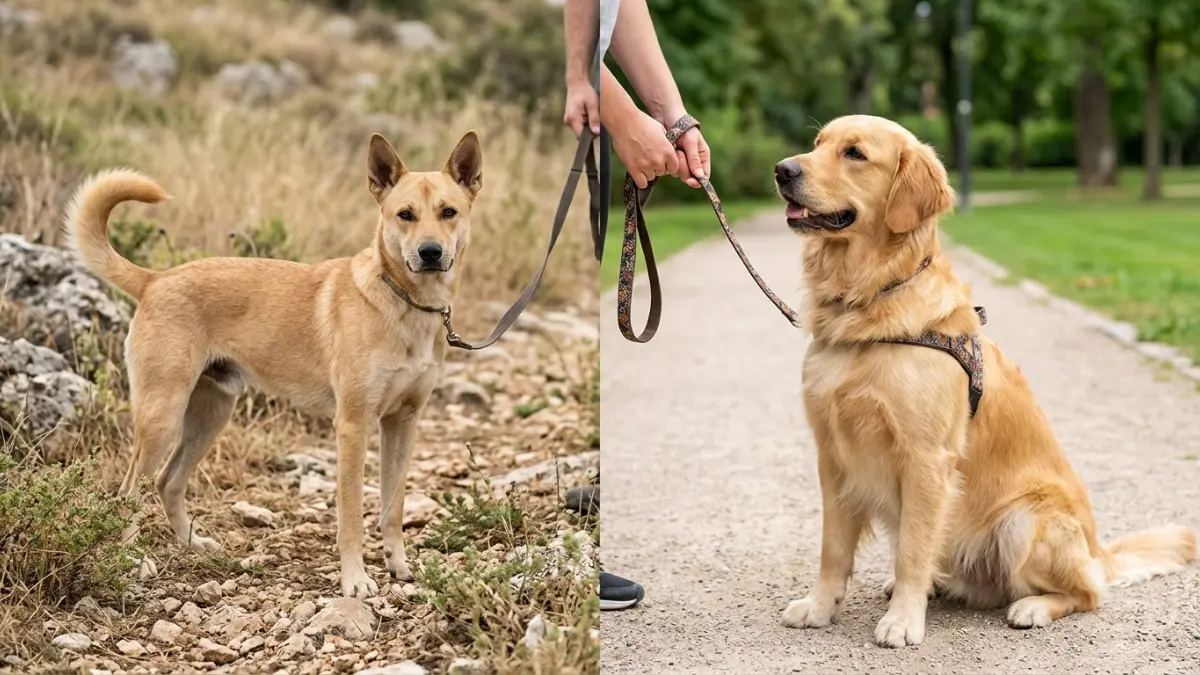
Why does a Golden Retriever usually come running the moment you call, while a Thai Ridgeback may stop, stare, and seem to weigh whether your request is worth following?
That contrast tells you something important.
Dogs may all belong to the same species, but they do not all think the same way.
Some were shaped primarily by survival, harsh environments, and early domestication. Others were shaped by generations of highly intentional human breeding for jobs like herding, retrieving, guarding, and companionship.
That difference sits at the center of one of the most fascinating topics in canine evolution: Primitive Dogs vs Modern Dogs.
Primitive dogs often feel more instinct-driven and self-directed. They notice everything. They scan environments quickly, assess situations on their own, and don’t always look to humans first.
Modern dogs, in many cases, feel different. They are often more socially tuned to people, more cooperative, and easier to guide through structured training.
But this comparison gets oversimplified all the time.
Primitive dogs are not wolves.
Modern dogs are not automatically easy pets.
And “ancient” doesn’t automatically mean “genetically closest to wolves.”
Reality is more nuanced than internet myths suggest.
To understand the real difference between primitive and modern dogs, we need to examine:
- canine domestication
- ancient canine lineage
- genetic divergence
- natural selection
- selective breeding
- wolf-like traits
- breed evolution
By the end of this guide, you’ll understand not just how primitive and modern dogs differ—but which type is more likely to fit your actual lifestyle.
Quick Comparison Table: Primitive Dogs vs Modern Dogs
| Trait | Primitive Dogs | Modern Dogs |
|---|---|---|
| Evolutionary background | Older lineage traits retained | Recent specialization |
| Main selection pressure | Natural + limited human influence | Heavy human selection |
| Temperament | More independent | More cooperative |
| Trainability | Usually harder | Often easier |
| Human focus | Lower | Higher |
| Prey drive | Frequently stronger | Variable |
| Stranger tolerance | Often lower | Usually broader |
| Beginner-friendly | Rarely | Often |
Here’s the short version:
Primitive dogs usually retain more survival-oriented instincts and autonomy. Modern dogs are generally more specialized for human cooperation and specific tasks.
That’s the overview.
Now let’s unpack what that really means.
What Are Primitive Dogs?
Primitive dogs are domestic dogs that retain more ancestral behavioral, physical, and genetic characteristics than highly modernized breeds.
In everyday terms, many of them behave more like early domestic dogs than highly specialized modern breeds.
That doesn’t make them wild.
It simply means fewer ancestral traits were bred out over time.
A large number of primitive breeds developed as landrace dogs. These are dog populations shaped mostly by geography, function, environmental survival, and practical usefulness—not by strict modern breeding programs.
That distinction matters.
When humans don’t control reproduction heavily, nature continues doing much of the selection.
And nature tends to reward dogs that are good at surviving.
That often means stronger:
- environmental awareness
- caution
- resource management
- threat detection
- independent problem-solving
This helps explain why primitive breeds often feel unusually observant.
They tend to notice things before you do.
Common primitive traits include:
- strong prey drive
- independent decision-making
- territorial sensitivity
- high situational awareness
- lower handler dependency
- caution with strangers
- strong survival instincts
Examples of primitive dog breeds include:
- Basenji
- Carolina Dog
- Thai Ridgeback
- Shiba Inu
- Akita
- Canaan Dog
- New Guinea Singing Dog
For deeper breed-specific reading, see your primitive dog breeds guide.
What Are Modern Dogs?
Modern dogs are breeds shaped heavily by intentional selective breeding, especially over the last few centuries.
Instead of survival making most of the decisions, humans increasingly decided which dogs reproduced.
The goals varied.
Sometimes humans selected for working ability. Other times for appearance, temperament, or companionship.
Common selection targets included:
- obedience
- friendliness
- herding instinct
- retrieving behavior
- guarding ability
- body size
- coat type
- appearance
This produced extreme specialization.
That’s why modern breeds can look—and behave—so differently from one another.
Consider the gap between a:
- Border Collie
- French Bulldog
Both are domestic dogs, yet their energy, behavior, body structure, and needs are radically different.
Still, as a broad category, modern breeds tend to show stronger human-oriented behavioral shaping than primitive dogs.
The Biggest Difference: Selection Pressure
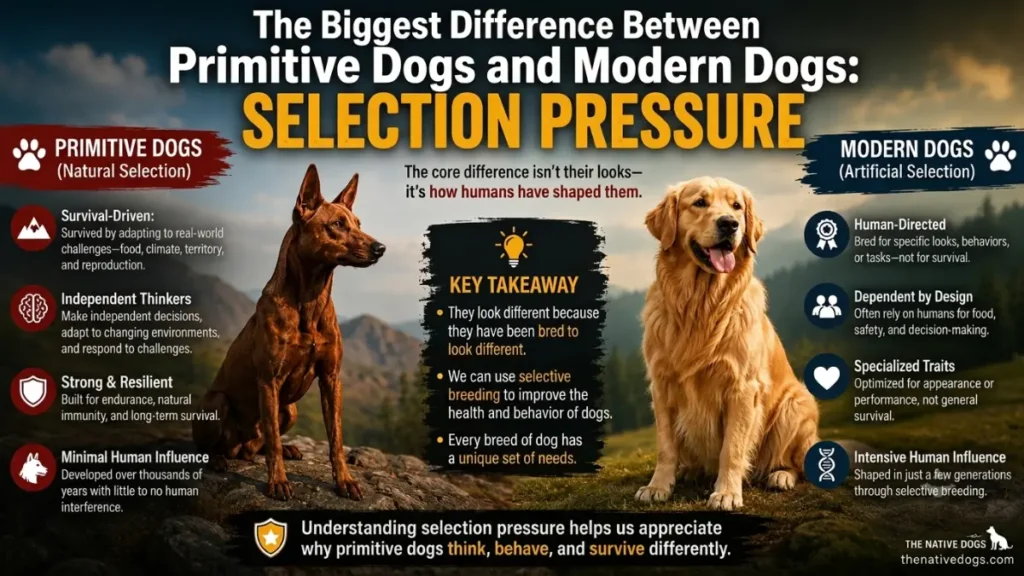
If you remember only one concept from this article, make it this one:
The biggest difference between primitive dogs and modern dogs is selection pressure.
Selection pressure simply means the forces deciding which traits survive and get passed on.
Primitive dogs developed under stronger survival pressure.
Historically, many needed to evaluate situations without immediate human guidance.
They had to:
- locate food
- avoid danger
- assess strangers
- defend territory
- solve problems independently
That environment rewarded dogs that could think for themselves.
Independence wasn’t a flaw.
It was an advantage.
Modern breeds developed under much stronger human pressure.
Humans repeatedly selected dogs that cooperated better.
A herding dog benefited from:
- eye contact
- impulse control
- responsiveness
- trainability
A retriever benefited from:
- task persistence
- soft mouth
- handler focus
- cooperative behavior
Generation after generation, those traits became stronger.
And eventually, those behavioral differences became deeply embedded.
This is why daily life with primitive and modern dogs can feel dramatically different.
One often thinks:
“Does this make sense?”
The other often thinks:
“What would you like me to do?”
That difference affects nearly everything.
Primitive Does Not Mean “Wolf”
This myth causes endless confusion.
You’ll constantly hear primitive breeds described as “closest to wolves.”
That wording is misleading.
All domestic dogs descended from ancient wolf populations through domestication.
Primitive breeds are still fully domestic dogs.
They are not semi-wild animals.
What makes them different is trait retention—not wolf identity.
And there’s an important nuance many articles miss.
Primitive does not automatically mean genetically closest to wolves across every genomic region.
Modern canine genetics is complex.
Some primitive breeds retain strong ancestral signatures in certain genomic areas. Others preserve ancestral behaviors more than genetics.
Those are not identical things.
A Basenji is not part wolf.
A Thai Ridgeback is not a wild canine.
What you’re seeing is retained ancestral behavior.
That’s very different from saying the dog is “wolf-like” in a simplistic biological sense.
Research indexed through PubMed shows dog evolution involved repeated domestication bottlenecks, regional divergence, and later intense breed formation.
In other words, canine evolution wasn’t linear.
It was messy.
Genetic Differences
Genetics explains a huge part of why living with a primitive dog can feel so different.
Modern dog evolution was shaped by two major forces:
- early domestication
- recent breed formation
Early domestication changed dogs broadly.
Recent breed formation intensified specific traits rapidly.
Primitive breeds often retain:
- older lineage signatures
- fewer exaggerated physical traits
- less concentrated specialization
Modern breeds more commonly show:
- narrower gene pools
- concentrated breed traits
- stronger specialization
These differences influence both appearance and behavior.
Selective breeding intensified traits such as:
- brachycephalic skulls
- dwarf limbs
- giant body size
- extreme coat growth
- unusually high sociability
This happened incredibly fast in evolutionary terms.
That speed came with trade-offs.
One major downside is the genetic bottleneck effect.
When breeding populations become too narrow, inherited disorders become more likely to persist.
This helps explain why some modern breeds face elevated inherited health risks.
A Genetic Detail Most Articles Miss
Here’s something page-one competitors often skip.
Behavior is not controlled by one gene.
It’s polygenic.
That means many genes collectively influence traits like:
- sociability
- prey drive
- fear response
- persistence
- trainability
That’s why the question:
“Which dog is closest to wolves?”
is usually the wrong question.
A better question is:
“Which ancestral behaviors remain strongly expressed?”
That question tells owners much more about real-life compatibility.
Physical Differences
Genetic differences eventually become visible in body structure.
Primitive dogs typically retain highly functional physical architecture.
You’ll often notice:
- wedge-shaped heads
- upright ears
- almond-shaped eyes
- athletic frames
- moderate coats
- curled or sickle tails
- efficient movement
These aren’t random aesthetic features.
They support survival advantages like:
- thermoregulation
- endurance
- awareness
- mobility
- fast directional movement
Primitive breeds usually look functional first and decorative second.
Modern breeds show far more physical diversity because human preference accelerated breed evolution.
Compare a:
- Dachshund
- Great Dane
- Pug
These body types are wildly different.
That kind of variation rarely develops naturally in landrace populations.
Behavior and Temperament Comparison
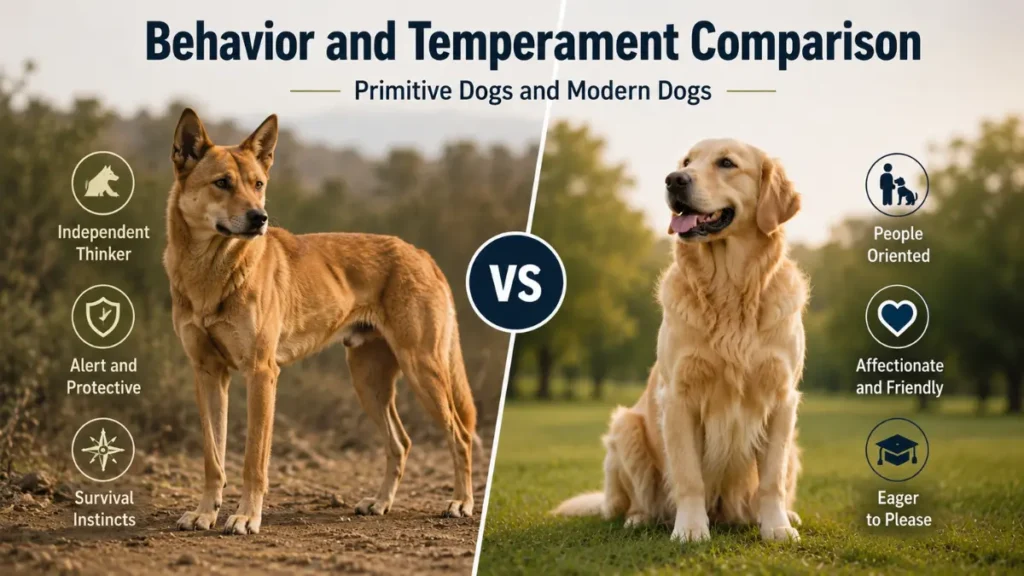
This is usually where owners feel the difference first—and sometimes within days of bringing the dog home.
Living with a primitive dog can feel fundamentally different from living with a modern breed, even when both are affectionate and deeply bonded to their families.
A primitive dog often moves through the world with a survival-first mindset.
Instead of reacting immediately, many instinctively pause and assess the situation.
It almost looks like an internal check:
- Is this safe?
- Is this necessary?
- Does this make sense for me?
That mental processing creates a behavioral style that feels very different from highly handler-focused breeds.
Primitive dogs commonly show:
- strong environmental awareness
- selective affection
- territorial awareness
- caution around unfamiliar people
- fast situational scanning
- stronger prey drive
Many of these dogs form deep bonds with their families, but they don’t always express obedience in an automatic way.
That’s where confusion often begins.
Bonding and compliance are two different systems in their mind.
A primitive dog may love its owner deeply and still pause before responding to a command.
That pause is often misunderstood.
People call it stubbornness.
But in reality, it is more often evaluation.
The dog is not ignoring you. It is deciding whether responding is worth it in that moment.
Modern breeds, especially those shaped for close human cooperation, behave differently.
Dogs like a Golden Retriever or Labrador Retriever were selectively bred for responsiveness and engagement with humans.
So they often appear naturally eager to participate.
Primitive dogs are more likely to internally process like:
“Why should I do this right now?”
Modern cooperative breeds tend to think:
“What do you want me to do next?”
That difference quietly shapes everyday life more than most owners expect.
Myth vs Reality: Are Primitive Dogs Stubborn?
This is one of the most persistent misunderstandings in dog ownership.
Common belief
Primitive dogs are stubborn.
More accurate reality
They are not built for blind compliance—they are built for independent decision-making.
That difference is important.
Traditional training systems reward:
- fast response
- repetition tolerance
- strong handler focus
- consistent obedience loops
Primitive dogs don’t always prioritize those behaviors naturally.
Instead, their intelligence often shows up in other ways:
- environmental awareness
- risk assessment
- problem-solving without guidance
- situational judgment
In survival-oriented ancestry, questioning behavior was useful.
A dog that blindly follows every instruction without assessing risk wouldn’t last long in unpredictable environments.
So what looks like “stubbornness” is often a different kind of intelligence expression.
A more accurate way to describe them is this:
They are self-directed thinkers, not obedience-first learners.
Trainability Comparison
Trainability is one of the clearest dividing lines in the primitive dogs vs modern dogs comparison.
| Training Factor | Primitive Dogs | Modern Dogs |
|---|---|---|
| Recall reliability | Often inconsistent | More reliable |
| Food motivation | Variable | Usually stronger |
| Repetition tolerance | Lower | Higher |
| Off-leash reliability | Challenging | Easier |
| Handler focus | Selective | Strong |
Primitive dogs are absolutely trainable—but the process feels different.
It is less about repetition and more about communication clarity.
If timing, consistency, or reward structure is off, they notice quickly.
And they respond accordingly.
Training often feels less like issuing commands and more like building cooperation over time.
Modern working breeds were generally shaped to enjoy structured repetition and human interaction.
Primitive breeds were not shaped with that expectation in mind.
So inconsistency in training becomes visible very quickly.
If cues change often, rewards are delayed, or expectations shift daily, a primitive dog will pick up on that imbalance.
And they may simply choose not to respond.
Prey Drive Differences
Prey drive refers to instinctive chase behavior triggered by movement.
In primitive dogs, this drive is often more pronounced.
It can follow a sequence such as:
- noticing movement
- focusing attention
- tracking
- chasing
- attempting capture
This becomes important in everyday environments.
A high prey-drive primitive dog may react strongly to:
- cats
- rabbits
- squirrels
- birds
- small animals
This does not automatically mean aggression.
It is instinct, not intention.
One common mistake owners make is confusing play-chasing with prey-driven chasing.
They can look similar from the outside.
But the internal motivation is different.
A modern retriever might chase because of excitement and play drive.
A primitive hunting-type dog may chase because instinctive predatory sequencing has been activated.
That difference matters when managing safety in real environments.
Social Behavior Differences
Primitive dogs often show more selective social behavior.
They are not universally friendly or universally unfriendly—they are selective.
Common patterns include:
- preference for familiar people
- cautious approach to strangers
- sensitivity to chaotic environments
- discomfort in unpredictable social settings
This is why some primitive breeds struggle in dog parks.
Dog parks reward social flexibility.
Primitive dogs often prefer structure over randomness.
They tend to do better in:
- calm introductions
- predictable environments
- familiar social groups
- controlled interactions
This does not mean they lack social ability.
It means their social system is more selective and structured.
Modern companion breeds generally tolerate a wider range of social exposure more easily.
Diet and Metabolism Differences
A common myth says primitive dogs must eat like wolves.
That idea does not hold up scientifically.
Domestic dogs, including primitive breeds, are still biologically adapted to domesticated nutrition.
Research indexed in PubMed shows that dogs developed increased starch digestion capacity during domestication, meaning they are not metabolically identical to wolves.
So feeding decisions should not be based on ancestry assumptions alone.
Guidelines from veterinary nutrition sources such as WSAVA and Merck Veterinary Manual emphasize one key principle:
Balanced, complete nutrition matters more than feeding ideology.
Some primitive dogs may show:
- lean body structure
- selective eating habits
- scavenging tendencies
- preference for high-protein foods
But these are tendencies, not universal rules.
Health Differences
It is incorrect to assume primitive dogs are automatically healthier.
Health depends on genetics, breeding quality, and environment—not just category.
Modern breeds can face issues linked to extreme physical selection, such as:
- respiratory challenges
- joint problems
- skin and eye conditions
These issues often arise from exaggerated physical traits.
Primitive dogs often retain more functionally balanced structures, which can reduce some structural risks.
However, they are not immune to health problems.
For example:
- Basenjis may face inherited metabolic issues
- Akitas may be prone to immune-related conditions
- Thai Ridgebacks may carry lineage-specific concerns
So health should always be evaluated at the breed and lineage level, not just “primitive vs modern.”
Energy and Lifestyle Differences
Primitive dogs usually require more than physical exercise.
A long walk may satisfy the body, but not necessarily the mind.
These dogs often need:
- mental stimulation
- structured interaction
- environmental engagement
- problem-solving outlets
Without that, boredom can lead to behavior that feels intense or destructive.
Some primitive dogs become highly skilled at:
- escaping enclosures
- finding weaknesses in fencing
- creating their own entertainment routines
- testing household boundaries
They are observant, intelligent, and often very resourceful.
That intelligence requires thoughtful management.
Pros and Cons Overview
Primitive dogs bring depth, intelligence, and independence—but they require experience and consistency.
Modern dogs offer more predictability, flexibility, and beginner-friendly behavior—but vary widely depending on breed purpose.
Neither category is superior.
They simply serve different lifestyles.
Final Thought on Compatibility
At the end of the day, breed categories matter far less than daily life alignment.
Some dogs want guidance and structure.
Others want space to think and decide.
The real question is not which category sounds better on paper.
It is which type of mind fits the life you actually live.
Because the strongest human-dog relationships are not built on control or labels.
They are built on understanding, timing, and compatibility that works in real-world conditions.
Frequently Asked Questions
What’s the biggest difference between primitive dogs and modern dogs?
The biggest difference is how they think and respond to humans. Primitive dogs act more independently and evaluate situations before responding, while modern dogs are bred to follow human direction more quickly and consistently.
Are primitive dogs harder to train than modern dogs?
Yes, in most cases primitive dogs take more patience. They learn well, but they don’t repeat commands blindly. They often pause and decide whether a command makes sense in that moment, which can feel like stubbornness to new owners.
Are primitive dogs good for first-time dog owners?
Usually no. First-time owners often find modern dogs easier because they are more predictable and forgiving. Primitive dogs need consistency, calm handling, and a good understanding of dog behavior to do well.
Do primitive dogs have stronger prey drive?
Many primitive dogs do show stronger prey drive because they are closer to their natural survival instincts. This can lead to chasing small animals or reacting quickly to movement, so leash control and training are important.