Ancient dog breeds have fascinated historians, archaeologists, geneticists, and dog lovers for decades. Their stories stretch across deserts, mountains, forests, frozen Arctic landscapes, and ancient civilizations. Yet one of the biggest surprises is that there isn’t a single dog breed scientists universally recognize as the oldest breed in the world.
Instead, modern research points to several breeds that preserve remarkably old lineages or long regional histories. Some are supported by ancient DNA studies, others by archaeological discoveries, and many by centuries of cultural continuity. Together, they offer an extraordinary glimpse into the early partnership between humans and dogs.
In this guide, you’ll learn what makes a dog breed “ancient,” how experts evaluate historical evidence, which breeds have the strongest claims to ancient ancestry, and what those centuries-old traits mean for today’s owners.
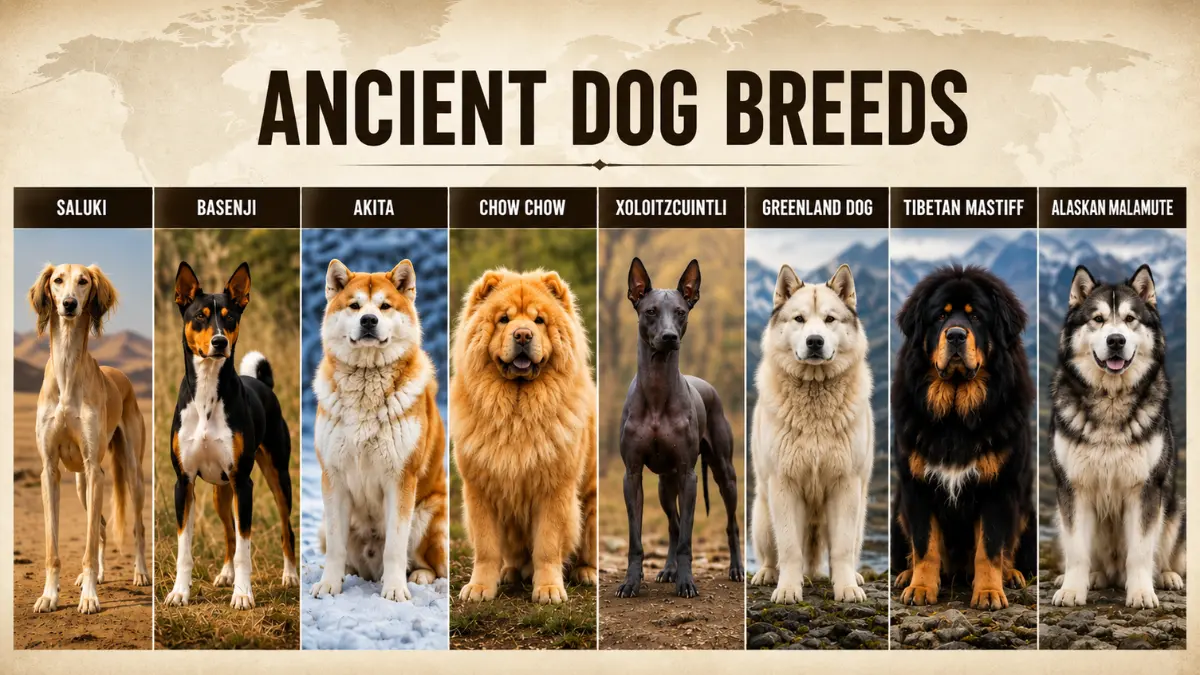
Ancient Dog Breeds at a Glance
Breed
Historical Region
Traditional Purpose
Evidence Confidence*
Saluki
Middle East
Hunting
High
Basenji
Central Africa
Hunting
High
Afghan Hound
Afghanistan
Hunting
Moderate–High
Chow Chow
China
Guarding, hunting
Moderate–High
Akita
Japan
Large-game hunting
High
Shiba Inu
Japan
Small-game hunting
High
Tibetan Mastiff
Himalayas
Livestock guarding
Moderate–High
Greenland Dog
Arctic
Sled work
High
Siberian Husky
Northeastern Asia
Transportation
High
Alaskan Malamute
Arctic
Heavy hauling
High
Samoyed
Northern Eurasia
Herding and hauling
High
Xoloitzcuintli
Mexico
Companion
High
Canaan Dog
Middle East
Guarding
Moderate–High
Peruvian Inca Orchid
Peru
Companion
Moderate
Korean Jindo
Korea
Hunting
Moderate–High
Evidence Confidence
High – Supported by strong historical and genetic evidence.
Moderate–High – Strong evidence exists, although some historical continuity is still debated.
Moderate – Ancient regional roots are well accepted, but the continuity of the modern breed is less certain.
What Is an Ancient Dog Breed?
An ancient dog breed is a breed or traditional dog population with deep historical roots, long-standing regional continuity, or genetic evidence suggesting it belongs to one of the earlier branches of domestic dog history.
That definition is important because ancient doesn’t mean unchanged.
Every living dog breed has evolved over time. Climate, geography, selective breeding, and changing human needs have influenced how dogs look and behave today. Even breeds with very old ancestry are not identical to the dogs that lived thousands of years ago.
A better way to think about ancient breeds is this:
They preserve an old heritage, not a frozen moment in history.
That distinction helps explain why responsible researchers rarely describe any modern breed as a “living fossil.”
Ancient Lineage vs. Modern Breed
This is where many articles oversimplify the subject.
People often assume that if a breed is ancient, the dogs alive today must be exactly the same as those seen in archaeological sites or ancient artwork.
Current evidence doesn’t support that conclusion.
An ancient lineage refers to a long-established regional population of dogs that existed before kennel clubs, written breed standards, or pedigree records.
A modern breed is a carefully maintained population developed through organized breeding programs and recognized standards.
Take the Saluki as an example.
Dogs resembling modern Salukis appear in historical artwork from the Middle East, and the breed has exceptionally deep cultural roots. Even so, today’s Saluki has still been influenced by centuries of selective breeding.
Both statements are true:
The lineage is ancient.
The modern breed has continued to evolve.
Recognizing that difference leads to a much more accurate understanding of canine history.
Ancient, Primitive, Basal, Landrace, and Village Dogs
These terms are frequently used together, but they describe different ideas.
Term
What It Means
What It Doesn’t Mean
Ancient breed
A breed with deep historical or regional roots
A completely unchanged prehistoric dog
Primitive breed
A breed that retains many older physical or behavioral characteristics
A wild or undomesticated dog
Basal lineage
A lineage that diverged relatively early in certain genetic analyses
The very first dog breed
Landrace
A locally adapted dog population shaped mainly by environment and work
A standardized pedigree breed
Village dog
A naturally breeding dog population living near human communities
An officially recognized breed
Understanding these differences matters because scientific research uses these terms very precisely.
For example, a village dog population may preserve valuable genetic history without belonging to any registered breed. Likewise, a landrace can exist for centuries before anyone develops an official breed standard.
Is There Really an Oldest Dog Breed?
The honest answer is no—not according to current scientific evidence.
There isn’t one universally accepted oldest living dog breed.
Instead, several breeds consistently appear in discussions about ancient ancestry because they are supported by different kinds of historical evidence.
Each earned its reputation for a different reason.
Some have exceptionally old historical records.
Others show genetic patterns associated with early-diverging dog lineages.
Several have remained closely connected with the same geographic region for hundreds—or even thousands—of years.
Because these forms of evidence answer different questions, experts avoid declaring a single undisputed winner.
Instead, they describe these breeds as belonging to some of the world’s oldest surviving dog lineages.
How Experts Determine Whether a Dog Breed Is Ancient
When researchers study ancient dog breeds, they don’t rely on a single discovery or one famous historical story. Instead, they compare multiple types of evidence to build the clearest possible picture of a breed’s history.
This is why two experts can reach slightly different conclusions while still working from the same scientific evidence. One may focus on genetics, while another places greater weight on archaeology or documented history.
The strongest conclusions usually come from combining several independent sources rather than relying on just one.
1. Ancient DNA Research
Evidence Confidence: High
Ancient DNA has transformed our understanding of canine history.
Scientists can now compare DNA extracted from archaeological dog remains with the DNA of modern dogs. These comparisons help answer questions such as:
Which dog populations separated earliest?
How did dogs spread alongside humans?
Which modern breeds preserve older genetic lineages?
How much mixing occurred between different populations over time?
One important point is often misunderstood.
Ancient DNA studies do not identify modern pedigree breeds inside ancient archaeological sites. Instead, they reveal relationships between historical dog populations and the ancestors of today’s breeds.
For example, several Arctic dogs, Japanese breeds, and Middle Eastern hunting dogs consistently show genetic patterns associated with long-established lineages. That doesn’t make them “unchanged prehistoric dogs,” but it does strengthen the evidence for their ancient heritage.
2. Archaeological Evidence
Evidence Confidence: High
Archaeology tells another part of the story.
Excavations around the world have uncovered dog remains dating back thousands of years, showing that dogs lived and worked beside humans long before modern breeds existed.
These discoveries can reveal:
Body size and proportions
Estimated age
Diet
Injuries and healing
Burial practices
Relationships between people and dogs
Some ancient burials even suggest that dogs held important cultural or emotional roles within human communities.
However, bones alone rarely allow scientists to identify a modern breed with certainty. They help us understand ancient dog populations, not today’s pedigree dogs.
3. Historical Records and Ancient Artwork
Evidence Confidence: Moderate–High
Long before photography, civilizations recorded daily life through carvings, paintings, pottery, sculptures, and written accounts.
These records provide valuable clues about:
A dog’s appearance
Its working role
Regional distribution
The relationship between dogs and people
For example, slender hunting dogs appear in ancient Middle Eastern artwork, while powerful guardian dogs are found in Himalayan traditions. Hairless dogs are also represented in the art of several pre-Columbian cultures.
Even so, appearance should never be treated as proof of direct ancestry.
Dogs performing similar jobs in similar environments often develop similar body shapes, even if they are not closely related.
4. Regional Continuity
Evidence Confidence: Moderate–High
Some breeds have remained closely associated with the same landscape, culture, and working purpose for centuries.
Examples include:
Arctic sled dogs
Japanese hunting dogs
Middle Eastern sighthounds
Himalayan livestock guardians
Central African hunting dogs
This long-term regional continuity becomes especially convincing when it matches archaeological discoveries and genetic evidence.
It also explains why Indigenous and traditional dog populations continue to play an important role in modern canine research.
5. Modern Breed Records
Evidence Confidence: Moderate
Kennel clubs preserve valuable information about today’s breeds, including:
Breed standards
Registration records
Pedigrees
Controlled breeding programs
These records are essential for understanding the modern breed.
However, they cannot demonstrate prehistoric ancestry because organized pedigree breeding is relatively recent compared with the thousands of years dogs have lived alongside people.
Why There Isn’t a Single “Oldest Dog Breed”
One of the biggest misconceptions surrounding ancient dogs is the belief that science has identified one clear winner.
Current evidence doesn’t support that idea.
Instead, researchers evaluate several different questions, and each one may point toward a different breed.
For example:
Which breed has the oldest historical artwork?
Which lineage shows the oldest genetic patterns?
Which population has the longest cultural continuity?
Which breed has remained in the same geographic region for centuries?
Which dogs best represent early-diverging domestic lineages?
Because these questions measure different things, they naturally produce different answers.
That’s why responsible historians and canine researchers usually avoid ranking breeds from oldest to newest.
Understanding Evidence Confidence
Throughout this guide, each breed is assigned an evidence confidence level.
This isn’t a popularity score. It reflects how strongly current evidence supports the breed’s ancient heritage.
Evidence Level
Meaning
High
Strong support from multiple sources, including genetics, archaeology, and documented history.
Moderate–High
Considerable evidence exists, although some historical continuity remains debated.
Moderate
Ancient regional roots are well supported, but the modern breed’s continuity is less certain.
Traditional / Still Studied
Historical importance is recognized, but some claims remain under active scientific discussion.
Using evidence confidence helps separate well-supported history from popular internet myths.
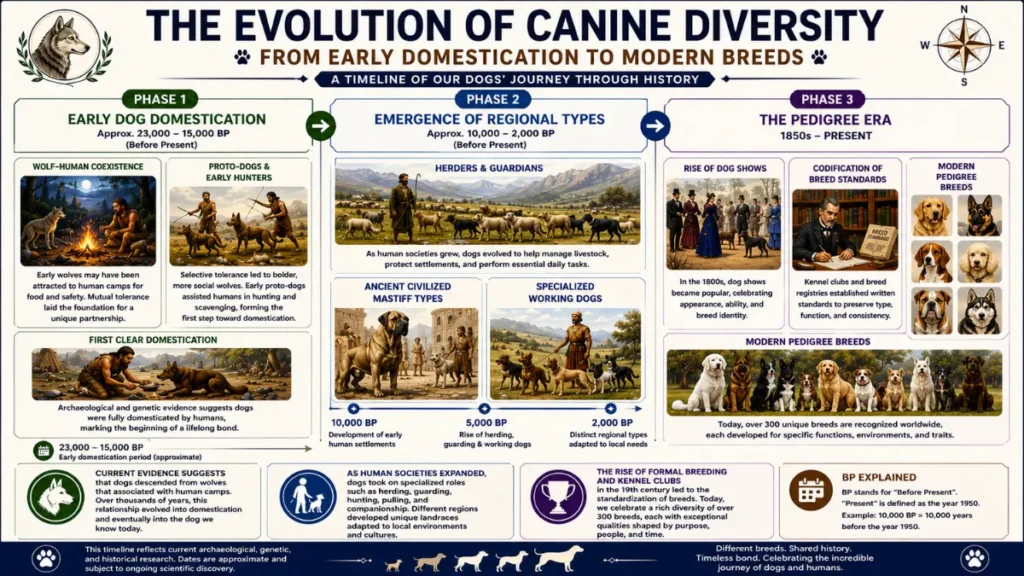
Dogs Existed Long Before Modern Breeds
It’s easy to forget that the concept of a modern dog breed is relatively new.
Thousands of years ago, dogs weren’t organized into pedigree breeds with written standards. Instead, they existed as regional working populations, shaped by the environments where they lived and the jobs they performed.
Some pulled sleds across Arctic snow.
Others guarded livestock in mountain villages.
Some hunted gazelle across deserts, while others tracked small game through dense forests.
Over countless generations, these populations gradually developed consistent characteristics that suited local conditions.
Only much later did organized breeding programs transform many of those regional dogs into the standardized breeds recognized today.
Understanding this timeline helps explain why a breed can have ancient roots while still being a modern breed in its present form.
Early Domestication Changed Everything
Although researchers continue studying exactly when and where dogs were first domesticated, several conclusions are widely supported.
Dogs were humanity’s first domesticated animal.
They lived alongside people thousands of years before agriculture became widespread.
Early domestic dogs were not modern pedigree breeds.
Human migration helped spread dogs across continents.
Rather than happening all at once, domestication was almost certainly a gradual process that unfolded over many generations.
As humans adapted to different environments, their dogs adapted with them—creating the remarkable diversity we see today.
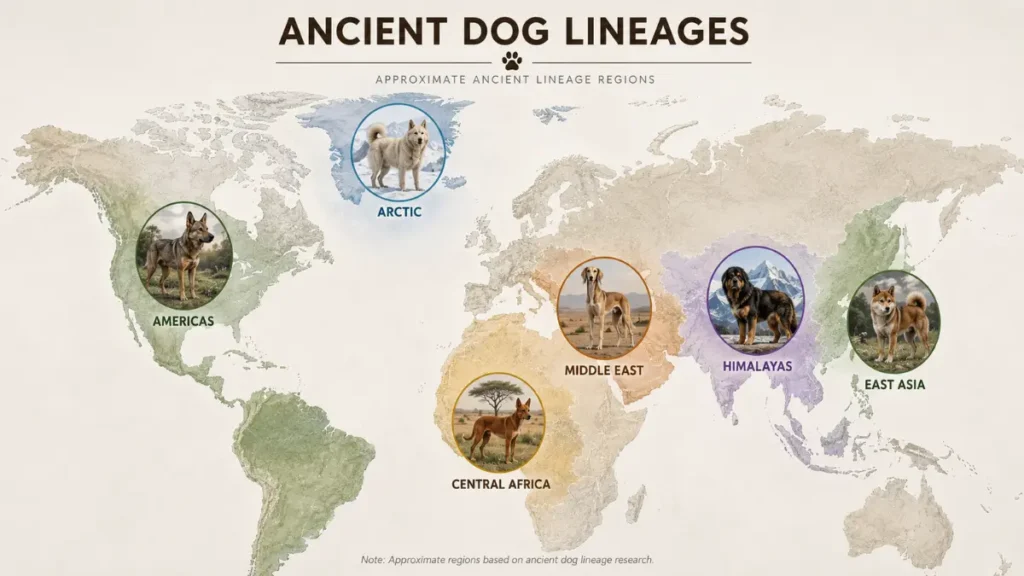
Ancient Dog Breeds Around the World
Rather than ranking breeds from oldest to youngest—a ranking that current evidence cannot support—it’s more useful to explore them by region.
Each region developed dogs that reflected its geography, climate, wildlife, and the daily needs of the people who depended on them.
The breeds in the following sections are among the best-supported examples of ancient or historically significant dog lineages that are still alive today.
Ancient Dog Breeds of the Middle East and Africa
The Middle East and parts of Africa played a major role in the early history of domestic dogs. For thousands of years, hunters relied on fast, agile dogs to pursue game across deserts, grasslands, and rocky terrain. Many of today’s oldest hunting breeds trace their heritage to these regions.
Although each breed developed under different conditions, they share one important characteristic: they were shaped by function long before appearance became a priority.
Saluki
Evidence Confidence: High
Historical role: Sighthound used for hunting gazelle, hare, and other fast game.
The Saluki is one of the strongest candidates whenever experts discuss the world’s oldest living dog breeds.
Dogs resembling modern Salukis appear in ancient Middle Eastern artwork, and the breed has remained closely associated with the region for centuries. Combined with genetic research, this long cultural history gives the Saluki one of the strongest claims to ancient ancestry.
What makes the Saluki remarkable isn’t only its history. It was developed to cover vast distances while chasing fast-moving prey, often making decisions without constant direction from its handler.
That heritage is still visible today.
Most Salukis are:
Graceful and athletic
Quiet indoors
Affectionate with family
Independent thinkers
Strongly motivated to chase moving animals
For modern owners, this means reliable recall can be difficult in open spaces. Even well-trained Salukis may instinctively pursue wildlife if given the opportunity.
A securely fenced exercise area is usually a safer choice than relying on off-leash freedom.
Basenji
Evidence Confidence: High
Historical role: Hunting dog from Central Africa.
The Basenji dog developed from traditional hunting dogs that worked alongside communities in Central Africa for generations.
Rather than relying solely on speed, Basenjis used intelligence, agility, and close cooperation with hunters to locate and flush game.
The breed is famous for being called the “barkless dog,” but the nickname is slightly misleading.
Basenjis don’t completely lack a voice. Instead of producing a typical bark, many make a unique yodel-like sound often called a baroo. They also whine, howl, and communicate using a variety of other vocalizations.
Living with a Basenji can be rewarding, but it’s rarely boring.
Owners often describe them as:
Curious problem-solvers
Extremely clean
Agile climbers
Independent
Clever enough to test household rules
Because they’re naturally inquisitive, secure fencing and consistent supervision are important. A bored Basenji may quickly discover creative ways to escape or investigate its surroundings.
Afghan Hound
Evidence Confidence: Moderate–High
Historical role: Mountain hunting dog.
The Afghan Hound developed in the rugged mountains of Afghanistan, where hunters needed a dog capable of navigating steep terrain while pursuing swift prey.
Its long, flowing coat wasn’t developed for appearance alone. It also provided protection from cold mountain weather and rough vegetation.
Today, Afghan Hounds combine elegance with impressive athletic ability.
Typical characteristics include:
Excellent speed
Strong endurance
Independent decision-making
Quiet confidence
Sensitivity toward harsh handling
Training usually works best when sessions remain positive, varied, and engaging.
Repetitive drills often produce frustration rather than enthusiasm, especially in breeds originally expected to think for themselves.
Their beautiful coat is another important consideration.
Regular brushing isn’t simply cosmetic—it helps prevent painful mats and keeps the skin healthy throughout the year.
Sloughi
Evidence Confidence: Moderate–High
Historical role: Hunting dog of North Africa.
The Sloughi originated across North Africa, particularly in Morocco, Algeria, Tunisia, and Libya.
Like the Saluki, it was developed as a sighthound capable of pursuing fast-moving prey across open country.
Although the two breeds share similar jobs, they developed independently within different regions and cultures.
Most Sloughis are known for being:
Quiet around the home
Loyal to their family
Naturally reserved with strangers
Athletic without being hyperactive indoors
They usually appreciate calm handling and thoughtful socialization rather than constant excitement.
Because of their hunting background, they also benefit from secure areas where they can exercise safely without encountering wildlife.
Azawakh
Evidence Confidence: Moderate–High
Historical role: Hunting and camp guarding.
The Azawakh developed in the Sahel region of West Africa, where nomadic communities valued a dog that could both protect camp and hunt efficiently.
Unlike many modern companion breeds, the Azawakh was expected to work with minimal direction while remaining alert to unfamiliar people and animals.
That heritage explains much of its personality today.
The breed is typically:
Lean and exceptionally athletic
Loyal to its immediate family
Naturally observant
Reserved around strangers
Its short coat also reflects adaptation to hot climates rather than cold environments.
Owners living in colder regions often need to provide appropriate protection during winter walks.
Ancient Dog Breeds of East Asia
East Asia has preserved several historically important dog lineages through centuries of geographic isolation and cultural continuity.
Many of these breeds were developed as practical working dogs long before they became family companions. Their original responsibilities included hunting, guarding property, and protecting livestock.
Those instincts remain part of their character today, even if most now live very different lives.
Chow Chow
Evidence Confidence: Moderate–High**
Historical role: Guarding, hunting, and general farm work.
The Chow Chow is one of China’s oldest and most recognizable breeds.
Historical records suggest that dogs resembling modern Chow Chows served many different purposes, including guarding homes, assisting with hunting, and helping on farms.
The breed’s distinctive appearance makes it easy to recognize.
Notable features include:
A dense double coat
A blue-black tongue
A sturdy build
A lion-like mane
Behind that impressive appearance is a dog known for quiet confidence rather than constant enthusiasm.
Many Chow Chows naturally prefer observing new situations before deciding how to respond.
With thoughtful early socialization, they often become calm, dependable companions that remain deeply loyal to their families.
Their thick coat also requires regular brushing, particularly during seasonal shedding.
Chinese Shar-Pei
Evidence Confidence: Moderate**
Historical role: Farm dog and property guardian.
The Chinese Shar-Pei developed as a versatile working dog in southern China.
Historically, these dogs guarded homes, watched livestock, and helped around farms, earning a reputation for independence and reliability.
Today they’re instantly recognized by their:
Loose skin
Deep wrinkles
Broad head
Calm expression
Modern Shar-Pei populations descend from relatively few surviving dogs after the breed experienced a dramatic decline during the twentieth century.
Because of this limited population history, responsible breeders place considerable emphasis on health screening.
Anyone considering a Shar-Pei puppy should ask about recommended health testing and discuss the breed’s specific care needs with both the breeder and a veterinarian.
Akita
Evidence Confidence: High**
Historical role: Large-game hunting.
The Akita originated in northern Japan, where hunters relied on powerful dogs capable of tracking and holding large game.
That demanding work required courage, intelligence, and confidence—qualities the breed continues to display today.
Most Akitas are:
Quiet
Loyal
Confident
Protective of their family
Reserved with unfamiliar people
They usually develop strong bonds with the people they know while remaining naturally cautious in new situations.
Early socialization and consistent training help channel these instincts into appropriate behavior.
Because of their size, strength, and protective nature, Akitas generally suit owners who understand the responsibilities that come with managing a powerful guardian breed.
Shiba Inu
Evidence Confidence: High
Historical role: Small-game hunting.
The Shiba Inu may be Japan’s smallest native hunting breed, but its history is every bit as impressive as its larger relatives.
Originally developed to flush birds and small mammals through dense mountain brush, the Shiba combines agility, confidence, and quick decision-making. Those qualities helped hunters work efficiently across difficult terrain and still shape the breed’s personality today.
A typical Shiba Inu is:
Alert and observant
Intelligent
Independent
Clean by nature
Surprisingly athletic for its size
One characteristic new owners often underestimate is the breed’s prey drive. A squirrel, rabbit, or bird can instantly become more interesting than even the best-trained recall cue.
Because of this, many experienced owners choose secure, fenced areas for off-leash exercise instead of relying on voice commands alone.
Shibas also tend to appreciate training that feels like a game. Short, rewarding sessions usually produce better results than repetitive drills.
Korean Jindo
Evidence Confidence: Moderate–High
Historical role: Hunting and guarding.
The Korean Jindo developed on Jindo Island, where geographic isolation helped preserve many of the breed’s traditional characteristics.
Known for remarkable loyalty, Jindos often form exceptionally strong bonds with their families. At the same time, they usually remain reserved with unfamiliar people, making early socialization an important part of raising a confident adult dog.
Many Jindos are known for:
Strong problem-solving skills
Excellent hunting instincts
Clean habits
Quiet confidence
Deep family loyalty
Their intelligence can make training rewarding, but it also means they notice inconsistency quickly. Clear expectations and positive reinforcement generally produce the best long-term results.
Tibetan Mastiff
Evidence Confidence: Moderate–High
Historical role: Livestock guardian.
The Tibetan Mastiff developed across the Himalayan region, where it guarded livestock and remote settlements against predators.
Unlike herding dogs that work closely with people throughout the day, livestock guardians often had to make independent decisions while protecting animals through the night.
That history still influences the breed today.
Typical characteristics include:
Strong territorial instincts
Calm confidence
Independence
Excellent awareness of surroundings
Protective behavior toward family and property
These qualities make Tibetan Mastiffs outstanding guardians in suitable environments, but they also mean the breed isn’t the right fit for every household.
They generally thrive with experienced owners who understand guardian breeds and can provide structured training, careful socialization, and secure containment.
Lhasa Apso
Evidence Confidence: Moderate–High
Historical role: Indoor watchdog and companion.
Despite its small size, the Lhasa Apso has a long history as an alert watchdog in Tibetan monasteries and homes.
Its job wasn’t to confront intruders but to notify larger guardian dogs and people when something unusual happened.
Modern Lhasa Apsos remain:
Confident
Alert
Intelligent
Affectionate with family
Naturally cautious around strangers
Their long coat requires regular maintenance, although many owners choose a shorter trim that’s easier to manage while still protecting the skin.
Pekingese
Evidence Confidence: Moderate
Historical role: Imperial companion.
Unlike many ancient working breeds, the Pekingese was closely associated with the imperial courts of China, where it served primarily as a companion.
Its distinctive appearance includes:
A compact body
A luxurious coat
Large expressive eyes
A shortened muzzle
Today’s Pekingese can make affectionate companions, but prospective owners should understand the responsibilities that come with caring for a flat-faced breed.
Because of their facial structure, some Pekingese may be more susceptible to breathing difficulties, overheating, and eye injuries than longer-muzzled dogs.
Keeping them at a healthy weight, avoiding strenuous exercise during hot weather, and maintaining regular veterinary care can help reduce these risks.
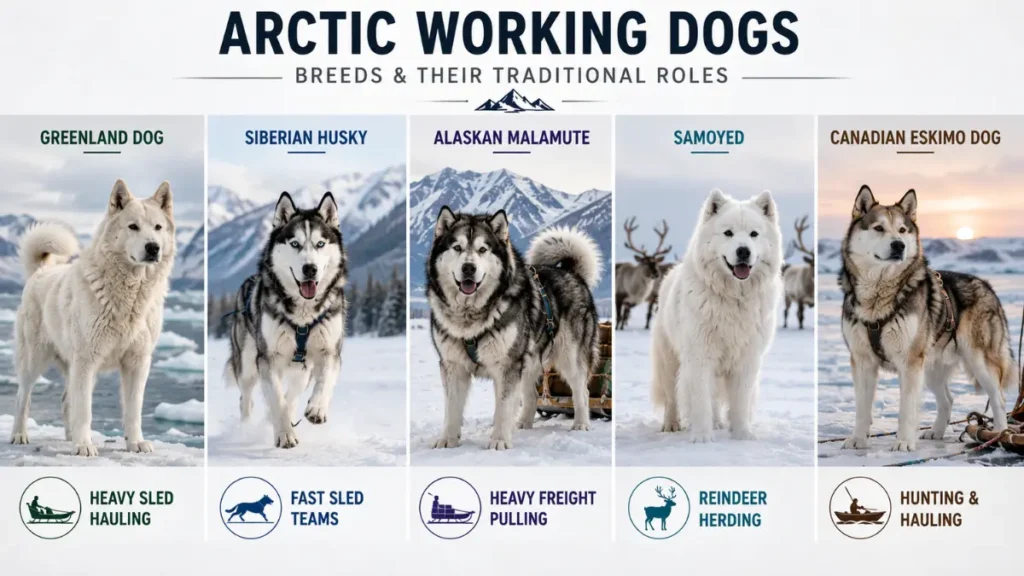
Ancient Arctic and Northern Dog Breeds
Life in the Arctic demanded extraordinary dogs.
Long before snowmobiles and modern transportation, Indigenous communities depended on powerful working dogs to pull sleds, transport supplies, assist with hunting, and survive in some of the harshest climates on Earth.
These breeds weren’t developed for appearance. Every physical and behavioral trait served a practical purpose.
Greenland Dog
Evidence Confidence: High
Historical role: Sled dog and hunting companion.
The Greenland Dog—also known as the Greenland Qimmeq—is among the oldest surviving Arctic working dog populations.
For generations, Inuit communities relied on these dogs for transportation, seal hunting, and daily survival across Greenland’s demanding landscape.
The breed is known for:
Exceptional endurance
Physical strength
Thick weather-resistant coat
Team-oriented working style
High energy
A Greenland Dog isn’t a dog that enjoys spending most of the day indoors.
Owners should expect to provide substantial daily exercise, meaningful mental stimulation, and opportunities to perform activities that satisfy its natural working instincts.
Without enough physical and mental outlets, frustration can quickly develop into unwanted behaviors.
Siberian Husky
Evidence Confidence: High
Historical role: Long-distance sled pulling.
Developed by the Chukchi people of northeastern Asia, the Siberian Husky was bred to travel efficiently over long distances while conserving energy.
That heritage explains why modern Huskies seem capable of running for hours with remarkable enthusiasm.
Most Huskies are:
Friendly with people
Highly energetic
Athletic
Curious
Exceptionally good escape artists
Their friendly nature often surprises people expecting a guard dog.
While many Huskies happily greet strangers, they still require thoughtful management because of their intelligence and determination. Secure fencing isn’t optional for most households—it is an important safety measure.
Daily exercise, enrichment games, and structured training help channel their energy into appropriate outlets.
Alaskan Malamute
Evidence Confidence: High
Historical role: Heavy freight hauling.
Although the Alaskan Malamute is often mistaken for a Siberian Husky, the two breeds were developed for different jobs.
While Huskies excelled at covering long distances with lighter loads, Malamutes were bred to pull heavy freight through deep snow. Their build reflects that purpose—they are typically larger, more muscular, and incredibly strong.
A well-bred Alaskan Malamute is usually:
Powerful and athletic
Calm but confident
Affectionate with family
Intelligent and independent
Happy when given meaningful work
Their strength is one reason early training matters so much.
Teaching polite leash manners, reliable impulse control, and good household habits while they’re young is far easier than correcting poor habits in a fully grown adult.
Like other Arctic breeds, Malamutes have a dense double coat that sheds heavily during seasonal coat changes. Regular brushing helps remove loose hair and keeps the coat in good condition.
Samoyed
Evidence Confidence: High
Historical role: Herding, hauling, hunting, and companionship.
The Samoyed developed alongside the Samoyedic peoples of northern Eurasia, where these versatile dogs helped herd reindeer, pull sleds, hunt, and live closely with their families.
That close relationship with people still defines the breed today.
Samoyeds are often described as:
Friendly
Social
Intelligent
Playful
Eager to participate in family life
Unlike some independent ancient breeds, Samoyeds usually enjoy being involved in everyday activities. Many don’t cope well with long periods of isolation.
Their famous white coat is beautiful, but it also requires commitment. Frequent brushing helps prevent mats, removes loose undercoat, and keeps the skin healthy throughout the year.
For active families willing to invest time in grooming and exercise, the Samoyed can be an exceptionally rewarding companion.
Canadian Eskimo Dog
Evidence Confidence: High
Historical role: Transportation and hunting.
The Canadian Eskimo Dog is another ancient Arctic working breed with deep cultural importance.
Traditionally used by Inuit communities, these dogs transported supplies, assisted with hunting, and worked in conditions that demanded extraordinary endurance.
Today, they remain:
Powerful
Energetic
Highly driven
Intelligent
Independent
These characteristics make them impressive working dogs, but they also mean the breed isn’t suited to every lifestyle.
Owners should be prepared to provide:
Extensive daily exercise
Structured training
Consistent leadership
Plenty of mental stimulation
For households seeking a relaxed companion, a different breed may be a better match.
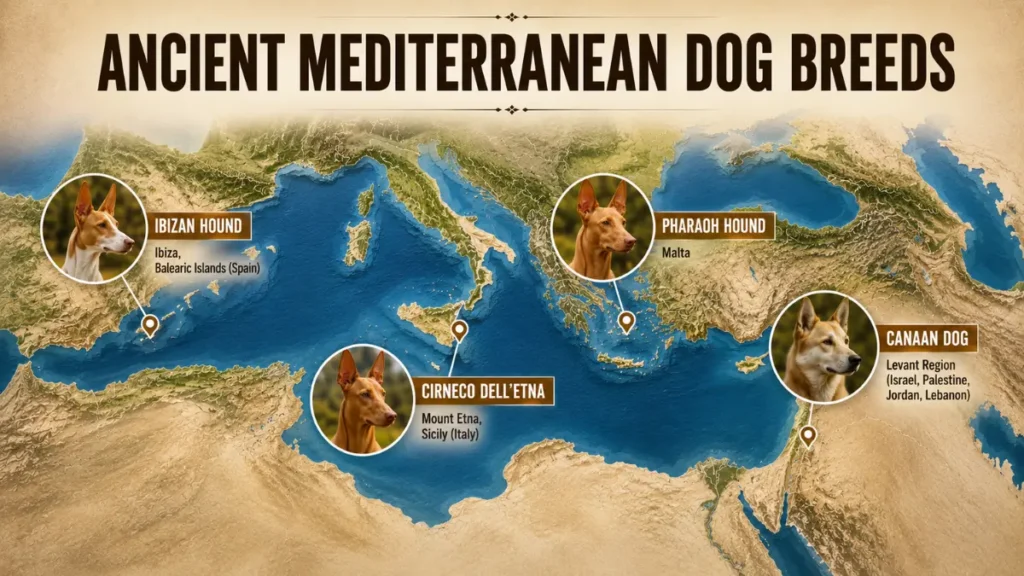
Ancient Dog Breeds of the Mediterranean and Near East
The Mediterranean region has produced several elegant hunting breeds whose histories stretch back hundreds, and in some cases thousands, of years.
Many of these dogs were developed to hunt rabbits and other fast-moving prey across open landscapes. Their athletic build and keen eyesight remain defining characteristics today.
Canaan Dog
Evidence Confidence: Moderate–High
Historical role: Guarding and general farm work.
The Canaan Dog traces its heritage to free-breeding dogs that lived throughout the Middle East long before formal breed standards existed.
Rather than being created through intensive selective breeding, these dogs adapted naturally to their surroundings while working alongside people.
Modern Canaan Dogs are generally:
Alert
Intelligent
Adaptable
Loyal
Naturally cautious around strangers
Their thoughtful temperament makes early socialization especially valuable. Positive exposure to new people, places, and experiences helps build confidence without changing the breed’s naturally observant personality.
Many owners appreciate that a well-socialized Canaan Dog is usually calm and measured rather than overly reactive.
Pharaoh Hound
Evidence Confidence: Moderate
Historical role: Rabbit hunting.
The Pharaoh Hound is frequently linked to Ancient Egypt because of its striking resemblance to dogs shown in Egyptian artwork.
However, modern research paints a more nuanced picture.
While the breed has genuine historical significance, today’s Pharaoh Hound is more closely associated with Malta than with an unbroken lineage from ancient Egyptian royal hunting dogs.
That distinction matters because it reflects the current scientific evidence rather than a popular legend.
Modern Pharaoh Hounds are known for being:
Athletic
Elegant
Friendly with family
Intelligent
Exceptionally fast
Their enthusiasm for chasing moving objects remains strong, making secure exercise areas an important part of responsible ownership.
Ibizan Hound
Evidence Confidence: Moderate
Historical role: Rabbit hunting.
The Ibizan Hound developed on Spain’s Balearic Islands, where speed, agility, and sharp eyesight made it an outstanding rabbit hunter.
Its upright ears and slender build often remind people of dogs shown in ancient Mediterranean art.
Even so, appearance alone cannot confirm direct ancestry.
Researchers evaluate historical continuity using multiple forms of evidence, not visual similarities by themselves.
Living with an Ibizan Hound usually means sharing your home with a dog that is:
Energetic outdoors
Calm indoors after exercise
Intelligent
Curious
Highly athletic
Like other sighthounds, they benefit from secure spaces where they can safely run without the temptation to chase wildlife.
Cirneco dell’Etna
Evidence Confidence: Moderate
Historical role: Rabbit hunting.
Developed on the slopes of Sicily’s Mount Etna, the Cirneco dell’Etna is one of the Mediterranean’s oldest hunting breeds.
Centuries of working across rocky volcanic terrain produced a dog that is both agile and remarkably resilient.
Despite its relatively small size, the Cirneco is an energetic athlete that enjoys regular activity and mental challenges.
Most are:
Alert
Affectionate
Agile
Intelligent
Eager to explore
Their compact build makes them easier to manage than some larger hunting breeds, but they still appreciate daily opportunities to exercise both body and mind.
Ancient Dog Breeds of the Americas
Long before modern kennel clubs existed, people throughout the Americas lived alongside unique dog populations that served as companions, guardians, and cultural symbols.
Some of today’s breeds preserve strong historical connections to those early dogs, while others continue to help researchers understand the movement of dogs across the continents.
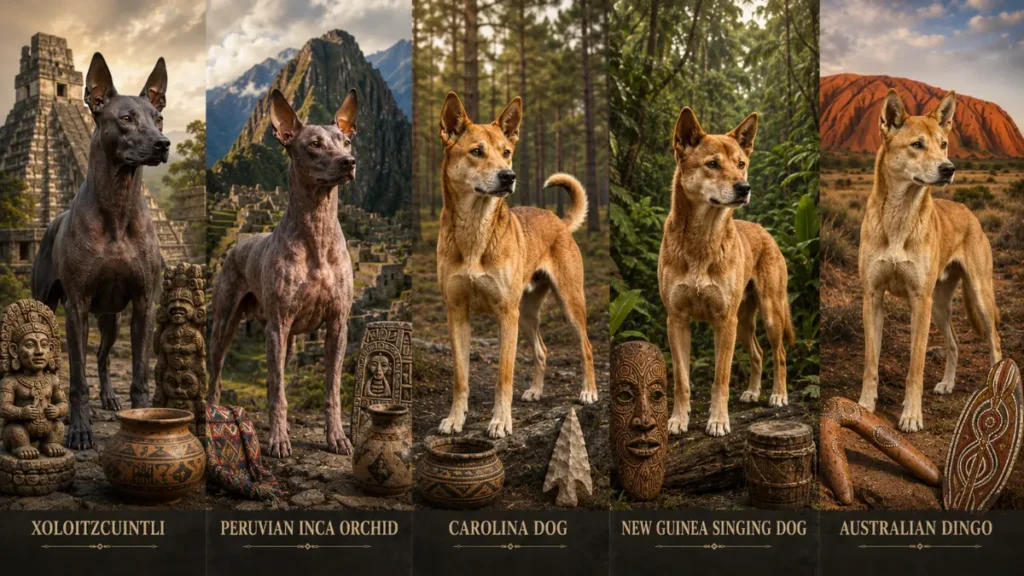
Xoloitzcuintli (Mexican Hairless Dog)
Evidence Confidence: High
Historical role: Companion and cultural dog.
The Xoloitzcuintli—often called the Xolo—is one of the oldest documented dog breeds in the Americas.
Archaeological discoveries, ceramic figures, and historical records from pre-Columbian civilizations show that hairless dogs resembling today’s Xolo were valued long before European contact.
Rather than being developed for hunting or guarding, the Xolo was closely integrated into everyday life. Over centuries, it became both a trusted companion and an important part of local culture.
Today, the breed is available in both:
Hairless
Coated
The two varieties share the same temperament but require different grooming routines.
Most Xolos are known for being:
Calm
Intelligent
Loyal
Observant
Reserved with unfamiliar people
Hairless Xolos require skin care instead of coat care.
Owners should pay particular attention to:
Sun protection during extended outdoor activities
Protection from cold weather
Gentle bathing when needed
Regular skin checks for irritation or dryness
With appropriate care, they’re clean, affectionate companions that often form exceptionally strong bonds with their families.
Peruvian Inca Orchid
Evidence Confidence: Moderate
Historical role: Companion.
The Peruvian Inca Orchid is another historically significant hairless breed with ancient roots in South America.
Like the Xolo, it appears in archaeological evidence associated with pre-Columbian cultures, although researchers continue studying the exact history of its development.
The breed combines elegance with surprising athletic ability.
Typical characteristics include:
Intelligence
Agility
Alertness
Affection toward family
Moderate activity needs
Hairless individuals need routine skin protection rather than traditional brushing.
Owners should help protect the skin from:
Excessive sunlight
Cold temperatures
Dry conditions
Minor cuts and abrasions
The coated variety requires normal coat maintenance similar to many short-haired breeds.
Carolina Dog
Evidence Confidence: Traditional / Still Studied
Historical role: Naturally occurring village dog population.
The Carolina Dog occupies a unique place in discussions about ancient dogs.
Unlike most breeds in this guide, it wasn’t developed through organized breeding programs. Instead, it represents a naturally occurring dog population found primarily in parts of the southeastern United States.
Researchers continue investigating its history.
Some studies suggest possible links to early dogs that accompanied people into North America, while other questions remain unresolved.
Because evidence is still developing, it’s more accurate to describe the Carolina Dog as a population with possible ancient continuity rather than presenting it as a proven prehistoric breed.
Modern Carolina Dogs are often:
Intelligent
Adaptable
Cautious in unfamiliar situations
Athletic
Independent
Their temperament can vary more than that of long-established pedigree breeds because of their unique population history.
Other Historically Important Dog Populations
Not every ancient dog fits neatly into a modern breed standard.
Several traditional populations continue to play an important role in canine genetics and evolutionary research.
New Guinea Singing Dog
Evidence Confidence: High
The New Guinea Singing Dog is famous for its unusual vocalizations, remarkable flexibility, and long period of geographic isolation.
Rather than representing a typical companion breed, it provides scientists with valuable insight into early dog populations.
Because conservation of genetic diversity remains a priority, these dogs are uncommon and generally unsuitable for the average pet owner.
Australian Dingo
Evidence Confidence: High
Although the Australian Dingo is frequently mentioned alongside wolves, it is better understood as an ancient dog population than a modern domestic breed.
Dingoes have lived in Australia for thousands of years and occupy an important ecological role.
They should not be confused with:
Domestic companion breeds
Recent wolf-dog hybrids
Ancient pedigree breeds
Ownership laws also vary significantly depending on the country or region, making Dingoes unsuitable as pets in many locations.
What Ancient Dog Breeds Have in Common
Although ancient breeds developed across different continents, climates, and cultures, many still share characteristics that reflect the work they performed for generations.
These similarities aren’t universal, but they appear often enough to help explain why ancient breeds can feel different from many modern companion dogs.
They Tend to Think Independently
Many ancient breeds weren’t expected to wait for constant human direction.
A livestock guardian protecting sheep through the night, or a hunting dog pursuing game across open country, often had to solve problems without immediate guidance.
That independence is still visible today.
Many ancient breeds are:
Confident decision-makers
Intelligent problem-solvers
Less eager to follow repetitive commands
More responsive to reward-based training than force
This doesn’t make them stubborn.
Instead, it reflects the kind of work they were originally bred to perform.
Their Original Instincts Are Often Still Strong
Centuries may have passed, but many ancient breeds still display behaviors connected to their historical roles.
Depending on the breed, those instincts may include:
Chasing moving animals
Guarding family or property
Pulling sleds
Protecting livestock
Alerting owners to unusual activity
Covering long distances with ease
Understanding these instincts helps owners build realistic expectations.
Trying to eliminate natural behaviors completely is usually less successful than learning how to manage and direct them appropriately.
Most Need Both Physical and Mental Exercise
A long walk alone isn’t always enough.
Many ancient breeds were developed to make decisions, solve problems, and remain active throughout the day.
Activities that often work well include:
Scent games
Puzzle toys
Obedience training
Hiking
Structured play
Breed-appropriate dog sports
Keeping both the body and mind engaged helps reduce boredom and encourages appropriate behavior at home.
They Often Form Deep Family Bonds
Although some ancient breeds appear reserved around strangers, many become deeply devoted to the people they know best.
That loyalty often develops gradually rather than immediately.
Owners who invest time in positive training, socialization, and daily interaction are usually rewarded with a confident, dependable companion that builds trust over time.
Ancient Dog Breeds and Wolves
Few topics create more confusion than the relationship between ancient dog breeds and wolves.
It’s easy to see why. Breeds such as the Akita, Siberian Husky, Alaskan Malamute, Greenland Dog, and Shiba Inu have features that many people associate with wolves, including erect ears, thick coats, almond-shaped eyes, and curled tails.
However, appearance tells only a small part of the story.
Are Ancient Dog Breeds Closer to Wolves?
The short answer is not in the way most people think.
All domestic dogs—including ancient breeds and modern companion breeds—share distant ancestors with ancient wolf populations. That shared ancestry is part of every dog’s evolutionary history.
What often causes confusion is that some ancient breeds belong to lineages that separated earlier than many modern European breeds in certain genetic analyses.
That does not mean these breeds are half wolf, more aggressive, or less domesticated.
They are fully domestic dogs that have lived alongside humans for thousands of years.
Wolf-Like Appearance Doesn’t Mean Wolf Ancestry
A thick coat or wolf-like face isn’t proof that a breed is genetically closer to wolves.
Natural selection often produces similar physical features in dogs living under similar environmental conditions.
For example:
Arctic breeds developed thick double coats to survive freezing temperatures.
Sighthounds evolved lean bodies for speed.
Livestock guardians became large and powerful to deter predators.
These adaptations reflect function and environment—not necessarily a closer relationship with modern wolves.
That’s why researchers rely on genetics, archaeology, and historical records rather than appearance alone.
Are Ancient Dog Breeds Wolfdogs?
No.
A wolfdog is the result of breeding a domestic dog with a wolf.
Ancient breeds are something entirely different.
They are established domestic dog lineages that developed naturally over long periods while living and working alongside people.
Confusing the two can lead to unrealistic expectations about temperament and behavior.
Are Ancient Dog Breeds Good Family Dogs?
Some are excellent family companions.
Others are better suited to experienced owners with specific lifestyles.
Their history can provide useful clues about what living with them is actually like.
For example:
A Saluki may prefer sprinting across a secure field over repeated games of fetch.
A Tibetan Mastiff is more likely to patrol its property than greet every visitor enthusiastically.
A Samoyed often enjoys spending time with people and participating in family activities.
A Basenji may solve problems in ways its owner never expected.
A Greenland Dog generally thrives when given regular opportunities to work and exercise.
Rather than asking whether ancient breeds are “good” or “bad” family dogs, it’s more useful to ask whether a particular breed matches your household.
Choosing the Right Ancient Dog Breed
History is fascinating, but it shouldn’t be the only reason to choose a dog.
The happiest matches happen when a breed’s natural instincts fit comfortably into its owner’s everyday life.
Before bringing home an ancient breed, think about the following questions.
How Active Are You?
Some breeds in this guide need far more exercise than many people expect.
If you enjoy hiking, running, outdoor adventures, or dog sports, an energetic working breed may suit your lifestyle.
If your routine is quieter, a breed with more moderate exercise needs may be a better choice.
How Much Time Can You Spend Training?
Ancient breeds often learn quickly.
The challenge isn’t intelligence—it’s motivation.
Many were bred to make independent decisions instead of waiting for constant direction.
Owners who enjoy patient, reward-based training usually have the greatest success.
What Kind of Home Do You Have?
Living space matters.
Large guardian breeds usually appreciate secure outdoor areas, while athletic hunting breeds need safe places to run.
Apartment living can work for some ancient breeds, but only if their physical and mental needs are consistently met.
Are You Prepared for Grooming?
Coat care varies dramatically.
For example:
Samoyeds need frequent brushing.
Alaskan Malamutes experience heavy seasonal shedding.
Xoloitzcuintlis require skin care rather than coat maintenance.
Basenjis need relatively little grooming.
Choosing a breed whose grooming requirements match your routine can make ownership much more enjoyable.
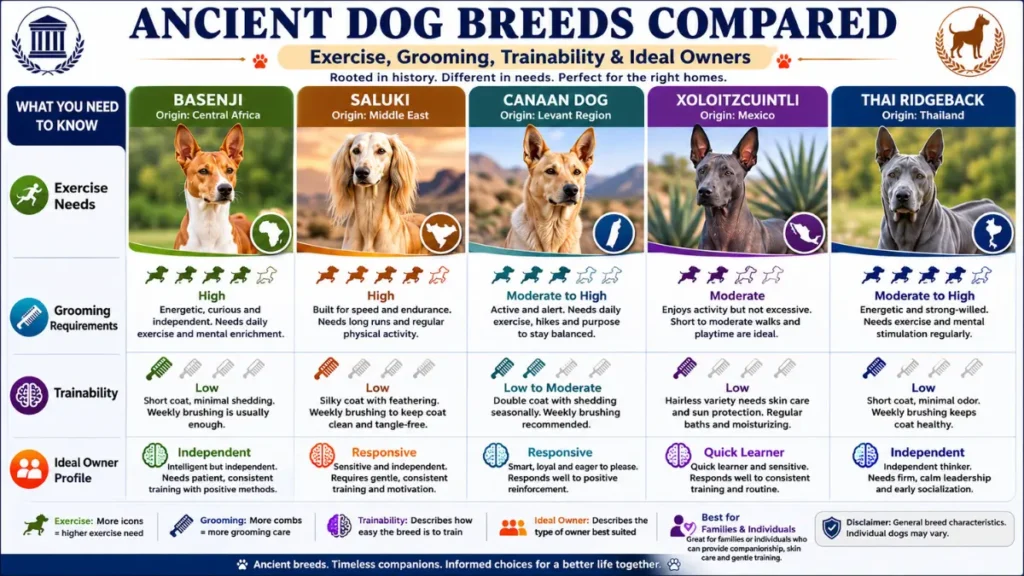
Comparison Table: Which Ancient Breed Fits Your Lifestyle?
Breed Group
Energy Level
Grooming Needs
Training Style
Best For
Sighthounds
High
Low to Moderate
Independent, reward-based
Active owners with secure exercise areas
Arctic Working Breeds
Very High
High
Consistent and structured
Experienced, active households
Guardian Breeds
Moderate to High
Moderate
Early socialization and leadership
Owners familiar with protective breeds
Hairless Breeds
Moderate
Skin care
Positive reinforcement
Families wanting loyal companions
Companion-Oriented Ancient Breeds
Moderate
Moderate
Patient and engaging
Many committed first-time owners
No category is inherently better than another.
The goal is to choose the breed whose natural behavior fits your expectations instead of expecting the dog to change its instincts completely.
Common Myths About Ancient Dog Breeds
Ancient dog breeds are surrounded by fascinating stories, but not all of them are accurate. Separating fact from fiction helps you better understand these remarkable dogs and choose a breed based on evidence rather than internet myths.
Myth
Reality
Ancient breeds have never changed.
Every modern breed has changed over time. Ancient breeds preserve old lineages, not unchanged prehistoric dogs.
The oldest-looking breed must be the oldest.
Appearance alone cannot determine ancestry. Researchers rely on genetics, archaeology, and historical records.
Ancient breeds are part wolf.
Ancient breeds are fully domestic dogs. They are not wolfdogs simply because they have wolf-like features.
Independent dogs are less intelligent.
Many ancient breeds are highly intelligent. They were bred to solve problems on their own rather than wait for constant instructions.
Ancient breeds are impossible to train.
They can be excellent learners when training is consistent, rewarding, and suited to their temperament.
All ancient breeds are aggressive.
Temperament depends on genetics, responsible breeding, early socialization, training, and individual personality—not age of the breed.
Frequently Asked Questions
What is the oldest dog breed in the world?
There is no universally accepted answer. Current evidence suggests that several breeds—including the Saluki, Basenji, Akita, Chow Chow, Shiba Inu, Greenland Dog, Tibetan Mastiff, and Xoloitzcuintli—belong to some of the world’s oldest surviving dog lineages. Each is supported by different combinations of historical, archaeological, and genetic evidence.
What makes a dog breed “ancient”?
A breed is generally considered ancient when it has deep historical roots, long regional continuity, or genetic evidence linking it to early domestic dog lineages. The term doesn’t mean the breed has remained unchanged for thousands of years.
Are ancient dog breeds closer to wolves?
Not in the way many people assume. All domestic dogs share distant ancestors with ancient wolf populations. While some ancient breeds belong to older genetic lineages, they are fully domesticated dogs and should not be confused with wolfdogs.
Which ancient dog breed is best for families?
There isn’t one breed that’s ideal for every household. For active families, breeds like the Samoyed or Siberian Husky may be rewarding if their exercise needs are met. Families looking for a calmer companion may appreciate the Xoloitzcuintli. Experienced owners seeking a protective guardian might prefer an Akita or Tibetan Mastiff. The best choice always depends on your lifestyle, experience, and ability to meet the breed’s needs.
Are ancient dog breeds healthier than modern breeds?
Not necessarily. Some ancient breeds have broad genetic diversity, while others are affected by inherited health conditions that developed through modern breeding. Regular veterinary care, responsible breeding practices, proper nutrition, exercise, and preventive healthcare remain important regardless of a breed’s history.
Which ancient breed is easiest for first-time owners?
No ancient breed is automatically easy. Among the breeds covered in this guide, some first-time owners may find the Samoyed, Xoloitzcuintli, or certain Shiba Inu individuals more manageable than large guardian breeds or high-drive Arctic working dogs. Even then, success depends on choosing a responsible breeder or rescue, investing time in training, and selecting a breed that matches your daily routine
Are all ancient dog breeds rare?
No. Some, such as the Akita, Shiba Inu, Siberian Husky, and Chow Chow, are widely recognized around the world. Others—including the Greenland Dog, New Guinea Singing Dog, and several traditional Indigenous dog populations—remain uncommon outside their native regions.
Key Takeaways
There is no single scientifically proven oldest living dog breed.
Ancient dog breeds are identified through a combination of genetics, archaeology, documented history, and long regional continuity.
Ancient ancestry doesn’t mean a breed has remained unchanged throughout history.
Many ancient breeds still display the instincts that once made them exceptional hunters, guardians, sled dogs, or companions.
Independent thinking is a common trait among ancient breeds, but it should never be mistaken for low intelligence.
Choosing an ancient breed should be based on lifestyle compatibility, not simply on historical significance.
Responsible ownership—including positive training, appropriate exercise, preventive veterinary care, and realistic expectations—is the foundation of a successful relationship with any dog.