
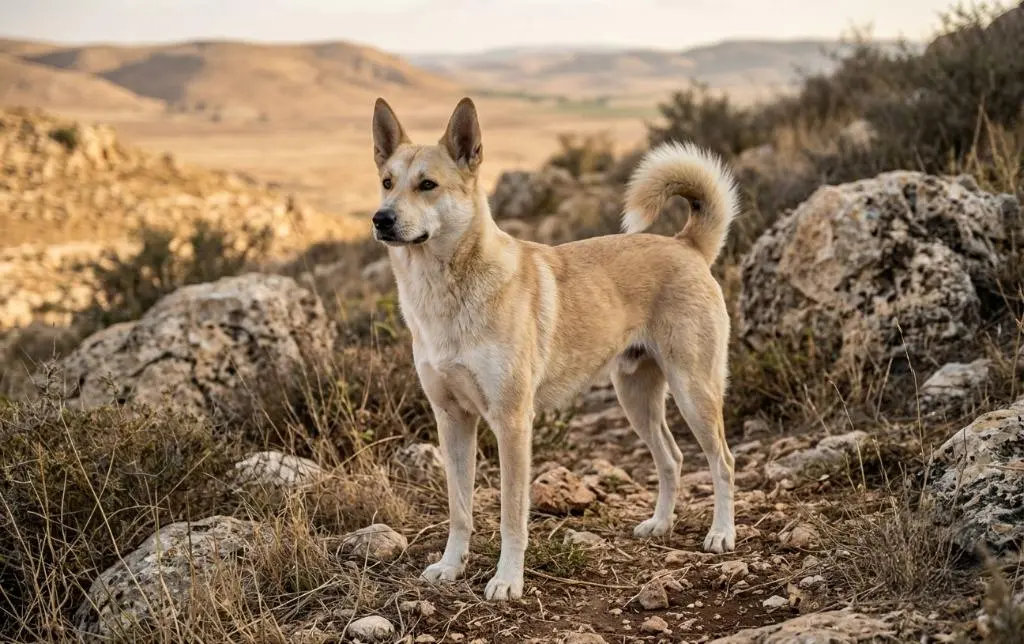
Most dogs tell you what they feel pretty quickly.
The Canaan Dog doesn’t.
Many owners experience the same strange moment during the first few weeks.
You call your dog. It clearly hears you. It looks straight at you.
…Nothing.
No movement. No eager response. Just quiet observation.
That moment frustrates some owners. Experienced primitive-breed handlers usually recognize it immediately.
Because what looks like stubbornness often isn’t stubbornness at all.
The dog is thinking.
And that single behavioral difference explains almost everything about living with a Canaan Dog.
What Is a Canaan Dog?
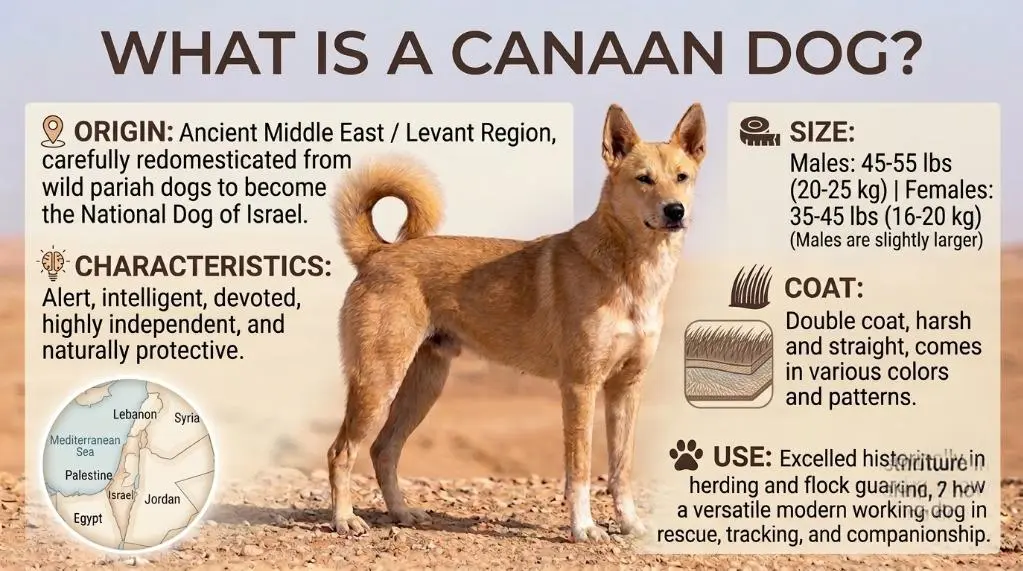
The Canaan Dog is a primitive landrace breed originating in the Middle East, where it developed largely through natural selection rather than intensive human-directed breeding.
That history matters.
Unlike many modern companion breeds selectively shaped for human responsiveness, the Canaan Dog retained strong survival instincts, environmental awareness, and independent decision-making.
Quick breed snapshot:
| Trait | Overview |
|---|---|
| Breed Type | Primitive / Landrace |
| Origin | Middle East |
| Size | Medium |
| Weight | 35–55 lbs |
| Lifespan | 12–15 years |
| Energy Level | Moderate |
| Trainability | Intelligent but independent |
| Shedding | Moderate to heavy (seasonal) |
Expert Insight: Primitive breeds often process the environment before responding to commands. That is a genetic behavioral pattern, not a training defect.
Why Canaan Dogs Feel Different From Most Modern Breeds
This breed doesn’t behave like a typical eager-to-please companion dog.
A Labrador often asks: “What do you want me to do?”
A Canaan Dog often asks: “What is happening around me, and does your request matter right now?”
That difference sounds subtle.
In real life, it changes everything.
You’ll notice it in:
- recall training
- stranger interactions
- barking behavior
- territorial responses
- environmental sensitivity
This breed is constantly assessing.
That makes them exceptionally aware—but not always easy.
Canaan Dog Temperament
The Canaan Dog is best described as:
- Highly alert
- Independent
- Loyal to family
- Reserved with strangers
- Naturally territorial
They usually form strong bonds with their household but rarely offer instant trust to unfamiliar people.
That reserve is often misunderstood.
A cautious Canaan Dog is not automatically aggressive.
In most cases, it is simply evaluating unfamiliar stimuli before deciding how to respond.
Temperament Breakdown
| Trait | Real-World Behavior |
|---|---|
| Family Bond | Strong and loyal |
| Stranger Response | Reserved / cautious |
| Intelligence | High |
| Independence | High |
| Guarding Instinct | Moderate to high |
| Social Style | Selective |
Are Canaan Dogs Good Family Dogs?
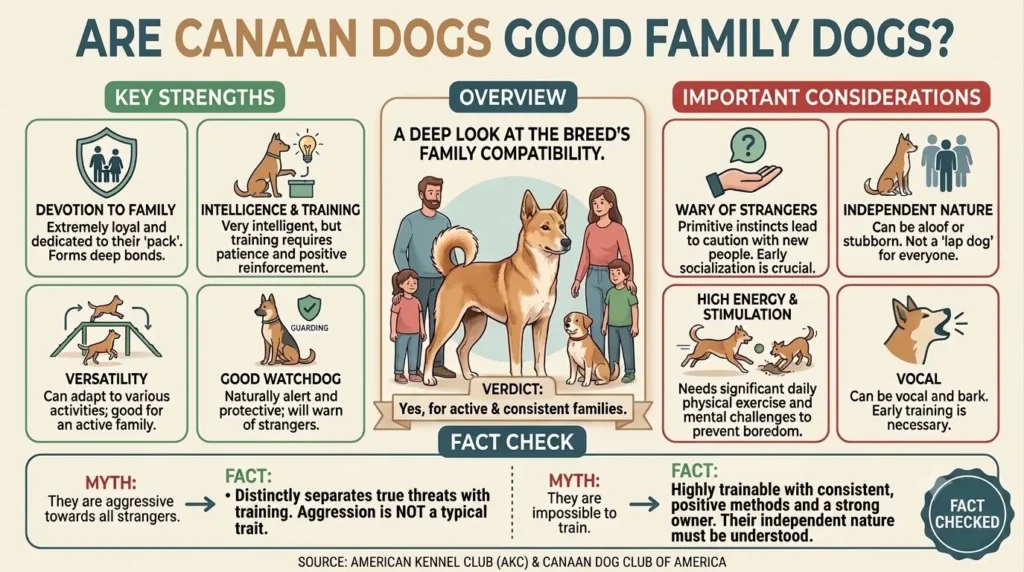
Yes—but not for every household.
They do best in homes with:
- stable routines
- consistent boundaries
- calm leadership
- respectful children
They often struggle in highly chaotic homes with:
- constant visitors
- inconsistent rules
- rough child handling
- noisy unpredictable environments
This breed values predictability.
That doesn’t mean they need silence.
They need clarity.
Are Canaan Dogs Good With Children and Other Pets?
They can be excellent with children when raised and socialized properly.
The keyword is respect.
Canaan Dogs generally prefer children who understand boundaries rather than rough play.
With other pets, outcomes vary.
Factors that matter:
- early exposure
- prey drive level
- individual temperament
- household structure
Some coexist beautifully with cats.
Others maintain strong chase instincts.
Because this is a primitive breed, never assume prey drive is absent.
Training Reality: Why Smart Owners Still Struggle
Here’s what surprises many first-time owners.
Training failure with a Canaan Dog usually has very little to do with intelligence.
In fact, intelligence is rarely the issue.
The real challenge is cooperation under distraction.
In simple terms, your dog may understand the command perfectly and still decide something else deserves more attention.
That’s not uncommon.
What works best in training
- Short sessions (5–10 minutes)
- Clear repetition
- Calm correction
- Immediate reward
- Consistent household rules
Force-heavy training usually backfires.
Pressure often increases resistance.
Trainer Observation: Professional handlers working with primitive breeds often report that Canaan Dogs learn commands fast. Reliability—not comprehension—is usually the harder part.
Puppy Socialization: The Window Many Owners Miss
The early puppy period shapes adult behavior more than most owners realize.
The most sensitive window is roughly 8–16 weeks.
During this period, puppies learn how to interpret:
- strangers
- sounds
- movement
- environments
- novelty
One common pattern seen in primitive breeds is delayed behavioral fallout.
An under-socialized puppy may seem fine early on.
Then adolescence hits.
Suddenly:
- alert barking increases
- stranger suspicion rises
- territorial behavior becomes obvious
That delayed shift catches many owners off guard.
Why Canaan Dogs Bark
Canaan Dogs usually do not bark without reason.
Their barking tends to be trigger-based.
Common triggers include:
- movement near territory
- unfamiliar sounds
- visitor arrival
- environmental changes
Think of their barking as a monitoring system.
They are reporting.
Not merely vocalizing.
That distinction matters when training barking behavior.
Exercise Needs: Physical Exercise Alone Is Not Enough
This is a common owner mistake.
A long walk does not automatically satisfy a Canaan Dog.
Why?
Because this breed often needs mental workload, not just physical fatigue.
Helpful activities include:
- scent games
- structured exploration
- obedience drills
- problem-solving tasks
- environmental enrichment
Without enough mental stimulation, owners often notice:
- restlessness
- scanning behavior
- repetitive alert barking
- increased reactivity
A tired body is useful.
A mentally satisfied dog is better.
Do Canaan Dogs Shed?
Yes.
Canaan Dogs are not hypoallergenic and they do shed.
Most shedding is moderate throughout the year, with heavier seasonal coat blow during climate transitions.
Typical grooming needs:
- Weekly brushing during normal months
- More frequent brushing during shedding seasons
- Nail trimming
- Ear checks
- Basic dental care
Their coat is naturally weather-resistant and relatively low maintenance compared with many other double-coated breeds.
Nutrition: What Should a Canaan Dog Eat?
Despite their primitive ancestry, Canaan Dogs do not require exotic feeding systems.
They need what every healthy dog needs:
A nutritionally complete, balanced diet.
According to WSAVA-aligned nutrition principles, diet quality matters more than trendy feeding ideology.
Focus on:
- adequate protein
- calorie control
- body condition maintenance
- consistent feeding schedule
Good protein sources
- Chicken
- Turkey
- Lamb
- Fish
- Beef (if tolerated)
Supportive whole-food additions may include:
- pumpkin
- carrots
- omega-3-rich fish oil
Consistency matters more than constant variety.
Common Feeding Mistakes
Owners commonly make these mistakes:
Overfeeding treats
Training rewards add calories fast.
Frequent diet switching
Constant changes may trigger GI upset.
Misreading lean structure
Primitive breeds often look leaner than modern companion breeds.
That doesn’t automatically mean underfeeding.
Ignoring body condition score
Weight alone can mislead.
A lean but muscular dog may be perfectly healthy.
Pro Tip: Use Body Condition Score (BCS), not scale weight alone, to assess feeding success.
Common Canaan Dog Health Problems
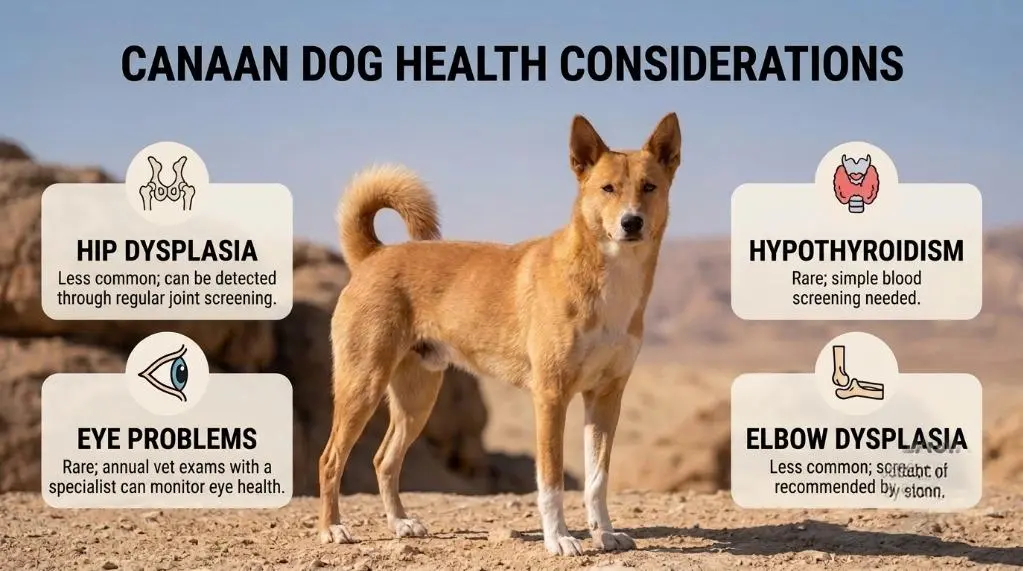
For a primitive breed, the Canaan Dog is generally quite durable.
That doesn’t mean health issues are nonexistent—only less exaggerated than in many heavily modified modern breeds.
Most well-bred dogs remain structurally sound, but responsible owners still monitor for inherited concerns.
Health issues to watch
- Hip dysplasia
- Progressive retinal issues
- Occasional eye disorders
- Rare neurological conditions
Responsible breeders often perform screening for:
- hip quality
- orthopedic soundness
- ophthalmic health
Before buying a puppy, ask for health testing documentation whenever possible.
How Long Do Canaan Dogs Live?
The average lifespan is 12–15 years.
Longevity depends heavily on:
- genetics
- weight management
- exercise quality
- preventive veterinary care
Lean body condition and consistent preventive care often support better long-term mobility.
Canaan Dog Price and Adoption Reality in the United States
Because the breed is relatively rare in the U.S., availability is limited.
Finding a reputable breeder may take time.
Typical breeder price
- Pet-quality puppy: $1,200–$2,500+
- Show lines: $2,500–$4,000+
Price depends on:
- pedigree
- health testing
- breeder reputation
- regional availability
Adoption
Rescue adoption is possible but uncommon.
Potential owners should expect:
- waitlists
- travel requirements
- limited regional availability
This is not a breed most people find quickly.
Canaan Dog vs Other Primitive Breeds
Comparisons help reveal this breed’s unique behavioral profile.
| Trait | Canaan Dog | Basenji | Carolina Dog |
|---|---|---|---|
| Origin | Middle East | Central Africa | U.S. |
| Social Style | Selective | Independent | Reserved |
| Barking | Moderate–High | Low | Moderate |
| Territorial Instinct | High | Moderate | Moderate |
| Trainability | Situational | Independent | Moderate |
Canaan Dog vs Basenji
The Basenji often appears more escape-driven and less vocal.
The Canaan Dog usually shows stronger territorial monitoring and watchdog behavior.
Canaan Dog vs Carolina Dog
The Carolina Dog shares primitive ancestry but often displays softer territorial expression.
The Canaan Dog generally remains more suspicious and alert around environmental change.
Common Myths About Canaan Dogs
“They are aggressive”
Usually false.
Most are cautious, not unstable.
“They are stubborn”
Oversimplified.
Many are independent decision-makers.
“They can eat anything natural”
Incorrect.
Nutritional balance still matters.
“Primitive means easy”
Definitely not.
Primitive often means behaviorally complex.
Is a Canaan Dog Right for You?
This breed may suit you if you want:
- a highly observant dog
- independent intelligence
- strong loyalty
- natural watchdog instincts
It may not suit you if you want:
- instant obedience
- highly social behavior
- easy first-time ownership
- low-effort training
Be honest with yourself here.
That matters more than admiration for the breed.
Final Field Insight
The easiest way to misunderstand a Canaan Dog is to compare it with modern companion breeds.
That comparison falls apart quickly.
This breed doesn’t respond well to chaos, inconsistent leadership, or constant pressure.
Give it clarity, routine, and fair boundaries, though, and something interesting happens.
You stop seeing “difficult behavior.”
You start seeing intelligence expressed differently.
That’s really the heart of this breed.
A Canaan Dog is not trying to challenge you every day.
It is constantly reading its environment and deciding what deserves attention.
For the right owner, that awareness feels remarkable.
For the wrong owner, it feels exhausting.
And that may be the simplest way to decide whether this breed belongs in your life.
Frequently Asked Questions
1- Are Canaan Dogs aggressive?
No. Most Canaan Dogs are cautious and highly alert, not naturally aggressive. They tend to watch strangers carefully before relaxing. Poor socialization or chronic stress can make defensive behavior more likely.
2- Are Canaan Dogs good for first-time owners?
Usually not. This breed can be challenging for first-time owners because it combines high intelligence with strong independence. People expecting easy obedience often struggle.
3- Why does my Canaan Dog ignore commands?
Usually because it is evaluating something else. A Canaan Dog often understands the command but may prioritize environmental stimuli first. That independent decision-making is common in primitive breeds.
4- Are Canaan Dogs smart?
Yes—very smart. Their intelligence just looks different from eager-to-please breeds. Instead of automatic compliance, they often analyze situations and make independent choices
Do Canaan Dogs get along with cats?
Some do very well, especially if raised with cats from puppyhood. Others may show prey-drive behavior. Early socialization makes a big difference.