
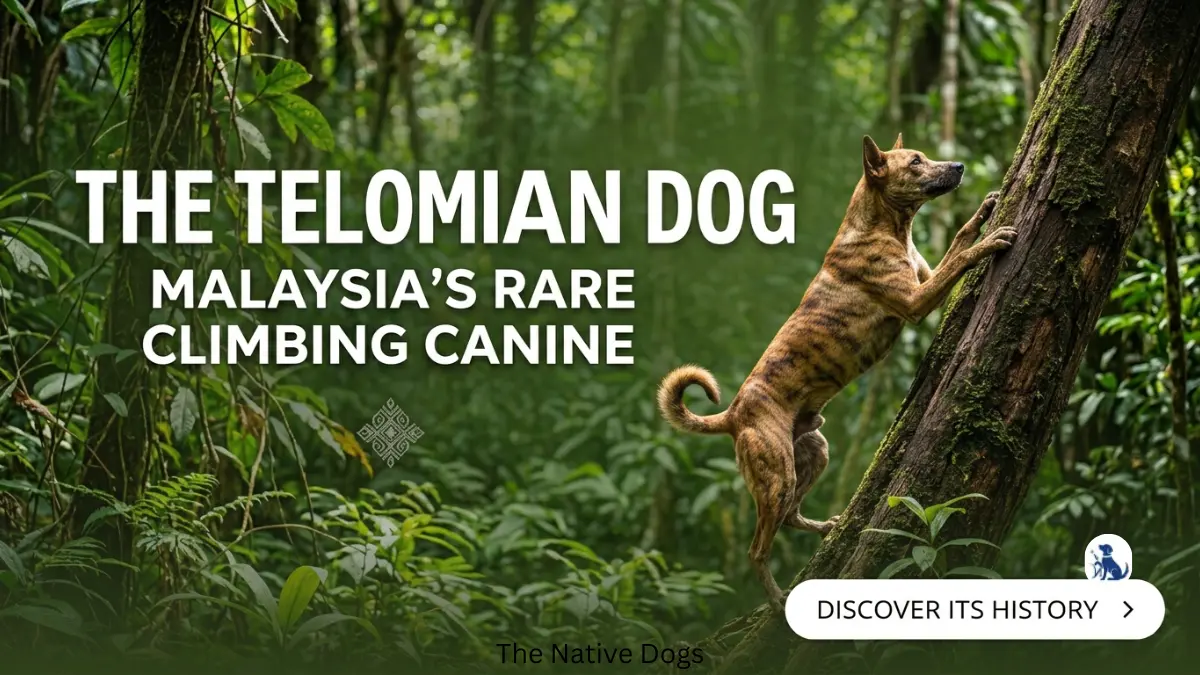
Most dogs run. Some jump. Very few climb.
The Telomian Dog, often called the Malaysian Climbing Dog, became famous because of one striking image: a small, agile dog climbing steep notched ladders into elevated stilt houses deep in the Malaysian rainforest. That image helped build the Telomian’s legend, but the ladder story is only the surface.
What makes the Telomian remarkable is not simply its agility; it is what this dog may represent in canine evolution. Unlike most modern breeds, the Telomian was not originally shaped by kennel clubs, show-ring preferences, or strict breeding standards.
Its ancestors were shaped by environmental pressure—heat, parasites, predators, food scarcity, and daily survival alongside indigenous humans living in one of the world’s most challenging ecosystems. That distinction changes everything.
Calling the Telomian merely a rare dog misses why researchers care about it. Its real significance lies in what it may preserve from early dog evolution—behavioral and biological traits that many modern breeds no longer carry. For canine geneticists, evolutionary anthropologists, and native dog conservationists, the Telomian is one of Southeast Asia’s most fascinating dogs.
What Is a Telomian?
The Telomian is a rare dog historically associated with the Telom River region of Peninsular Malaysia, particularly among certain Orang Asli communities. It is best known by another name: the Malaysian Climbing Dog.
Before going further, one clarification matters: the Telomian should not automatically be understood as a standardized modern breed like the German Shepherd or the Golden Retriever. That is not just a technical distinction; it changes how we interpret the entire Telomian story.
Is the Telomian a Breed or a Landrace?
This is one of the most misunderstood parts of Telomian history. The original dogs from the Telom River region were likely closer to a native landrace population than a formal breed. A landrace develops organically through environmental adaptation, geographic isolation, functional utility, and relatively open breeding.
Modern purebred dogs are different. They are deliberately standardized by humans around strict physical and behavioral criteria. The original Telomian population appears to have been shaped by performance, not appearance. That helps explain why scientists find these dogs so interesting; landrace populations often preserve old canine traits that disappear under intensive selective breeding.
Why Is It Called the Malaysian Climbing Dog?

The nickname comes from traditional Orang Asli architecture. Many forest dwellings were built on stilts above the ground to reduce exposure to seasonal flooding, venomous snakes, insects, and apex predators. Access to these homes often required climbing steep ladders or carved logs with narrow footholds.
Anthropologist Dr. Orville Elliot documented dogs capable of navigating these structures during fieldwork in the 1960s. This is where many articles become careless by repeating the climbing claim as if every Telomian naturally climbs ladders. The evidence is narrower than that.
Historical accounts are compelling, but they remain field observations rather than controlled behavioral or biomechanical studies. There is currently no modern peer-reviewed research directly measuring Telomian climbing performance.
The most evidence-based conclusion is more modest: some original Telomian-type dogs likely possessed unusual balance, coordination, and body awareness that made vertical movement easier than in typical domestic dogs. That is very different from saying the breed has a special “climbing gene.”
Discovery and Western Documentation
The Telomian entered Western canine literature largely through the work of Dr. Orville Elliot. During anthropological fieldwork in Malaysia in the 1960s, Elliot observed village dogs near the Telom River that differed noticeably from typical domestic dogs.
He reported several unusual traits:
- Exceptional agility
- Intense environmental awareness
- Strong prey responsiveness
- Independent problem solving
- Uncommon vocal patterns
Several of these dogs were later exported to the United States. This preserved global awareness of the Telomian, but it also created the biggest scientific problem surrounding the breed. The moment those dogs left Malaysia, the scientific picture became much less straightforward because the exported founder population was extremely small.
From a genetics perspective, a tiny founder group cannot represent the full diversity of an original landrace population. This issue sits at the center of every serious discussion about modern Telomians.
Has the Original Telomian Already Been Lost?
This is the question most breed articles avoid, yet it is the most important one. Not every dog labeled “Telomian” today necessarily represents the original Orang Asli dog population documented by Elliot. There are three major reasons for this authenticity debate.
Small Founder Population
Western Telomian dog lines descend from a very limited number of imported dogs. That creates strong founder effects, meaning rare genetic variants can disappear quickly in small populations.
Limited Historical Records
Early breeding documentation was incomplete. Without comprehensive registries, accurate lineage reconstruction is exceptionally difficult.
Admixture Over Time
Both native Malaysian dogs and Western lines may have interbred with other domestic dogs. This creates a difficult question: Are modern Telomians descendants of a true native landrace, admixed village dogs retaining ancestral traits, or reconstructed lines based partly on historical descriptions?
Right now, no large genomic study answers this conclusively. That uncertainty should not be hidden; it is central to understanding the true nature of the Telomian.
Evolutionary History and Genetic Importance
To understand why scientists care about the Telomian, we need to zoom out. Modern canine genetics increasingly shows that village dogs and free-breeding native dog populations contain genetic diversity missing in modern pedigree breeds.
Research by Dr. Adam Boyko and colleagues, including the landmark 2009 PNAS village dog study, demonstrated that free-breeding dog populations often preserve ancient diversity erased by selective breeding. This changed canine genetics by proving that modern purebreds are often poor models for ancestral canine diversity.
Research by Dr. Elaine Ostrander and the National Human Genome Research Institute has also shown how intense selective breeding creates severe genetic bottlenecks. Where does the Telomian fit? There is no published large-scale genomic evidence proving the Telomian forms a distinct ancient lineage. That point matters because many articles overstate this.
What we can say with confidence is more specific. Telomians display several traits often associated with low-selection dog populations, including:
- Autonomous decision making
- Strong environmental scanning
- High prey responsiveness
- Low handler dependence
That makes them scientifically important even without definitive genomic classification.
The Orang Asli Partnership and Functional Evolution
Certain Orang Asli communities did not keep dogs primarily for companionship; they kept dogs that improved survival. In dense rainforest ecosystems, dogs provided practical advantages.
They helped detect:
- Snakes
- Wild boar
- Intruders
- Rodent movement
- Subtle disturbances in vegetation
Over generations, useful dogs were favored. Dogs with poor awareness, low agility, or weak survival instincts were less likely to reproduce. This closely resembles early human-dog partnerships from prehistory. Before dogs became specialized companions, they were survival collaborators. The Telomian may preserve more of that original relationship than many modern breeds.
Physical Characteristics of the Telomian
The Telomian dog has no universally accepted breed standard because major registries like the American Kennel Club do not recognize it. Still, most descriptions of reported individuals are broadly consistent.
| Trait | Typical Range |
| Height | 15–20 inches |
| Weight | 18–35 lbs |
| Body | Lean, athletic |
| Coat | Short to medium |
| Ears | Semi-erect to erect |
| Tail | Curved or sickle |
The overall structure emphasizes mobility and balance. The body appears optimized for functional athleticism rather than force, featuring no exaggerated anatomy or extreme proportions.
Blue-Black Tongue: Real or Myth?
Some historical descriptions mention dark tongue pigmentation, a claim repeated often online. However, the evidence remains weak. While some lines may show localized dark spots, there is no strong evidence that a solid blue-black tongue is a defining Telomian trait. Treat this as anecdotal rather than diagnostic.
Climbing Adaptations and Biomechanics
The Telomian’s climbing reputation likely comes from multiple biomechanical advantages working together rather than one specific physical anomaly.
Exceptional Proprioception
Proprioception is body-position awareness in space. Dogs with strong proprioception navigate unstable surfaces more precisely. Telomians appear especially capable in this area, calculating their footing on narrow structures instantly.
Efficient Hindquarter Power
Strong rear drive improves explosive movement and vertical propulsion, which naturally supports climbing mechanics.
Precise Paw Placement
Owners often report unusually careful paw placement when navigating difficult surfaces. Some websites call this “prehensile paws,” but that is biologically inaccurate. Telomians do not possess primate-like grasping limbs; they simply use standard canine anatomy with unusually refined coordination.
The Telomian Dog Mind: Behavioral Architecture
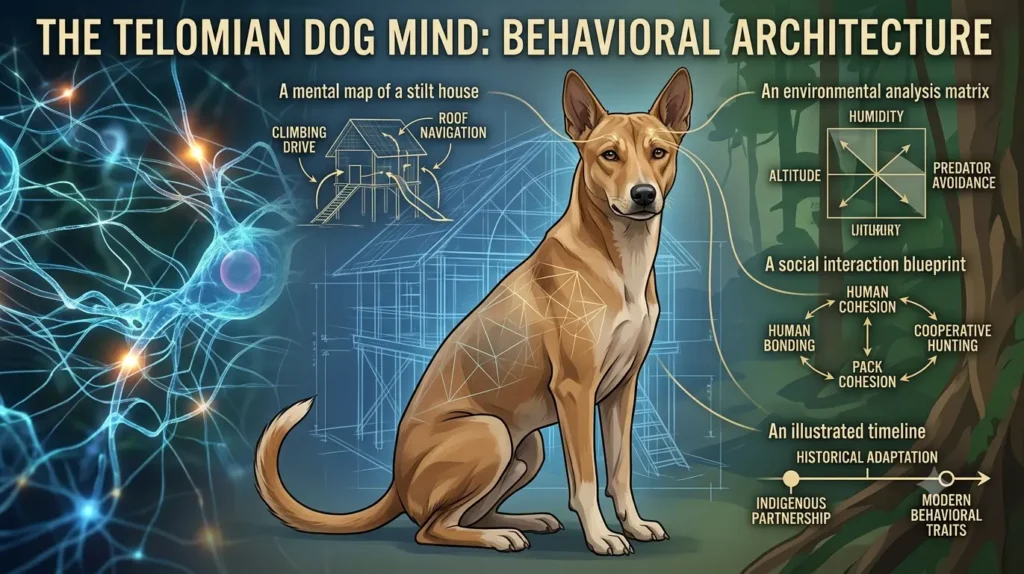
The Telomian’s most unusual trait may be cognitive rather than physical. This dog processes the world through a survival framework that differs completely from highly handler-focused companion breeds.
Autonomous Threat Assessment
Many companion breeds immediately seek human guidance or reassurance under uncertainty. Telomians do not. They assess risk independently. A Telomian may stop, scan, and refuse movement if something feels unsafe. This is often mistaken for stubbornness, but it actually reflects autonomous risk evaluation.
Constant Environmental Monitoring
These dogs notice changes rapidly. A new scent, a new sound, or a subtle movement triggers immediate focus. That permanent vigilance reflects adaptation to high-risk ecosystems.
Practical Intelligence and Training Realities
This is not obedience intelligence; it is context intelligence. Telomians learn environmental consequences faster than repetitive command drills. They excel at remembering where prey appeared, where escape routes exist, which surfaces are unstable, and where risk occurred.
Because of this unique learning profile, training a Telomian can frustrate owners used to highly handler-focused breeds like Border Collies. Those breeds were shaped to repeatedly work under direct human instruction; the Telomian was not. Many Telomians learn quickly but show remarkably low tolerance for repetitive drills.
The dog often understands perfectly; it simply does not see endless repetition as rewarding or meaningful. Effective Telomian training relies on short sessions, novelty, high-value rewards, and trust building. Harsh corrections will quickly reduce cooperation.
Telomian Temperament
The Telomian temperament is best described as observant, loyal, cautious, highly intelligent, and self-directed. This is not a dog built around constant human approval. Trust must be earned over time. Once bonded, attachment can be deep, but reserve with strangers is common. Historically, this caution improved survival against threats.
Vocal Communication
Some Malaysian Climbing Dog produce high-pitched chirps, yodel-like sounds, chortles, and short alarm barks. This often leads to comparisons with the Basenji. They are not barkless; they simply communicate through a completely different vocal repertoire.
Hunting Instinct and Survival Drive
The Telomian retains strong predatory behavior. Fast movement can trigger immediate pursuit, with common triggers including rodents, birds, reptiles, and rabbits. This matters for ownership because outdoor recall can be challenging. The issue is rarely a lack of comprehension; it is thousands of years of survival instinct overpowering modern training.
Health and Lifespan — What Science Actually Supports
The reported Telomian lifespan is roughly 12–16 years. However, that estimate should be treated cautiously. Health analysis is difficult because Telomians lack large veterinary datasets.
Unlike popular breeds with registry-backed screening programs, Telomians have not been studied at population scale, meaning health claims require caution. Healthy looking individuals do not always mean a genetically secure population.
The original Malaysian population likely benefited from strong natural selection against structural weakness. Conversely, modern captive populations face different risks due to their small founder stock, including reduced genetic diversity, founder-effect disorders, and hidden recessive conditions. Long-term health tracking is still needed.
Reproductive Traits
Historical reports suggest certain Telomian lines may show monoestrus tendencies—approximately one heat cycle per year—resembling wolves, dingoes, and some basal canids. Evidence remains limited and inconsistent in captive environments. The safest conclusion is that annual cycling has been reported, but it is not proven as a universal Telomian trait.
Can a Telomian Adapt to Modern Life?
This is less about obedience and more about environmental compatibility. The Telomian evolved in environments filled with complexity, movement, and meaningful work. Modern suburban life often provides the opposite: predictable routines, reduced environmental challenge, and limited sensory complexity.
That mismatch can create severe behavioral frustration. A Telomian usually thrives with owners who understand that mental stimulation matters as much as physical exercise. Long walks alone are rarely enough for a dog built to scan, assess, and solve problems.
Conservation Threats
The greatest threat to the Telomian may not be extinction in the traditional sense; it may be genetic dilution. Major threats include habitat fragmentation, modernization, disease introduction, and interbreeding with free-roaming village dogs. This is how native dog populations often disappear quietly—the animals may still exist physically while their ancestral genetic identity has already been erased.
Why Conserving the Telomian Matters
The value of conserving the Telomian goes beyond preserving a rare dog; it is about protecting biological information.
Research groups studying native dog populations, including teams at the Cornell University College of Veterinary Medicine and the National Human Genome Research Institute, show that free-breeding dogs preserve genetic diversity often lost in closed breeding systems. That diversity helps scientists study domestication, migration patterns, disease resistance, and adaptive evolution. Once lost, that information cannot be recreated.
Telomian vs Dingo vs New Guinea Singing Dog
| Trait | Telomian | Dingo | New Guinea Singing Dog |
| Region | Malaysia | Australia | New Guinea |
| Classification | Native landrace / debated | Wild canid population | Primitive lineage |
| Human Bond | Moderate–Strong | Low | Variable |
| Vocalization | Variable (Chirps/Yodels) | Howl | Distinct Harmonic calls |
| Prey Drive | High | Very High | High |
This comparison reveals an important distinction. The Telomian occupies a unique middle ground: it retains more autonomous survival behavior than most domestic breeds, yet remains far more socially bonded to humans than wild-adapted canids like the Dingo.
Common Myths About the Telomian
“Telomians are wild animals”
False. They are domestic dogs (Canis lupus familiaris). Their unique behavioral traits are a result of primitive trait retention, not wild ancestry.
“They are part cat”
False. Climbing ability comes from exceptional biomechanics, balance, and coordination, not feline ancestry.
“They cannot be house-trained”
False. They can be house-trained, though they often mature differently and require more patience than highly biddable companion breeds.
Final Thoughts
The image that made the Telomian famous was simple: a dog climbing a steep ladder into a stilt house above the rainforest floor. Whether every historical Telomian actually performed that feat matters less than what the image represents: adaptation, intelligence, and survival.
The Telomian reminds us that dogs were not always shaped for show rings, trends, or aesthetics. Many were shaped by harder realities—scarcity, predators, disease, and the daily need to make independent decisions. That is what makes the Telomian extraordinary.
It resists easy classification, and that may be exactly the point. Some native dogs refuse to fit neatly into kennel club categories because they carry older biological stories written by environment, function, and survival. For canine science, the Telomian remains a living clue to the ancient dog.
Scientific References
- Boyko AR et al. (2009). Complex population structure in African village dogs and its implications for inferring dog domestication history. PNAS.
- Research on canine genomics conducted by the National Human Genome Research Institute.
- Research on global village dog genetics by the Cornell University College of Veterinary Medicine.
- Field observations and documentation on Telomian dogs by Dr. Orville Elliot.
- Primitive canine behavioral studies by Dr. I. Lehr Brisbin Jr.
FAQ
What is a Malaysian Climbing Dog?
The Malaysian Climbing Dog is the common nickname for the Telomian, a rare primitive landrace dog native to the rainforests of Peninsular Malaysia. They earned this name after being documented climbing the steep, notched log ladders used to access the elevated stilt houses of the indigenous Orang Asli people.
Can Telomian dogs climb trees?
Yes, some individual Telomians can climb trees and ladders due to a combination of exceptional balance, strong hindquarter drive, and precise paw coordination. This climbing ability is a functional behavioral adaptation to their native environment rather than a physical deformity or a feline genetic trait.
Is the Telomian dog a recognized breed?
No, the Telomian is not recognized as an official breed by major global dog registries like the American Kennel Club (AKC). It is classified by canine geneticists and researchers as an indigenous landrace population shaped by geographic isolation and natural selection rather than strict human show standards.
Do Telomian dogs make good family pets?
Telomians generally do not make good pets for the average household. They possess intense predatory drives, independent danger-assessment skills, and a low tolerance for repetitive training. While they can bond deeply with a family, they require specialized mental enrichment and owners experienced with primitive canine behavior.
1- How many Telomian dogs are left?
A- There is no exact count. Most live in remote Malaysian rainforests, while the captive population in the West is critically small and rare.
2- Why do Telomians yodel instead of bark?
A- As a primitive landrace, they retain ancient vocal traits. Like Basenjis, they use natural chirps and yodels due to evolutionary isolation.
3- Do Telomian dogs have health issues?
A- Wild populations are naturally hardy. However, captive lines outside Malaysia face risks of genetic issues due to a very small initial gene pool.