
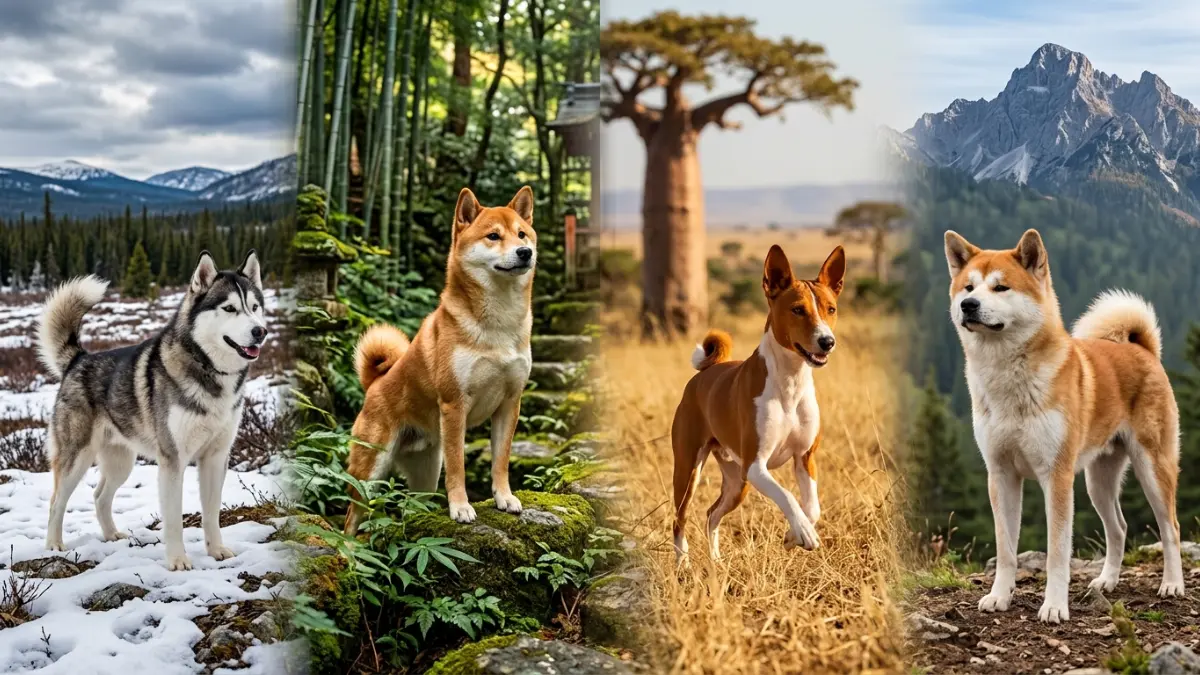
What Are Primitive Dog Breeds?
Spend a few minutes around a primitive dog breed, and you’ll notice something different.
The way they watch.
The way they pause before reacting.
The way they seem to think for themselves.
Primitive dog breeds are ancient domestic dogs that retain more ancestral traits than most modern breeds. They are fully domesticated, but genetically and behaviorally, many remain closer to early canine lineages.
That does not mean they are wild dogs or wolf hybrids.
It means these breeds went through less intense human-directed breeding, allowing more instinct-driven traits to remain intact over time.
This is exactly why so many dog enthusiasts are drawn to them. Primitive breeds often feel raw, intelligent, and strikingly authentic. But those same qualities can also make them difficult for the average owner.
This guide explains what primitive dog breeds are, how they evolved, why they behave differently from modern dogs, and which primitive breeds fit different lifestyles.
Why Are They Called Primitive?
The word primitive causes confusion because it sounds outdated or inferior.
In canine science, that is not what it means.
Primitive refers to dog breeds that stayed closer—genetically and behaviorally—to earlier domesticated dogs.
In practical terms, these breeds experienced less artificial modification.
Modern dog breeds were heavily shaped by humans for specific purposes:
- companionship
- hunting specialization
- herding
- guarding
- appearance
Primitive breeds followed a different path.
They were shaped more by:
- environment
- survival pressure
- natural selection
- functional adaptation
That difference changed behavior.
Most primitive breeds show:
- stronger independence
- sharper environmental awareness
- intense prey drive
- selective bonding
- lower desire to please humans
A Golden Retriever usually asks:
“What do you want me to do?”
A primitive breed often asks:
“Why should I do that?”
That mindset explains a lot about ownership.
What Science Says About Primitive Dog Genetics
Modern canine genomics has changed how researchers understand dog evolution.
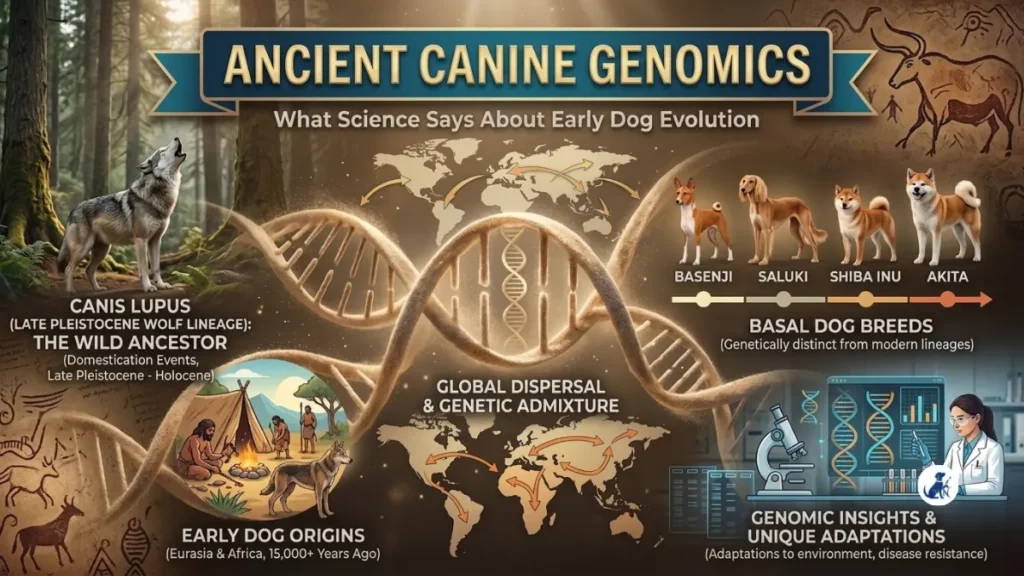
Research indexed in PubMed suggests several primitive breeds diverged earlier in the domestic dog family tree, preserving more ancestral genetic markers than many modern breeds.
Organizations like AKC and veterinary references such as Merck Veterinary Manual also recognize that certain breeds display behavior patterns strongly associated with early domestication.
Here’s the important part most people misunderstand:
Primitive does not mean “part wolf.”
This myth spreads constantly online.
Primitive breeds are fully domesticated dogs.
Their lineage simply experienced less aggressive artificial selection compared with many modern breeds.
Think of it like this:
A modern breed may represent centuries of human design.
A primitive breed often reflects thousands of years of environmental adaptation.
That distinction matters.
Deep Genetics of Primitive Dog Breeds
All domestic dogs trace back to ancient wolf populations, but not every breed moved equally far from those origins.
Primitive breeds are often considered basal lineages, meaning they branch closer to early domesticated dogs on the canine family tree.
That makes them especially important in evolutionary research.
What genetic science suggests
Current canine research indicates:
- Dog domestication likely began around 15,000–30,000 years ago
- Early proto-dogs gradually adapted to human settlements
- Some canine populations remained geographically isolated
- Isolation reduced outside breeding influence
Those isolated populations preserved more ancestral characteristics.
That helps explain why breeds like Basenji, Shiba Inu, and Carolina Dog attract so much scientific interest.
Lower artificial selection pressure
Modern breeds are often shaped around strict breed standards.
Humans selected for:
- coat type
- skull shape
- body size
- movement style
- predictable temperament
Primitive breeds experienced much less of that.
Instead of appearance, survival mattered more.
A dog with poor awareness or weak instincts would struggle in harsh environments.
Nature filtered for function.
Humans influenced less.
That led to dogs that often feel more balanced—but also less predictable.
Preservation of ancestral behavioral traits
Behavior is complex.
It is not controlled by a single gene but by many interacting biological systems affecting:
- prey drive
- fear response
- impulse control
- social bonding
- environmental sensitivity
Primitive breeds often show stronger raw expression of these traits.
That is why owners commonly describe them as:
- intense
- observant
- stubborn
- brilliant
- unpredictable
Interestingly, once you understand their motivations, they become far less mysterious.
They are not random.
They simply think differently.
Genetic stability through isolation
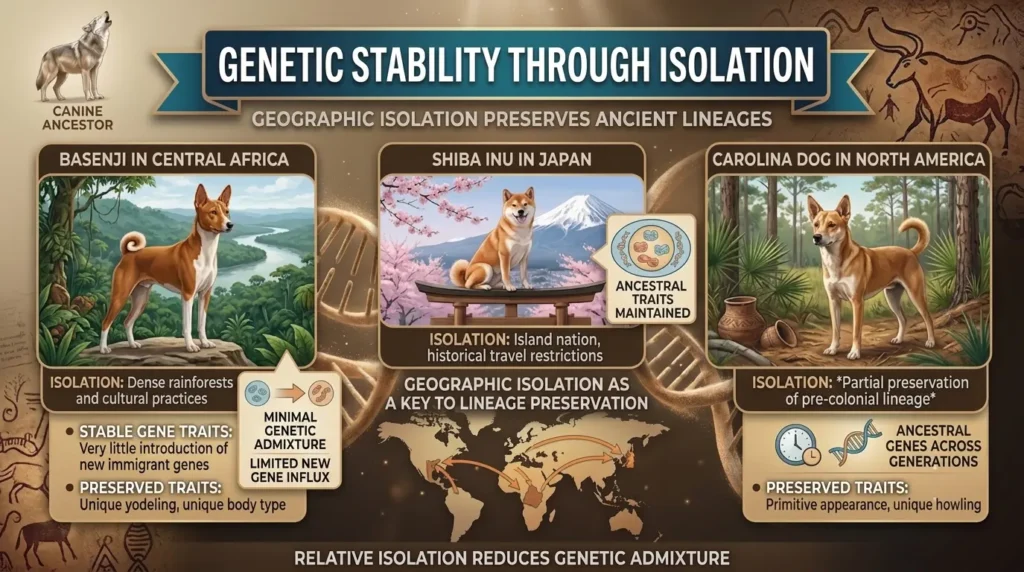
Geographic isolation plays a major role in preserving lineage.
When a population develops in relative isolation, its gene pool changes more slowly.
That preserves ancestral traits across generations.
Examples include:
- Basenji in Central Africa
- Shiba Inu in Japan
- Carolina Dog in North America
These breeds act almost like living windows into earlier canine evolution.
Regional Evolution of Primitive Dog Breeds
Primitive dogs did not emerge in one location.
They evolved independently across different regions, often under similar survival pressures.
What’s fascinating is how many developed similar traits despite living continents apart.
That suggests natural selection repeatedly favored the same survival behaviors.
Asia: Mountain and Forest Survival
Breeds such as:
- Shiba Inu
- Akita
developed in rugged environments where hunting efficiency was essential.
These dogs needed to:
- track prey
- navigate difficult terrain
- react quickly
- make decisions without constant human guidance
Over generations, independence became an advantage.
That trait remains deeply visible today.
Africa: Heat-Adapted Silent Hunters
The Basenji developed in hot African environments where stealth offered survival benefits.
This breed became famous for its unusual vocalization.
Instead of traditional barking, Basenjis produce a distinctive yodel-like sound.
But the vocal trait is only part of the story.
Basenjis also evolved for:
- focus
- speed
- agility
- low-noise pursuit
These are highly efficient hunting traits.
Even modern Basenjis often retain that intense mental sharpness.
Related reading: primitive dog diet → /primitive-dog-diet/
North America: Landrace Survival Adaptation
The Carolina Dog—sometimes called the American Dingo—developed through semi-feral survival patterns.
Unlike heavily standardized breeds, Carolina Dogs evolved with limited human intervention.
Their survival depended on:
- pack awareness
- environmental scanning
- caution
- resource efficiency
Even in domestic homes, many still show remarkable situational awareness.
Owners often notice how quickly they detect small environmental changes.
Related reading: Carolina Dog profile → /carolina-dog-profile/
Southeast Asia: Jungle Guardians
The Thai Ridgeback developed in environments where self-reliance was essential.
This breed evolved strong instincts for:
- territory defense
- rapid movement
- threat detection
- independent decision-making
That combination creates a highly capable dog.
It also creates a challenging one.
This is rarely a beginner-friendly breed.
Common Primitive Dog Traits
Spend enough time around primitive breeds and patterns become obvious.
Strong Independence
They prefer evaluating situations before responding.
To inexperienced owners, this can look like stubbornness.
Often, it is intelligence expressed through decision-making.
High Prey Drive
Fast movement can trigger immediate chase behavior.
That includes:
- squirrels
- rabbits
- cats
- small wildlife
This is one reason reliable off-leash control can be difficult.
Exceptional Environmental Awareness
Primitive dogs notice everything.
A new smell.
A subtle sound.
A body-language shift.
They miss very little.
This constant scanning is one of their defining traits.
Selective Social Bonding
Primitive breeds usually do not offer instant affection to everyone they meet.
Trust tends to be earned, not automatically given.
Once bonded, however, loyalty can be incredibly deep.
Behavioral Psychology of Primitive Dogs
Primitive dogs operate on a very different psychological framework from most modern companion breeds.
This is where many owners get surprised.
These dogs are not necessarily harder.
They simply process decisions differently.
Instinct-First Decision Making
Rather than responding automatically, primitive dogs often run a quick internal calculation:
- Is this safe?
- Is this useful?
- Is this worth the reward?
- Does this benefit me?
That mental filtering changes everything about training.
Independence as Survival Intelligence
People often mistake independence for low trainability or low intelligence.
That is backward.
In many cases, primitive breeds show extremely high adaptive intelligence—the ability to assess situations and make autonomous decisions.
They excel at:
- reading environments
- evaluating risk
- choosing actions independently
These are not mindless dogs.
They are thinkers.
| Breed | Energy Level | Independence | Family Friendly | Trainability | Prey Drive |
|---|---|---|---|---|---|
| Basenji | High | Very High | Medium | Medium-Low | Very High |
| Shiba Inu | High | High | Medium | Medium | High |
| Akita | Medium-High | High | Medium | Medium | Medium-High |
| Carolina Dog | Medium | High | Medium-High | Medium | Medium |
| Thai Ridgeback | High | Very High | Medium-Low | Medium-Low | High |
This table highlights something important: not all primitive breeds are equally difficult.
Some are challenging but manageable. Others demand serious experience.
Major Primitive Dog Breeds List
Basenji
The Basenji is often called the “barkless dog,” though that nickname is only partly true.
Basenjis do vocalize—they simply do not bark in the typical way. Instead, they produce a yodel-like sound called a baroo.
What really makes them stand out is mindset.
They are fast thinkers, fast movers, and surprisingly clean in their habits.
Typical traits:
- extremely intelligent
- highly independent
- very clean
- intense prey drive
Living with a Basenji often feels less like giving commands and more like negotiating with a very opinionated roommate.
Related reading: Basenji guide
Shiba Inu
Spend time with a Shiba Inu and one thing becomes obvious quickly: this dog respects competence.
Shibas are bold, sharp, and intensely self-directed.
They are famous for their fox-like appearance, but their personality is even more memorable.
Typical traits:
- confident
- alert
- intelligent
- selective in affection
Many owners describe Shibas as cat-like.
That is not entirely wrong.
They often choose when and how affection happens.
Akita Inu
The Akita brings power, dignity, and natural protective instinct.
This breed tends to be calm rather than chaotic.
But calm should never be confused with soft.
Akitas are highly aware of territory and deeply loyal to their family.
Typical traits:
- loyal
- protective
- confident
- reserved with strangers
They usually thrive with structured leadership and clear boundaries.
Carolina Dog
The Carolina Dog is one of America’s most fascinating primitive breeds.
Sometimes called the American Dingo, this breed retained many landrace survival behaviors.
Their body language often reveals exceptional environmental awareness.
Typical traits:
- adaptable
- observant
- cautious
- balanced temperament
For some experienced owners, this breed offers one of the most approachable primitive-dog experiences.
Thai Ridgeback
This is where difficulty rises sharply.
The Thai Ridgeback is athletic, powerful, and mentally intense.
These dogs are not naturally eager to please.
They are highly capable—but they expect competent handling.
Typical traits:
- athletic
- territorial
- independent
- strong-willed
This is rarely a good match for beginners.
Primitive Dogs vs Wolves vs Modern Breeds
One of the biggest myths online is that primitive dogs are basically wolves.
They are not.
The differences are substantial.
| Trait | Wolves | Primitive Dogs | Modern Companion Breeds |
|---|---|---|---|
| Independence | Very High | High | Medium-Low |
| Human Dependency | Low | Medium | High |
| Trainability | Low | Medium | High |
| Prey Drive | Very High | High | Low-Medium |
| Social Selectivity | High | Medium-High | Low |
Primitive breeds sit in a fascinating middle ground.
They are fully domesticated.
But compared with many modern breeds, they retain more instinct-driven behavioral systems.
That is why they can feel unusually “wolf-like” without actually being wild.
Real Behavior Case Studies
Case Study 1: Recall Training With a Shiba Inu
A Shiba owner once described recall training perfectly:
“It felt less like obedience training and more like negotiation.”
That captures primitive psychology well.
A Golden Retriever may run back because you called.
A Shiba often evaluates:
- distance
- distractions
- motivation
- reward value
Then decides.
That is not defiance.
That is selective decision-making.
Case Study 2: Basenji Prey-Drive Response
One Basenji owner reported flawless leash manners—until a squirrel appeared.
Within a second, calm behavior switched into intense chase focus.
That instant transition highlights how strongly prey circuitry remains active in many primitive breeds.
Training helps.
Instinct still matters.
Case Study 3: Carolina Dog Environmental Awareness
A Carolina Dog owner noticed something unusual.
Their dog consistently detected visitors before anyone else in the house—sometimes minutes earlier.
Not through barking.
Through posture changes, ear shifts, and silent alertness.
Primitive breeds often communicate subtly.
Owners who learn to read those signals understand their dogs far better.
Pros of Owning Primitive Dog Breeds
Primitive dogs offer qualities many experienced owners deeply admire.
Exceptional Intelligence
These dogs often excel at:
- problem-solving
- adaptive thinking
- environmental awareness
They notice patterns quickly.
Sometimes faster than their owners.
Deep Loyalty
Primitive breeds may not love everyone.
But once trust is established, many form extremely strong bonds.
Their loyalty tends to feel deliberate rather than automatic.
Natural Athleticism
Many primitive breeds are physically impressive.
They are often:
- agile
- fast
- coordinated
- resilient
These dogs were built for function.
That shows.
Strong Individuality
Primitive dogs rarely feel generic.
Each dog often has an unmistakable personality.
That uniqueness is a huge part of their appeal.
Cons of Owning Primitive Dog Breeds
This is where realism matters.
These breeds are not ideal for everyone.
Training Can Feel Difficult
Primitive dogs may question commands rather than blindly follow them.
That surprises many first-time owners.
Strong Prey Drive
Small animals can trigger immediate chase behavior.
Management matters.
A lot.
Poor Fit for Passive Owners
Low stimulation often leads to:
- frustration
- escape behavior
- destructive habits
- mental shutdown
These dogs need engagement.
Socialization Matters More
Poor early socialization can amplify:
- fear
- reactivity
- territorial behavior
- suspicion toward strangers
Early exposure matters significantly.
Ownership Decision Framework
This is the section most buyers need.
Primitive dogs are often misunderstood because people judge them using modern obedience expectations.
That creates mismatch.
Step 1: Evaluate Experience Level
Ask honestly:
How experienced are you with difficult dogs?
- First-time owner → High difficulty
- Intermediate owner → Possible with guidance
- Experienced owner → Stronger fit
Primitive breeds reward skill.
They expose inexperience quickly.
Step 2: Evaluate Lifestyle
Ask yourself:
Do you want a dog that responds instantly?
Or a dog that thinks independently before acting?
Primitive breeds fit the second category.
Best suited for:
- active owners
- structured households
- outdoor lifestyles
Poor fit for:
- sedentary routines
- inconsistent boundaries
- low-engagement homes
Step 3: Evaluate Behavioral Tolerance
Can you comfortably handle:
- selective listening
- prey drive
- territorial alertness
- emotional independence
If that sounds frustrating, a primitive breed may not be the right choice.
And that is okay.
Not every great dog is right for every owner.
Training and Handling Mini Analysis
Primitive dog training is often misunderstood.
This is not about dominance.
It is about communication and trust.
Reward-Based Learning Works Best
Primitive breeds usually respond better to:
- food rewards
- play rewards
- environmental rewards
- motivation-based reinforcement
Force often damages trust.
Repetition Alone Does Not Work
This is where many owners struggle.
With some modern breeds, repetition builds reliability.
Primitive dogs often ask:
“Why are we doing this again?”
Meaning matters.
Context matters.
Motivation matters.
Leadership Must Feel Trustworthy
The best handlers are usually:
- calm
- consistent
- predictable
- emotionally stable
Primitive dogs respond strongly to reliability.
Chaos weakens trust.
Myth vs Reality
Myth: Primitive dogs are part wolf
Reality: They are fully domesticated dogs.
Myth: Primitive dogs cannot be trained
Reality: They are trainable, but traditional methods often fail.
Myth: Primitive dogs are aggressive
Reality: Independence and alertness are often misread as aggression.
Myth: Primitive means low intelligence
Reality: This myth refuses to die—and it is completely false.
Primitive breeds often show exceptional adaptive intelligence.
Final Expert Verdict
Primitive dog breeds are not primitive in intelligence.
They are simply less modified versions of domestic dogs, retaining ancient behavioral and genetic systems shaped more by survival than by human preference.
That changes everything about ownership.
They demand:
- patience
- knowledge
- emotional consistency
- respect for instinct
For the right owner, primitive breeds offer one of the most rewarding canine relationships possible.
For the wrong owner, they can feel exhausting and unpredictable.
The difference usually is not the dog.
It is compatibility.
Final Thoughts
Primitive dog breeds offer a rare glimpse into early canine domestication.
Their genetics, behavior, and psychology reflect a time when dogs were shaped more by nature than by breed standards.
They are not wild.
They are not wolves.
And they are not typical modern companion dogs either.
They exist in a fascinating middle ground—fully domesticated, yet deeply instinct-driven.
Understanding them is not about control.
It is about respect, interpretation, and trust.
Continue Exploring Primitive Dog Care
Want to go deeper into ownership and care?
Read next:
- primitive dog diet →
- primitive dog training →
- Basenji guide →
/ - Carolina Dog profile →
These guides will help you better understand feeding, behavior management, and breed-specific care.
Frequently Asked Questions
Q: Are primitive dog breeds closer to wolves?
Not in the way most people think.
Primitive dog breeds are fully domesticated dogs, not wolf hybrids. They simply retain more ancestral genetic and behavioral traits than many modern breeds, which can make them seem more wolf-like in certain situations
Q: Are primitive dogs harder to train?
Usually, yes—but not because they are less intelligent.
In fact, many primitive breeds are highly intelligent. The challenge is that they often think independently and may question commands instead of following automatically.
Q: Are primitive dog breeds good for first-time owners?
Often, no.
Many primitive breeds need confident handling, consistent boundaries, and strong behavioral understanding. First-time owners usually do better with more handler-focused breeds.
Q: Which primitive dog breed is easiest to own?
It depends on experience and lifestyle.
Some owners find the Carolina Dog more manageable than highly intense breeds like the Thai Ridgeback or Basenji.