

Rain in the Congo Basin changes how a hunter reads the world. It softens distance and dampens echoes. Sound doesn’t travel cleanly through wet vegetation; it gets absorbed by layers of leaves, vines, bark, and humidity. In dense rainforest, vision becomes unreliable fast. Ears, scent, and movement take over.
In that kind of environment, noise becomes expensive. A barking dog can ruin a hunt before it even begins.
That is what makes the Basenji so extraordinary. This is a dog that challenges one of our deepest assumptions about canines. It hunts, tracks, chases, alerts, communicates, and forms strong bonds with humans—but it rarely produces the repetitive explosive bark most people associate with domestic dogs.
Instead, it yodels. It growls, whines, chortles, and sometimes produces a dramatic scream that can shock first-time owners. Experienced Basenji handlers often laugh when newcomers call them “silent dogs.” Silent is the wrong word. The Basenji is not quiet. It is different. That distinction is where the real story begins.
Most breed profiles introduce the Basenji as the African barkless dog. That description is technically accurate but scientifically shallow. Calling a Basenji barkless is like calling a falcon “a bird that flies fast.” True, but incomplete.
The Basenji matters because it preserves physical traits that many modern dogs no longer display. Its seasonal reproductive cycle, unusual vocal behavior, autonomous problem-solving, hunting mechanics, and genomic lineage offer rare clues about early domestic dogs. That makes the Basenji more than a fascinating companion breed. It is one of the most informative living models in canine evolutionary science.
What Exactly Is a Basenji?
The first mistake people make with Basenjis is trying to place them into a single clean category. That doesn’t work. Call the Basenji a purebred, and you miss its landrace history. Call it primitive, and people assume semi-wild behavior. Call it barkless, and they imagine silence. All three labels describe part of the truth, but none explains the whole dog. The African dog breeds Basenji makes the most sense when viewed through three lenses.
A Modern Purebred
By kennel club standards, the Basenji is a recognized purebred. The breed is officially recognized by the American Kennel Club and the United Kennel Club. Breed standards define body structure, movement, coat, size, and temperament expectations. From a registry perspective, this is straightforward. From a biological perspective, things get more interesting.
An African Landrace
Long before show rings and pedigrees, Basenji-type dogs existed as functional hunting dogs across Central Africa. That distinction matters because landraces are shaped differently than modern breeds. A landrace develops primarily through survival and utility. No one selectively bred these dogs for cosmetic traits like head shape or ring presence.
They were shaped by:
- Prey behavior
- Terrain and climate
- Parasites and infectious disease pressure
- Hunting demands
Function came first; appearance followed. That evolutionary pathway leaves lasting biological signatures.
A Primitive Dog
The word primitive is often misunderstood in dog writing. People hear primitive and imagine something halfway between dog and wolf. That is not what canine geneticists mean. Primitive breeds are fully domestic dogs that retain a higher number of ancestral biological or behavioral traits relative to heavily modified modern breeds.
In Basenjis, those traits include:
- Strong autonomous decision-making
- Reduced barking
- Seasonal estrus
- High prey drive
- Intense environmental awareness
These are not quirky personality features; they are evolutionary clues.
Before It Became a Breed, the Basenji Was a Hunting Specialist
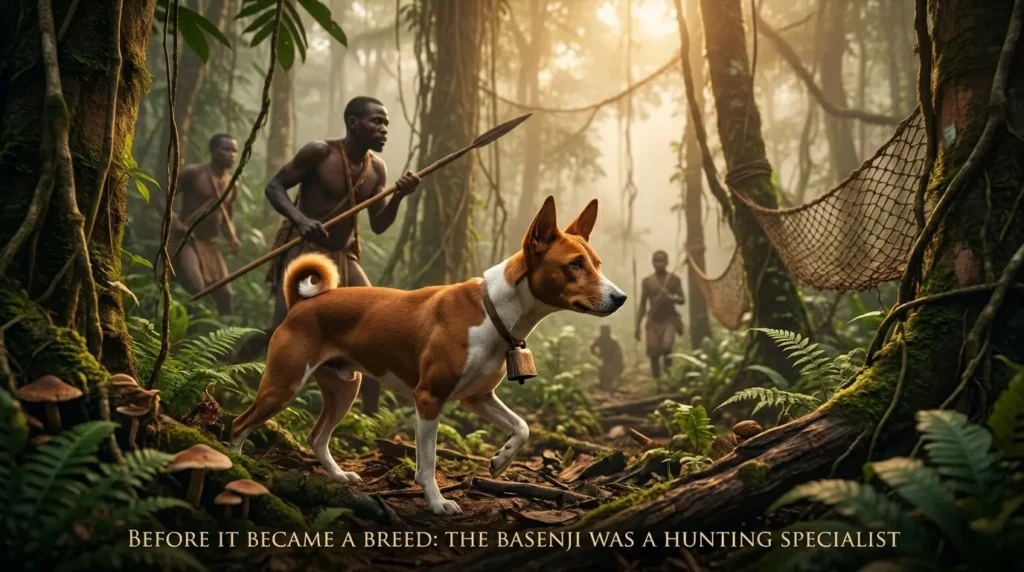
To understand Basenji behavior, forget modern pet ownership for a moment. Start with the forest. Ethnographic research involving Central African forest hunter communities—including groups such as the Aka, Mbuti, and Baka—documents sophisticated cooperative hunting systems where dogs served highly specialized roles. These were not random chases; they were coordinated operations.
Hunters stretched woven nets across forest corridors, forming capture zones. Dogs moved ahead through thick undergrowth, flushing duikers, rodents, and small antelope toward these nets. The ideal hunting dog for this work needed very specific qualities.
It had to be:
- Fast in short bursts and highly agile
- Mentally sharp
- Responsive without constant commands
- Difficult for prey to detect
This last point is easy to overlook. Excessive barking worked against the entire hunting system. A loud dog could warn prey too early and collapse the hunt. A quiet, observant dog increased efficiency.
Historical expedition records from the late 19th and early 20th centuries mention Central African hunting dogs wearing small wooden bells around their necks. Hunters needed bells because the dogs moved so quietly through dense brush that visual tracking became difficult. A dog so silent in motion that humans needed artificial sound just to track it tells you almost everything about the Basenji’s hunting design.
Basenji History — How Old Is This Dog?
This is where breed mythology often outruns science. One of the most repeated claims online is that the Basenji has remained unchanged for 5,000 years. That statement sounds impressive, but it is scientifically indefensible. No modern dog breed has remained genetically unchanged for thousands of years. Not the Basenji, not the Saluki, not any breed.
But rejecting that myth does not make the Basenji recent. Far from it. The evidence strongly supports the existence of ancient African hunting dogs with striking physical similarity to modern Basenjis.
Egyptian and North African Evidence
Ancient Egyptian artwork depicts compact hunting dogs with erect ears, curled tails, and athletic bodies. Similar dog forms also appear in North African rock art dated thousands of years ago.
This is where many articles become sloppy. A dog that looks like a Basenji is not automatically a Basenji. Physical resemblance is not lineage proof. What we can say with confidence is this: a recognizable African hunting-dog type existed long before modern breed registries. That is the responsible conclusion.
Geographic Isolation Preserved Older Traits
Central Africa’s geography helped preserve older canine characteristics. Rainforest barriers, major river systems, parasite pressure, and regional disease ecology reduced unrestricted mixing with outside dog populations for long periods. Reduced gene flow allows older trait combinations to persist, which helps explain why Basenji-type populations retained features uncommon in many modern breeds.
Why Basenjis Don’t Bark Like Other Dogs
This is the question every Basenji article has to address. Unfortunately, most articles oversimplify the answer. Basenjis are not mute. Anyone who has lived with one knows that almost immediately. They vocalize often—but differently.
Common Basenji vocalizations include:
- Yodeling and whining
- Growling and screaming
- Chortling and the famous “barroo”
The real question is not whether they make sound, but why they rarely produce conventional barking.
The Larynx Explains Part—Not All—of the Story
The common explanation focuses on the laryngeal ventricle, a cavity involved in vocal resonance and airflow. Basenjis are widely described as having a shallower, flatter laryngeal ventricle than conventional barking breeds. When air is expelled forcefully, it moves across the vocal folds without creating the resonant acoustic pocket required for a sharp bark.
While this anatomical difference alters sound production, evidence remains limited, and there is no strong peer-reviewed consensus proving anatomy alone explains the behavior. Canids like wolves possess the physical hardware to bark but rarely do so. The most scientifically accurate explanation involves multiple interacting factors:
- Vocal Anatomy: Small structural differences in the vocal apparatus alter resonance and pressure release.
- Neural Patterning: Vocal behavior is partly neurological. How the brain triggers vocal output matters just as much as physical anatomy.
- Behavioral Selection: Generations of selection for quieter hunting behavior likely reinforced reduced bark frequency.
This broader pattern of unusual primitive vocalization also appears in other native dog populations known for highly unusual sound production.
The Genetic Research That Changed Basenji Science

For decades, the Basenji’s antiquity was inferred from appearance, behavior, and historical records. Genomics changed everything. Large-scale canine DNA studies led by researchers such as Dr. Heidi Parker and Dr. Elaine Ostrander fundamentally reshaped breed science. Their genome-wide analyses produced a consistent finding: Basenjis repeatedly cluster among early-diverging, basal domestic dog lineages.
What “Basal” Actually Means
This is one of the most misunderstood findings in dog journalism. Basenjis are not semi-wild dogs, they are not part wolf, and they are not genetically “almost wolves.” They are fully domestic dogs. When geneticists describe the Basenji as belonging to a basal lineage, they mean its branch on the canine family tree diverged much earlier relative to modern European breeds. It is a phylogenetic statement, not a wildness score.
Pedigrees vs. Native Congo Dogs
Modern registered Basenjis and native Central African hunting dogs overlap genetically, but they are not identical populations. The modern pedigree population descended from a limited founder base. Founder bottlenecks reduce genetic diversity. Later African imports helped refresh the gene pool, which was critical for long-term breed health, but founder effects still matter.
This is exactly why Basenjis are so useful in research involving domestication pathways, inherited disease mapping, population bottlenecks, and ancestral behavior retention. Research from Dr. Adam Boyko on global village dog populations reinforced a major point in canine evolution: native dog populations preserve genetic information that modern pedigree systems often compress or erase.
Physical Characteristics — Anatomy of a Hunter
The Basenji’s body makes immediate sense once you stop viewing it as a pet and start viewing it as a functional hunting partner. Very little is wasted, and nothing feels exaggerated or ornamental.
Size and Structure
- Typical Height: 16–17 inches
- Typical Weight: 22–24 pounds
They are compact, lean, and athletic. The square body structure gives the breed excellent balance between speed, agility, and control.
Movement Mechanics
A Basenji does not move like a heavy scent hound; its movement rhythm is distinctive. Experienced owners recognize it instantly. A Basenji often alternates between intense stillness and explosive motion. It may remain perfectly motionless while observing the environment, then launch into full-speed pursuit in less than a second. That movement pattern reflects short pursuit bursts and rapid directional changes required in dense environments.
Skull Morphology
The breed has a mesocephalic skull, positioned between long-headed sighthounds and short-headed brachycephalic breeds. This structural balance supports rapid motion detection, efficient bite mechanics, and healthy respiratory airflow. Unlike brachycephalic breeds, Basenjis do not suffer from extreme skull shortening that compromises breathing.
Wrinkles, Eyes, and Ears
Basenji puppies often display dramatic forehead wrinkles that soften with maturity in many bloodlines. Their almond-shaped eyes create an alert, analytical expression. Then there are the ears. Even during rest, a Basenji rarely appears fully off duty. The body may be still, but the ears rotate subtly toward faint sound sources, continuously scanning the environment.
Primitive Biological Traits Most Modern Dogs Lost
Many modern breeds were shaped through intense artificial selection for appearance, companionship, or specialized working tasks. That process amplified certain traits and suppressed others. The Basenji retained several biological patterns that feel older in evolutionary terms.
Single Annual Estrus Cycle
One of the most important examples is reproduction. Most domestic female dogs cycle twice per year. Most Basenji females cycle once annually, typically in a seasonal estrus cycle rhythm during autumn in the Northern Hemisphere. That pattern closely resembles wolves and several wild canids. Endocrinologists studying domestication pay close attention to reproductive timing because breeding cycles reveal how strongly a species has been shaped by human-controlled reproduction.
Cat-Like Grooming and Low Odor
The “cat-like” reputation is real. Basenjis groom themselves with remarkable precision, cleaning their paws, chest, shoulders, and face. This frequent self-grooming minimizes typical dog odors. However, low odor does not mean odorless—a wet Basenji still smells like a wet dog. The breed simply lacks the stronger oily coat odor common in many other dogs.
Dual Hunting Intelligence
Most hunting breeds heavily favor one sensory specialization. A Beagle leans strongly toward scent work, while a Greyhound is heavily visual. Basenjis sit in an unusual middle ground. They combine visual prey detection, scent tracking, and rapid pursuit decision-making. That blend made them highly adaptable hunters in unpredictable terrain.
Basenji Personality — Understanding Independent Behavior
People often describe Basenjis as stubborn, but what they interpret as stubbornness is often independent decision-making. That distinction matters because it changes how you evaluate intelligence.
Many obedience-focused breeds are heavily optimized for handler compliance. They think, “What does my human want?” A Basenji often operates differently. Its internal calculation sounds more like, “Does this command make sense right now?” That isn’t low intelligence; it reflects high-level problem assessment. They evaluate before acting, which can make them both brilliant and challenging.
Emotional Bonding
Basenjis are not emotionally shallow dogs; with their chosen people, many form intense attachments. They often prefer proximity over dramatic affection. Some lean against you, some quietly follow you room to room, and some insist on sleeping in physical contact. They bond deeply, they just don’t always express affection in stereotypical ways.
Behavior Around Strangers
With strangers, Basenjis tend to be reserved. They are not necessarily fearful, but not usually eager either. They prefer observation before engagement. That reserve is sometimes misread as aloofness, but in reality, many are simply selective social evaluators gathering information before deciding how much social energy to invest.
Behavioral Instincts and Management
Living with a Basenji can be incredibly rewarding, but it can also humble even experienced dog owners. This breed notices everything: a schedule change, a loose latch, a half-open gate, or a squirrel in their peripheral vision.
High Prey Drive
The prey drive is serious. Birds, rabbits, squirrels, and fast-moving small animals can trigger instantaneous pursuit. When that instinct activates, it is a motor pattern activation rather than intentional disobedience. Training helps, but biology can still win, which is why many Basenji experts strongly recommend caution with off-leash freedom outside secure areas.
Escape Intelligence
Basenji owners tell eerily similar stories of doors opened, latches manipulated, fences climbed, and routines exploited. This pattern appears so consistently because Basenjis analyze physical systems. This trait likely traces back to hunting roles requiring autonomous environmental problem-solving.
Same-Sex Tension
This topic is rarely discussed honestly in breed articles, but it should be. Some Basenjis—especially mature same-sex pairs—can show strong social friction. This does not happen in every individual or household, but the tendency is well known among experienced breeders, and prospective owners should know this before adding multiple dogs.
Basenji Health and Lifespan
The typical Basenji lifespan falls around 12 to 16 years, with many individuals remaining physically active well into their senior years. Structurally, the breed is healthier than many heavily engineered modern dogs, but responsible ownership still requires understanding inherited risks.
Fanconi Syndrome — Genetic Marker Breakthrough
Fanconi Syndrome is an inherited defect of the renal proximal tubules, causing the kidneys to dump essential nutrients—including glucose, amino acids, sodium, and potassium—directly into the urine. Untreated, it leads to muscle wasting, organ failure, and death.
Historically, breeders had to manage this risk blindly by testing their dog’s urine at home using glucose test strips every month. The major breakthrough came with the release of a DNA-linked marker test developed by researchers at the University of Missouri and processed via the Orthopedic Foundation for Animals (OFA). This test identifies carriers before they are bred. Responsible breeders use this data to ensure a carrier is only ever paired with a clear dog, entirely preventing the production of affected puppies.
Other Important Health Risks
Responsible breeders also screen for:
- Progressive Retinal Atrophy (PRA)
- Hypothyroidism
- Pyruvate Kinase Deficiency
- Hip Dysplasia
Exercise, Diet, and Training Reality

A Basenji is not a low-effort dog. It may be clean and relatively quiet, but that does not make it easy.
Exercise Needs
Many first-time owners assume high energy means constant movement, but Basenjis often operate in bursts. They may spend ten minutes motionless, silently observing, then suddenly explode into a sprint with breathtaking speed. This is why long, slow walks alone often fail to satisfy them.
Basenjis excel in:
- Lure coursing and open sprinting
- Agility work
- Scent tracking games
- Enrichment-based problem solving
Basenji Training
Let’s correct a common myth: Basenjis are not untrainable. However, coercive, repetitive training often fails and creates resistance fast. Short sessions work better, variety works better, and high-value rewards work best.
Recall Reality
Even well-trained Basenjis may remain unreliable off-leash when prey triggers activate. This isn’t always a training failure; sometimes it is simply instinct outranking learned behavior. Good environmental management matters.
Is the Basenji a Good Family Dog?
The honest answer depends heavily on the household. For calm, structured homes, a Basenji can be extraordinary. For chaotic environments, problems emerge quickly.
With Children
With respectful older children, many Basenjis do very well. With rough handling or unpredictable grabbing, tolerance drops fast. This breed generally dislikes invasive handling, and children must learn boundaries.
With Cats and Other Dogs
Outcomes vary. Early socialization improves compatibility, but prey drive remains an important variable. Some Basenjis coexist beautifully with indoor cats they grew up with, while others can never safely generalize. With other dogs, temperament compatibility and same-sex aggression risks should not be ignored.
For First-Time Owners?
Usually not the first recommendation. A Basenji rewards owners who appreciate independent canine psychology. People wanting instant, default obedience often choose the wrong breed.
Kennel Recognition and Modern Breed Status
The Basenji entered Western breeding programs in the early 20th century after repeated import attempts from Africa. Early importation efforts struggled primarily due to disease vulnerability, as many imported dogs lacked immunity to pathogens common in European breeding environments.
Eventually, breeding populations stabilized. Today the breed is recognized by major kennel organizations, including the official registry tracked on the AKC Basenji Breed Page. Modern preservation efforts include periodic African stock importation to refresh genetic diversity, which matters enormously for long-term breed health.
The Threat to Basenji Genetic Integrity
The greatest long-term threat to the breed is genetic dilution. Urbanization across Africa continues reshaping native dog populations, and crossbreeding with imported European and mixed-breed dogs is increasing. Once native landrace populations disappear, recovery becomes nearly impossible.
From an evolutionary perspective, losing native dog populations means losing biological evidence. Every disappearing lineage erases data that affects canine genetics, domestication research, disease mapping, and behavioral science. You cannot reconstruct lost genetic history once it disappears.
Basenji Comparison Tables
Basenji vs. Telomian Dog
| Feature | Basenji | Telomian Dog |
| Origin | Central Africa | Malaysia |
| Vocal Style | Yodel / Barroo | Chirps / Unique calls |
| Hunting Style | Ground flush hunter | Arboreal-adapted village hunter |
| Primitive Traits | Very high | High |
Expert Take: The comparison with the Telomian is notable because both breeds show unusual vocal behavior, yet their environmental pressures were very different. The Basenji evolved around cooperative forest hunting on the ground. The Telomian adapted to elevated housing and climbing in jungle village life.
Basenji vs. New Guinea Singing Dog
| Feature | Basenji | New Guinea Singing Dog |
| Vocalization | Polyphonic yodel / Barroo | Harmonic chorus singing |
| Genetic Status | Domesticated basal landrace | Wild / Dingo-congeneric lineage |
| Human Bond | Strong domestic bond | Variable / Primitive bond |
| Isolation History | African landrace barriers | Extreme island isolation |
Expert Take: Both breeds challenge simplistic definitions of domestic dogs. The New Guinea Singing Dog preserved extraordinary vocal complexity through wild island isolation, while the Basenji preserved adaptive hunting behavior through functional human partnership.
Basenji vs. Beagle
| Feature | Basenji | Beagle |
| Barking | Rare | Frequent |
| Estrus Cycle | Usually annual | Usually biannual |
| Training Style | Independent | Cooperative |
| Prey Tracking | Visual + Scent | Scent dominant |
Myth Busting — Three Common Basenji Myths
- Myth 1 — Basenjis Are Completely Mute: False. They are highly vocal dogs; they simply vocalize using alternative sounds like chortles, screams, and yodels.
- Myth 2 — Basenjis Are Not Smart: False. Many are exceptionally intelligent. The issue is handler willingness and motivation styles, not capability.
- Myth 3 — Basenjis Are Basically Cats: Mostly misleading. Yes, they groom frequently and value independence, but they remain deeply canine in social bonding, prey drive, and pack behavior.
Why Preserving the Basenji Matters
Somewhere beneath the green canopy of Central Africa, a curled-tail hunting dog still moves with the same alert precision that shaped generations before modern kennel clubs existed. Stillness, scan, movement. No wasted energy, no unnecessary sound—just calculation.
The Basenji matters because it preserves irreplaceable genetic markers in the modern dog world. Its genome, behavior, reproductive biology, and hunting cognition offer rare insight into how early domestic dogs lived beside humans. Lose that lineage, and we lose more than a breed; we lose biological evidence. And once evolutionary history disappears, no breeder, registry, or kennel club can bring it back.
1- Why do Basenjis not bark?
Basenjis rarely bark due to an asymmetrical larynx and a flattened laryngeal ventricle, which changes how air passes through the vocal folds. This physical trait, combined with centuries of natural and functional selection as silent hunting partners in the African rainforest, suppressed the conventional bark reflex.
2- Are Basenjis good house pets?
Basenjis make excellent house pets for dedicated owners who understand independent dog behavior. They are clean, self-groom frequently, and have very little coat odor. However, they require significant mental stimulation, secure yards, and reward-based training to manage their high prey drive and escape tendencies.
3- Do Basenjis get along with cats?
A Basenji’s compatibility with cats depends heavily on early socialization. While many individual Basenjis live peacefully with indoor family cats they were raised with, their high primitive prey drive means they may view unfamiliar outdoor cats or small animals as prey.