
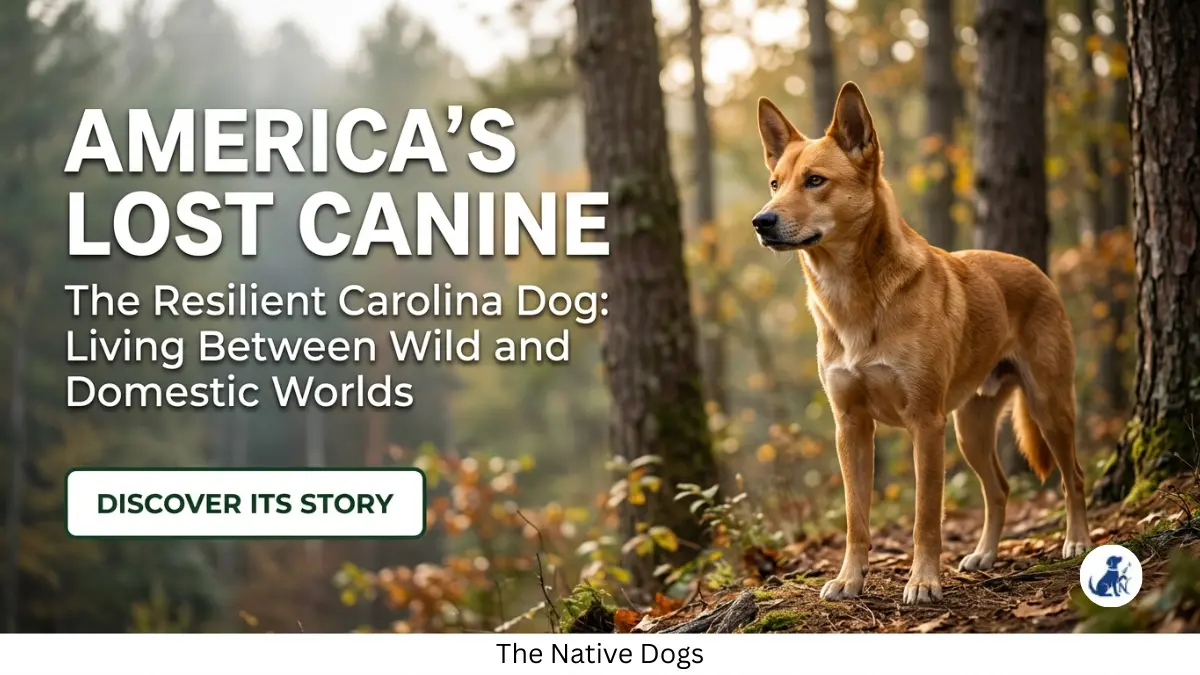
The dog that shouldn’t feel unfamiliar—but somehow does.
Deep within the forests and wetlands of the southeastern United States, researchers once kept noticing something highly unusual. It wasn’t wolves, coyotes, or your typical feral stray dogs. Instead, it was a distinct population of dogs moving through the landscape with an incredible, eerie consistency—careful, observant, and structurally unified. They didn’t behave like recently escaped pets, nor did they look like random mixtures of modern breeds. This striking contradiction is what finally brought the Carolina Dog out of the shadows and into the scientific spotlight.
What is a Carolina Dog?
The Carolina Dog is best described as a primitive landrace population found in the southeastern United States. It is not a kennel-created breed. There is no controlled origin point and no selective breeding program. Instead, it represents a population shaped gradually by environmental pressures and long-term semi-isolation.
Because of its appearance and behavior, it is often called the “American Dingo”, though this is a descriptive nickname rather than a genetic classification. The resemblance to dingoes is superficial and explained by convergent evolution in free-ranging dog populations, not direct ancestry.
Discovery in the Savannah River Forests
Scientific attention to these dogs began during ecological fieldwork at the Savannah River Site in South Carolina. Ecologist Dr. I. Lehr Brisbin Jr. and colleagues documented free-ranging dogs in restricted forest environments over multiple years.
What stood out was not a single sighting—but repetition. Across seasons, the same patterns appeared consistently:
- Physical & Social Trait Stability: Individuals maintained a highly consistent tan-to-ginger coat range and a stable, unified body structure.
- Survival Mechanisms: They displayed predictable social grouping behaviors, survival-based foraging patterns, and a significantly reduced dependence on human resources.
In most feral dog populations, variation increases quickly due to mixed breeding. Here, the pattern remained unexpectedly stable.
Where the Carolina Dog Fits in Evolution
One hypothesis places Carolina Dogs within early dog populations that moved with humans across the Bering Land Bridge. These early dogs were not modern breeds; they were village-associated canines—living near humans but not fully controlled by them. Another hypothesis suggests partial continuity with pre-colonial village dog populations in North America.
Neither model is fully confirmed. What genetics does support is a broader classification: Carolina Dogs align more closely with village dog populations worldwide than with modern breed clusters.
Genetics: What Studies Actually Suggest
Across comparative dog genomics (including work by Adam Boyko, Elaine Ostrander, and global village dog datasets), Carolina Dogs show patterns consistent with outbred, semi-isolated populations. Instead of tight breed clustering, they show:
- Broader genetic diversity.
- Weaker bottleneck signals.
- Mixed ancestral markers typical of village dog systems.
- threat to these ancient DNA structures
This places them outside the structure of modern purebred dogs and closer to naturally maintained dog populations.
Physical Structure & Behavior: Built for Function
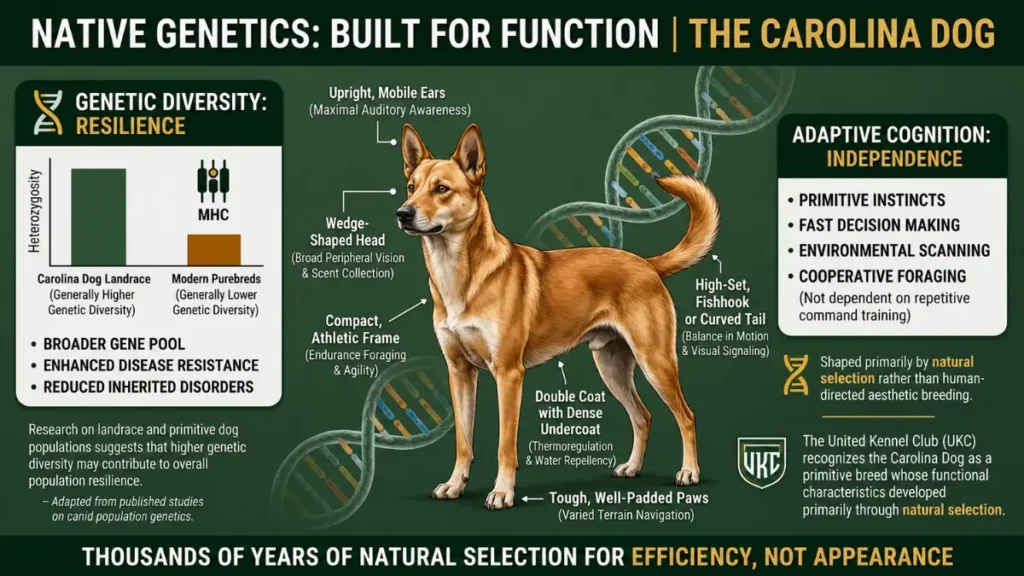
Carolina Dogs typically fall within a height of 17–24 inches and a weight of 30–55 pounds. Their entire anatomy and psychological blueprint reflect endurance, environmental efficiency, and independent problem-solving rather than aesthetic selection:
- Anatomical Adaptation: They possess a wedge-shaped head with a narrow muzzle, upright ears tuned for directional awareness, almond-shaped eyes suited for scanning movement, a curved tail used for balance/signaling, and a short coat adapted to humid climates.
- Cognitive Intelligence: They don’t respond to the world like highly domesticated breeds that wait for constant human instruction. Instead, they assess new spaces thoroughly before moving, prioritize clear escape routes, engage selectively with unfamiliar humans, and learn based on real-world relevance rather than endless repetition.
- Social Flexibility: Their social structure is highly adaptable rather than rigid, often forming loose family groups or temporary cooperative units to navigate threats, find food, and protect territory.
What some owners call stubbornness is often advanced decision-making shaped by evolution. This is not wild aggression; it is low-control environmental intelligence.
Temperament and Human Interaction
In domestic settings, Carolina Dogs tend to form strong bonds—but not immediate trust. Common behavioral patterns include:
- Loyalty to familiar individuals and a reserved response to strangers.
- High sensitivity to chaotic handling.
- A strong capacity for observational learning.
They are not untrainable; they are simply selectively responsive learners.
Health, Lifespan, and Trainability
- Health Profile: They have an average lifespan of 12–15 years, generally strong physical resilience, and a much lower incidence of inherited disorders compared to many purebred dogs. Health risks are typically environmental rather than genetic.
- Learning Style: Training works best when it matches their cognitive style. Effective approaches include short, structured sessions, positive reinforcement, and early social exposure. Less effective approaches involve repetitive drilling, force-based correction, or overly rigid training systems. They respond to meaning, not repetition.
Distribution, Recognition, and Current Status
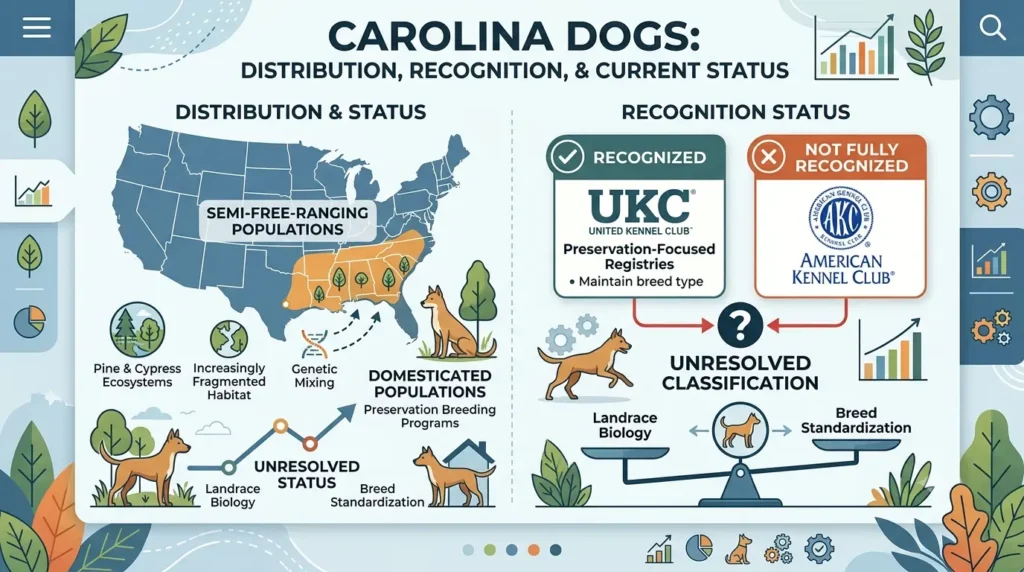
Today, Carolina Dogs exist in two distinct forms: semi-free-ranging populations in southeastern U.S. ecosystems, and domesticated populations maintained through preservation breeding. Wild-type populations are increasingly fragmented due to habitat changes and genetic mixing.
- Recognition Status: They are recognized by the United Kennel Club (UKC) and maintained through preservation-focused registries, but they are not fully recognized by the American Kennel Club (AKC). This classification remains partially unresolved because the population sits right between landrace biology and breed standardization.
Conservation Concern: Not Extinction, But Dilution
The main issue facing Carolina Dogs is not disappearance, but genetic and behavioral dilution. This is caused directly by:
- Crossbreeding with mixed domestic dogs.
- Loss of isolated populations.
- Increasing habitat overlap with human settlements.
Once diluted, these ancient landrace traits become nearly impossible to recover. That is what makes native dog loss so difficult to detect—the breed may still exist visually, but genetically, its original identity is disappearing.
Carolina Dog vs Other Dog Populations
Carolina Dog vs Dingo
- Origin: Carolina Dog is from North America; Dingo is from Australia.
- Status: Carolina Dog is a semi-domestic landrace; Dingo is a wild canid population.
- Human Contact: Moderate for Carolina Dogs; minimal for Dingoes.
Carolina Dog vs Indian Pariah Dog
Both represent ancient village dog systems shaped entirely by environmental selection and climate pressures rather than controlled human breeding.
Carolina Dog vs Modern Purebred Dogs
Modern breeds show a narrow genetic structure and human-controlled selection for appearance. Carolina Dogs show broader genetic diversity and thousands of years of natural environmental adaptation.
Myth Correction
- Myth 1 (Not Wild Dogs): They are domesticated, free-ranging populations.
- Myth 2 (Not Aggressive): Their natural behavior is cautious and reserved, not hostile.
- Myth 3 (Not Untrainable): They learn exceptionally well, but selectively based on context.
Final Perspective
The Carolina Dog remains one of the few canine populations in North America that still reflects how dogs behave when environmental selection plays a larger role than human-controlled breeding. Its importance is not symbolic. It lies in what it reveals about dogs as a species—adaptable, variable, and still shaped by forces beyond human design.
FAQ
1. What is a Carolina Dog?
A Carolina Dog is a primitive landrace dog from the southeastern United States, shaped primarily by environmental selection rather than controlled breeding.
2. Are Carolina Dogs related to dingoes?
No direct relation exists. The similarity is due to convergent evolution in free-ranging dog populations.
3. Are Carolina Dogs good pets?
They can be, but they require experienced handling and environments that respect their independent behavioral style.
4. How long do Carolina Dogs live?
Their average lifespan is around 12–15 years under proper care.
5. Are Carolina Dogs rare?
Yes, genetically consistent populations are limited and increasingly affected by dilution from mixed breeding.