A modern French Bulldog may require artificial insemination and, in many cases, surgical delivery due to body structure shaped by intensive selective breeding.
Now compare that to an Indian Pariah Dog surviving on busy city streets, or a Carolina Dog navigating forests in the American Southeast.
No assisted breeding.
No specialized nutrition.
No climate-controlled environment.
Just survival.
That contrast reveals something uncomfortable about modern dog breeding. In our effort to create specific looks—flatter faces, shorter legs, unusual coats—we have often traded biological resilience for appearance.
Some of the healthiest canine genetics left today may not exist in champion show lines, but in native dogs shaped by thousands of years of natural selection.
What Are Native Dogs?
Native Dogs Origin—also called landrace dogs or indigenous canine populations—are dogs that developed naturally within a specific region over many generations, with minimal human-controlled breeding.
Unlike modern pedigree breeds, these dogs were not primarily shaped for appearance.
They were shaped by survival.
Heat, cold, disease exposure, food scarcity, predators, and terrain acted as selection pressures. Dogs that adapted survived and reproduced. Dogs that didn’t gradually disappeared from the gene pool.
Canine researchers Raymond Coppinger and Lorna Coppinger argued that dogs are best understood through ecology and working function, not just breed labels.
That perspective makes native dogs especially important. They preserve evolutionary traits that existed long before kennel clubs created modern breed standards.
Native Dog Breeds vs Modern Selectively Bred Dogs
The biggest difference between native dog breeds and modern selectively bred dogs comes down to one question:
Who did the selecting—nature or humans?
With modern breeds, humans choose which traits continue. Breeders may prioritize coat color, head shape, body size, or appearance based on breed standards or market demand.
With native dogs, survival determines what gets passed on.
A dog unable to tolerate extreme heat in a tropical climate won’t thrive. A dog with poor immunity in parasite-heavy regions may never survive long enough to reproduce.
That natural filtering creates resilient dogs.
Dog geneticist Dr. Elaine Ostrander has shown how intensive selective breeding can quickly amplify both desired and harmful genes.
That’s why some purebred dogs carry inherited disorders at much higher rates than native dog populations.
How Climate and Geography Shaped Ancient Dog Breeds
Environment shapes dogs in measurable ways, from body structure to metabolism.
A dog shaped by arid deserts develops differently from one shaped by humid forests or mountain terrain.
The Indian Pariah Dog evolved with a lean body, short coat, upright ears, and efficient heat regulation—traits ideal for tropical climates where overheating can be deadly.
The Carolina Dog developed an efficient gait and athletic frame suited to the hot, humid American Southeast, where stamina matters more than brute strength.
Meanwhile, the New Guinea Singing Dog evolved remarkable flexibility, balance, and climbing ability to survive steep rocky terrain.
These traits were not bred for appearance.
They persisted because they improved survival generation after generation.
Dog Genetics and Survival Traits
Why can one dog survive harsh outdoor conditions with minimal care while another struggles with chronic allergies, joint issues, or breathing problems?
A major reason is genetic diversity.
One of the biggest advantages of native dog populations is broader genetic variation, especially in immune-system genes such as the major histocompatibility complex (MHC), which helps the body recognize harmful pathogens.
Greater diversity in these genes often means stronger resilience against disease.
Canine geneticist Dr. Adam Boyko’s genomic studies of village dogs found that free-breeding dog populations preserve significantly higher heterozygosity than many modern pedigree breeds.
That matters because lower diversity increases the probability of harmful recessive genes pairing together.
This is why inherited disorders appear more frequently in heavily standardized breeds with narrow bloodlines.
Why Native Dogs Often Have Stronger Instincts
Saying native dogs have “stronger instincts” can be misleading.
A better way to describe them is this: native dogs often show stronger environmental awareness and independent problem-solving.
They read movement quickly.
They detect unfamiliar sounds early.
They make decisions without waiting for human direction.
That behavior developed through survival.
Many native dogs spent generations navigating threats, finding food, and protecting territory with minimal human supervision.
What some owners call stubbornness is often advanced decision-making shaped by evolution.
How Modern Breeding Is Breaking Native Dog Genetics
Crossbreeding itself is not always harmful – modern breeding
In fact, controlled crossbreeding can sometimes improve genetic diversity and reduce inherited disease risk.
The real concern is uncontrolled genetic introgression—the gradual replacement of a native population’s gene pool by outside breeds.
When imported breeds dominate reproduction, locally adapted traits can disappear within just a few generations.
Heat tolerance may weaken.
Disease resistance may drop.
Structural efficiency may decline.
This doesn’t always look like extinction.
Sometimes the breed still exists visually.
Genetically, however, its original identity may already be disappearing.
That is what makes native dog loss so difficult to detect.
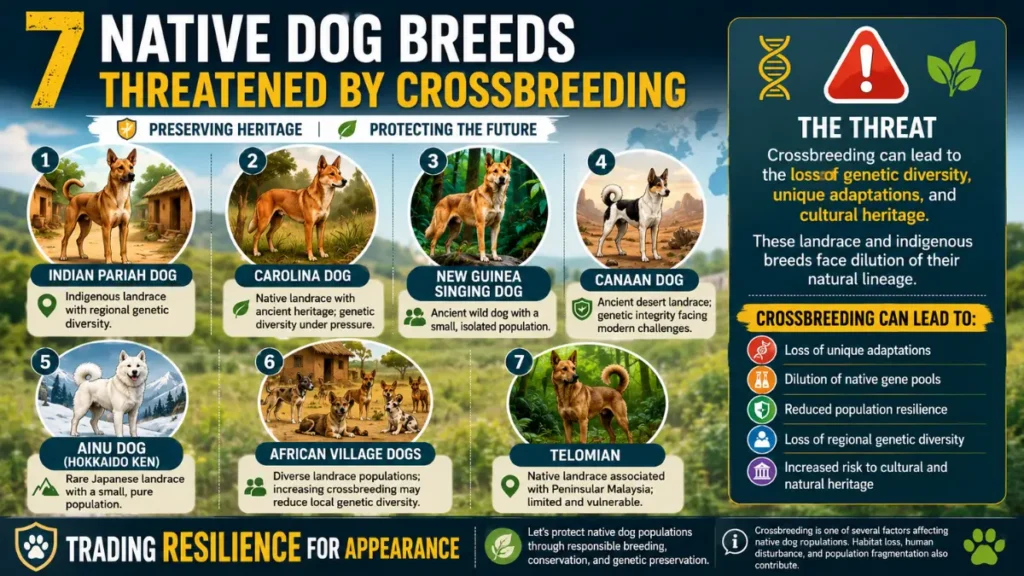
7 Endangered Dog Breeds at Risk Due to Crossbreeding
1. Indian Pariah Dog
The Indian Pariah Dog is widely considered one of the oldest surviving native dog populations in Asia, with roots tracing back thousands of years. These dogs evolved through natural selection in hot climates, developing heat tolerance, strong immunity, and impressive survival instincts. Rapid urbanization and crossbreeding with imported pet breeds are gradually altering their original gene pool.
2. Carolina Dog
Often called the “American Dingo,” the Carolina Dog is one of North America’s most fascinating native dogs. Known for their fox-like appearance, strong prey drive, and cautious intelligence, these dogs preserve primitive behavioral traits rarely seen in modern breeds. Interbreeding with domestic dogs threatens the genetic integrity of wild and semi-wild populations.
3. New Guinea Singing Dog
This rare canine is famous for its unique melodic vocalizations that sound almost like whale songs. Isolated in remote highlands for generations, the breed retained unusual genetic traits and remarkable flexibility. Because the population is extremely small, genetic dilution poses a serious long-term threat.
4. Canaan Dog
The Canaan Dog developed in harsh desert environments across the Middle East. These dogs became highly alert, territorial, and exceptionally adaptable to limited resources. While recognized as a formal breed today, unmanaged breeding and shrinking native populations threaten preservation of original landrace genetics.
5. Ainu Dog
The Ainu Dog, native to Japan, historically assisted with hunting large animals in cold mountainous terrain. Built for endurance, intelligence, and courage, this breed now faces declining population numbers. Crossbreeding and reduced breeding programs have made preservation increasingly difficult.
6. African Village Dogs
African village dogs are not a single breed but genetically diverse native dog populations spread across multiple regions. These dogs provide valuable insight into early canine evolution because they preserve ancient genetic lineages. Imported modern breeds are increasingly influencing their gene pools.
7. Telomian
The Telomian is a rare native dog from Malaysia, originally associated with indigenous village communities. Known for agility and climbing ability, these dogs adapted to elevated homes and dense jungle terrain. Their already small population makes them highly vulnerable to genetic replacement.
Why Preserving Native Dog Genetics Matters
Preserving native dog genetics is about more than protecting rare breeds.
These dogs represent thousands of years of adaptation, survival, and co-evolution with humans.
Their DNA carries clues about migration, domestication, disease resistance, and environmental resilience.
That knowledge may become increasingly valuable as modern dogs face rising rates of inherited health disorders.
When native dog genetics disappear, we lose more than a breed.
We lose evolutionary intelligence shaped over millennia.
And once those ancient genetic blueprints are erased, they cannot be recreated.
What dog breeds are disappearing?
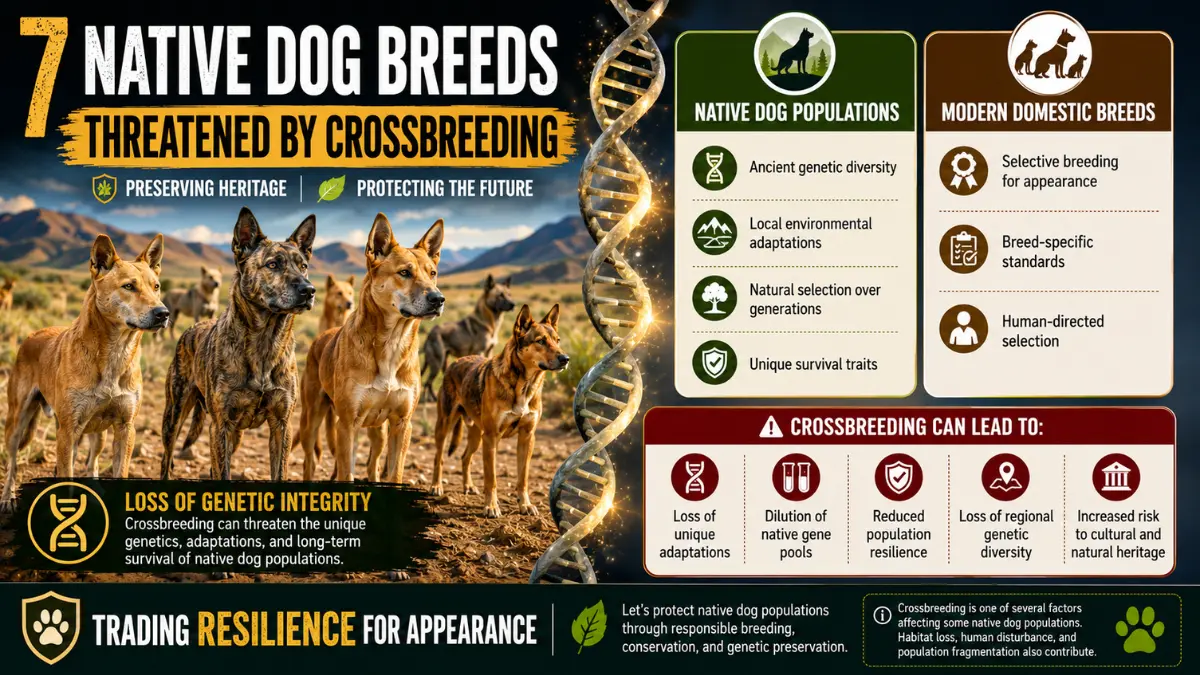
Native dog breeds like the Indian Pariah Dog, Carolina Dog, New Guinea Singing Dog, Canaan Dog, Ainu Dog, African Village Dogs, and Telomian are gradually disappearing due to crossbreeding.
Why are native dog breeds disappearing?
Native dog breeds are disappearing mainly because of uncontrolled crossbreeding with modern breeds, which can slowly erase important survival traits and unique genetics.
Why are native dogs often healthier than modern breeds?
Native dogs often have better genetic diversity, stronger immunity, and fewer inherited health problems because they evolved through natural selection.
Why is preserving native dog genetics important?
Preserving native dog genetics protects valuable traits like disease resistance, climate adaptation, and survival instincts that took thousands of years to develop.