

If you’re searching for a complete Kai Ken dog guide, you’re likely looking for more than basic breed facts. You want to know what it’s actually like to live with a Kai Ken, whether the breed matches your lifestyle, and what responsibilities come with owning one. This guide answers those questions through practical, evidence-based information designed to help prospective owners make informed decisions rather than emotional ones.
The Kai Ken is one of Japan’s rarest native dog breeds and remains uncommon outside its homeland. While its distinctive brindle coat often captures attention first, the breed has earned lasting respect because of its intelligence, athleticism, loyalty, and remarkable ability to work independently in demanding environments. Originally developed to hunt through Japan’s rugged mountain forests, the Kai Ken still carries many of the instincts that made it an exceptional hunting companion generations ago.
That heritage shapes nearly every aspect of the breed today. Unlike many modern companion dogs selectively bred for maximum sociability or easy obedience, the Kai Ken retains a thoughtful, independent nature. It forms exceptionally strong bonds with its family but usually approaches unfamiliar people and situations with quiet caution rather than immediate enthusiasm.
For experienced owners, these traits are often part of the breed’s appeal. For first-time owners expecting an outgoing, eager-to-please dog, they can become unexpected challenges.
This distinction is important because many people choose a dog based primarily on appearance. The Kai Ken’s tiger-like brindle coat is undeniably striking, but successful ownership depends far more on understanding the breed’s temperament, exercise requirements, prey drive, and long-term training needs than on its looks alone.
Throughout this guide, you’ll learn about the Kai Ken’s temperament, size, lifespan, grooming requirements, nutrition, exercise, training, health, puppy care, and long-term ownership responsibilities. You’ll also discover which households are most likely to thrive with this breed—and which may be happier choosing a different companion.
Rather than encouraging every reader to buy a Kai Ken, the goal is to help you determine whether this intelligent and loyal Japanese breed truly fits your lifestyle. Making the right decision before bringing any dog home is one of the most important steps toward responsible ownership.
Kai Ken at a Glance
| Trait | Details |
|---|---|
| Breed Type | Native Japanese hunting and companion breed |
| Size | Medium |
| Height | Approximately 17–22 inches |
| Weight | Approximately 25–55 pounds |
| Lifespan | Around 12–15 years |
| Coat | Weather-resistant double coat |
| Coat Colors | Black brindle, red brindle, and medium brindle |
| Energy Level | Moderate to high |
| Trainability | Intelligent but naturally independent |
| Shedding | Moderate with heavier seasonal shedding |
| Family Compatibility | Excellent for active, committed households |
| First-Time Owners | Better suited to experienced owners |
| Daily Exercise | Around 60–90 minutes plus mental enrichment |
Unlike many quick-reference breed summaries, these characteristics should be viewed together rather than individually. For example, the Kai Ken’s medium size often leads people to assume it is easier to manage than larger working breeds. In reality, its intelligence, stamina, and problem-solving ability usually have a much greater impact on daily ownership than its physical size. Understanding the complete picture is far more useful than evaluating any single trait in isolation.
What Is a Kai Ken?
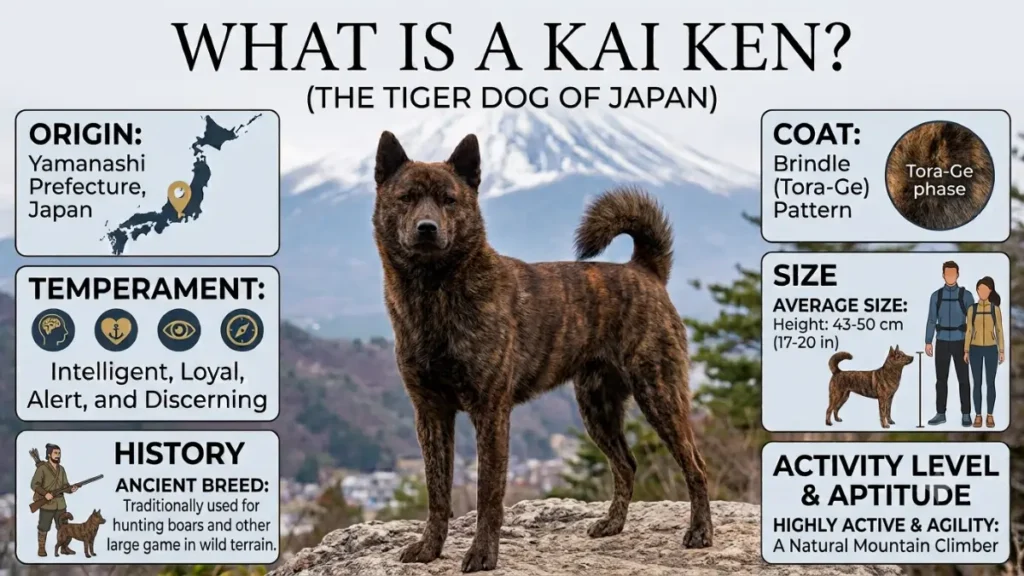
The Kai Ken is a rare, medium-sized Japanese dog breed originally developed to hunt large game in the steep, forested mountains of Japan. It belongs to the group of native Japanese breeds—collectively known as the Nihon Ken—alongside the Shiba Inu, Akita, Kishu Ken, Shikoku, Hokkaido, and Japanese Spitz.
Unlike many modern breeds that have been selectively developed primarily for companionship, the Kai Ken has retained much of its original working ability. It remains agile, sure-footed, highly observant, and capable of making independent decisions in challenging environments. Those traits helped the breed excel as a mountain hunting dog centuries ago, and they continue to shape its temperament today.
Although the Kai Ken is now most commonly kept as a companion, it has not lost the instincts that defined its original purpose. Many individuals still display excellent stamina, a strong prey drive, impressive problem-solving skills, and a natural desire to explore their surroundings. Understanding these inherited traits is essential because they influence everything from training and exercise to recall reliability and everyday household behavior.
For prospective owners, this means the Kai Ken should not be viewed as simply another medium-sized family dog. It is a working breed with companion qualities—not a companion breed with occasional working instincts. That distinction helps explain why some owners find the breed exceptionally rewarding while others struggle to meet its physical and mental needs.
Why Is the Kai Ken Called the Tiger Dog?
One of the Kai Ken’s most recognizable features is its naturally brindle coat. The striped pattern resembles the markings of a tiger, which has earned the breed the nickname “Tiger Dog.” Unlike many breeds where coat color is primarily cosmetic, the brindle pattern is considered one of the Kai Ken’s defining breed characteristics.
Interestingly, many Kai Ken puppies are born with coats that appear almost solid in color. As they mature, the brindle striping gradually becomes more visible, often continuing to develop throughout adolescence before reaching its adult appearance. This natural progression surprises many first-time owners, who may not immediately recognize the dramatic coat pattern their puppy will eventually develop.
While the brindle coat attracts attention, choosing a Kai Ken solely because of its appearance is rarely a good decision. Responsible ownership depends far more on understanding the breed’s temperament, exercise requirements, and independent personality than on its unique coloring.
What Makes the Kai Ken Unique?
Several characteristics distinguish the Kai Ken from other medium-sized breeds, including many other spitz-type dogs.
- Naturally brindle coat in every recognized color variation
- Strong loyalty toward its immediate family
- High intelligence paired with independent thinking
- Excellent balance and agility developed through mountain hunting
- Naturally calm but highly alert temperament
- Rare breed with carefully preserved bloodlines
What truly sets the Kai Ken apart, however, is the balance between independence and loyalty. Unlike breeds that constantly seek direction from their owners, the Kai Ken was developed to think for itself while still working in partnership with people. That combination creates a dog capable of solving problems without becoming disconnected from its family.
For experienced owners, this often results in a companion that is dependable, observant, and deeply devoted without becoming overly demanding. For inexperienced owners expecting automatic obedience, the same traits may be mistaken for stubbornness when they are actually signs of an intelligent dog evaluating its environment.
Understanding this balance early helps establish realistic expectations and lays the foundation for successful training, stronger communication, and a more rewarding lifelong relationship with the breed.
Kai Ken History and Origin
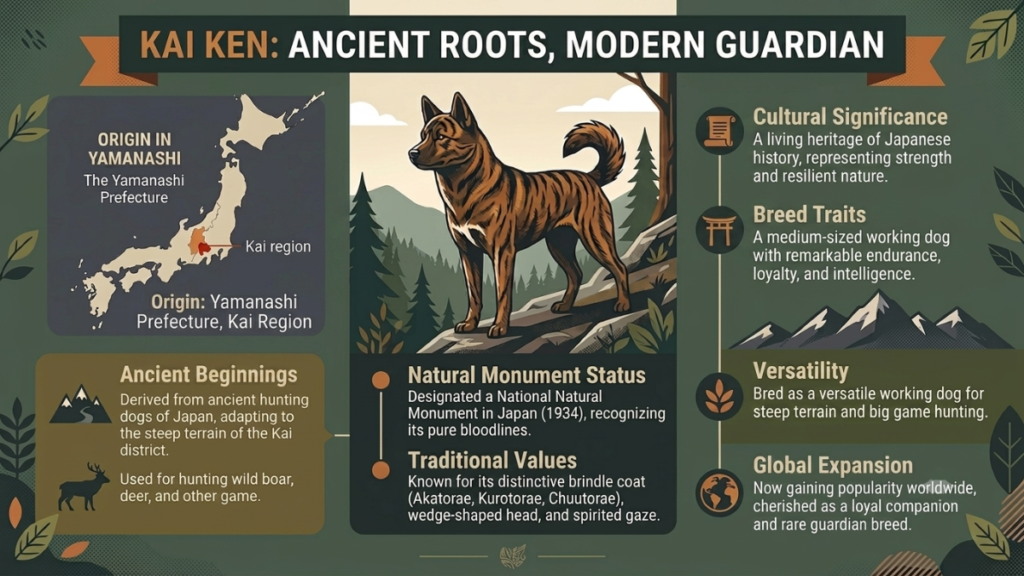
Understanding the Kai Ken’s history helps explain why the breed behaves the way it does today. Many of its defining traits—including independence, athleticism, intelligence, and strong family loyalty—are not accidental. They are the result of generations of selective breeding for a specific purpose rather than companionship alone.
Unlike many modern breeds that have gradually shifted away from their original jobs, the Kai Ken has remained remarkably close to its historical roots. That preserved heritage is one reason the breed continues to stand out among native Japanese dogs.
Origins in Japan
The Kai Ken originated in the historic Kai Province, now known as Yamanashi Prefecture, located in central Japan. The region’s steep mountains, dense forests, and isolated valleys created an environment where only agile, intelligent, and physically capable dogs could work successfully.
Geographic isolation also played an important role in preserving the breed. Because outside dogs had limited access to the mountainous region, the Kai Ken experienced relatively little crossbreeding for many generations. This natural isolation helped maintain both its physical characteristics and working instincts, making it one of Japan’s best-preserved native breeds.
Today, the Kai Ken remains an important part of Japan’s canine heritage and is widely recognized as one of the country’s traditional native breeds.
Original Hunting Purpose
The Kai Ken was bred primarily to hunt challenging game in rugged mountain terrain. Depending on the region and hunting conditions, these dogs were commonly used to track and pursue:
- Wild boar
- Deer
- Smaller mountain game
Hunting in steep forests demanded far more than speed. A successful Kai Ken needed exceptional endurance, excellent balance, sharp problem-solving ability, courage, and the confidence to make independent decisions while navigating difficult terrain.
Those historical responsibilities continue to influence the breed today. Even companion Kai Ken frequently display:
- Outstanding stamina
- Strong prey drive
- Excellent environmental awareness
- Quick decision-making
- Agile movement
- Natural curiosity
For modern owners, this explains why activities such as hiking, scent work, tracking games, and structured exploration often satisfy the breed far more effectively than simply spending time in a backyard.
Recognition Around the World
Although highly respected in Japan, the Kai Ken remains one of the rarest dog breeds outside its country of origin. It is still uncommon throughout the United States, Canada, and much of Europe, making responsibly bred puppies relatively difficult to find.
This rarity creates both advantages and challenges.
On the positive side, careful preservation efforts have helped maintain much of the breed’s original temperament, structure, and working ability. Unlike some popular breeds that have undergone extensive commercial breeding, the Kai Ken has largely avoided dramatic changes in appearance or purpose.
However, limited availability also means prospective owners often need patience. Waiting lists are common, and reputable breeders typically place greater emphasis on health, temperament, and responsible placement than on producing frequent litters.
When searching for a puppy, prioritize breeders who:
- Perform appropriate health testing on breeding dogs.
- Raise puppies in a well-socialized home environment.
- Discuss both the strengths and challenges of the breed honestly.
- Offer lifetime support to puppy buyers.
- Focus on preserving the Kai Ken’s temperament and health rather than producing puppies simply to meet demand.
Choosing a breeder based on quality instead of availability is one of the most important decisions a future Kai Ken owner can make. Waiting several months for a responsibly bred puppy is usually a far better investment than purchasing the first available dog from an unknown source.
The Kai Ken’s long-term preservation is closely tied to responsible breeding and continued appreciation of Japan’s native dog breeds. Because the global population remains relatively small, maintaining healthy breeding practices and preserving the breed’s original temperament are often considered more important than increasing popularity. This careful approach has helped the Kai Ken retain many of the physical and behavioral characteristics that originally made it an effective mountain hunting dog.
For modern owners, the breed’s history is more than an interesting background story—it helps explain many of the traits seen today. The Kai Ken’s intelligence, independence, strong environmental awareness, and natural athletic ability are all closely connected to the work it was originally developed to perform. Understanding this historical purpose allows owners to set realistic expectations for training, exercise, and daily management rather than judging the breed by the standards of dogs developed primarily for companionship.
Although the Kai Ken is now valued as both a companion and a preservation breed, its historical heritage continues to influence responsible breeding programs around the world. Protecting the breed’s health, stable temperament, and functional structure helps ensure that future generations retain the qualities that have defined the Kai Ken for centuries.
Kai Ken Appearance
The Kai Ken is a medium-sized breed with a naturally athletic build that reflects its history as a mountain hunting dog. Every aspect of its structure emphasizes efficiency, endurance, balance, and agility rather than exaggerated size or heavy bone.
Unlike breeds developed primarily for appearance, the Kai Ken’s physical characteristics remain closely tied to function. Its body is designed to move confidently across uneven terrain while maintaining stamina during long periods of activity.
For prospective owners, this means the Kai Ken should appear lean, well-balanced, and muscular—not bulky or oversized. A healthy dog looks fit and capable rather than heavily built or exaggerated in any one feature.
Size
The Kai Ken is a medium-sized breed with a naturally balanced and athletic body. Rather than appearing heavy or oversized, it combines strength with agility—qualities that allowed the breed to move confidently across Japan’s steep mountain terrain. Even today, a well-conditioned Kai Ken should look lean, efficient, and capable of sustained physical activity rather than bulky or exaggerated.
Typical adult height is:
| Sex | Height |
|---|---|
| Male | Approximately 18.5–22 inches |
| Female | Approximately 17.5–20 inches |
Individual dogs may vary slightly depending on genetics and breeding lines, but overall balance and sound movement are more important than achieving the largest possible size.
What This Means for Owners
The Kai Ken’s medium size offers a practical advantage. It is large enough to enjoy hiking, outdoor adventures, and canine sports while remaining easier to handle than many giant breeds. However, prospective owners should avoid assuming that a medium-sized dog automatically requires less work. In reality, the Kai Ken’s energy level and intelligence have a much greater impact on daily ownership than its physical size.
Weight
Healthy adult Kai Ken typically weigh 25–55 pounds, although sex, genetics, body structure, and overall conditioning all influence an individual’s ideal weight.
Rather than focusing exclusively on the number shown on the scale, owners should regularly evaluate body condition.
A healthy Kai Ken should have:
- A visible waist when viewed from above.
- Ribs that are easy to feel beneath a thin layer of fat.
- Noticeable muscle definition.
- Balanced proportions without appearing either thin or overweight.
- Smooth, athletic movement.
Maintaining a healthy weight throughout life helps reduce unnecessary stress on joints, supports endurance, and lowers the risk of obesity-related health problems.
Owner Tip
Small weight gains are often difficult to notice because they happen gradually. Checking your dog’s body condition every month is generally more effective than relying on occasional weigh-ins alone.
Coat
The Kai Ken has a weather-resistant double coat developed to protect it while working outdoors in changing mountain climates. Its coat provides insulation in cold weather while helping shield the skin from moisture, brush, and rough terrain.
The coat consists of:
- A straight, coarse outer coat that protects against dirt, water, and vegetation.
- A soft, dense undercoat that provides insulation during colder weather.
Unlike some double-coated breeds, the Kai Ken’s coat is relatively low maintenance. It does not require trimming, clipping, or professional styling to remain healthy.
Instead, regular brushing and occasional bathing are usually all that’s needed to keep the coat in good condition.
Seasonal Shedding
Owners should expect heavier shedding during seasonal coat changes, particularly in spring and fall, when much of the undercoat is naturally replaced.
Increasing brushing frequency during these periods helps:
- Remove loose hair before it spreads throughout the home.
- Reduce matting within the undercoat.
- Improve airflow to the skin.
- Keep the coat looking healthier.
Coat Colors
Every purebred Kai Ken displays a brindle coat, making it one of the breed’s most distinctive characteristics. While the intensity and pattern vary between individuals, brindle is considered an essential breed trait rather than an optional color variation.
Recognized brindle variations include:
- Black brindle
- Red brindle
- Medium brindle
One characteristic that surprises many new owners is how the coat develops over time. Puppies are often born with coats that appear almost solid, making the brindle pattern difficult to see. As they mature, the striping gradually becomes more pronounced, giving adult Kai Ken their well-known tiger-like appearance.
Because this transformation occurs naturally, prospective owners should avoid judging a young puppy’s adult coat based solely on its appearance during the first few months of life.
Physical Characteristics
The Kai Ken’s appearance reflects function rather than exaggeration. Every structural feature contributes to the breed’s original purpose as a capable mountain hunting dog.
Distinctive characteristics include:
- Wedge-shaped head
- Upright triangular ears
- Dark, alert eyes
- Strong neck
- Well-developed chest
- Lean but muscular body
- Compact, durable feet
- Curled or sickle-shaped tail
These features work together to produce a dog that is agile, balanced, and efficient over long distances.
The Kai Ken’s expression is equally distinctive. Rather than constantly seeking attention, many individuals quietly observe their surroundings before reacting. This calm attentiveness is one of the breed’s defining qualities and often gives experienced owners an early glimpse into the dog’s thoughtful personality.
More importantly, appearance and temperament are closely connected in this breed. A well-bred Kai Ken should project confidence without arrogance, alertness without nervousness, and athleticism without exaggeration. These characteristics have remained remarkably consistent because responsible preservation efforts have prioritized working ability and sound temperament alongside physical structure.
Kai Ken Temperament
The Kai Ken’s temperament is what truly defines the breed. While its tiger-striped coat often attracts attention first, owners usually stay devoted because of its intelligence, loyalty, emotional awareness, and calm confidence.
However, this is not a breed that tries to be everyone’s friend.
A well-bred and properly socialized Kai Ken is typically loyal to its family, naturally reserved with strangers, and highly aware of its surroundings. These traits are often misunderstood by people expecting the outgoing personality commonly seen in many companion breeds.
Instead of seeking attention from everyone it meets, a Kai Ken usually prefers to observe first and engage only after assessing the situation. That thoughtful approach is part of the breed’s natural temperament—not a behavioral flaw.
For prospective owners, understanding this distinction is important. A reserved dog is not automatically fearful, aggressive, or poorly socialized. In the Kai Ken, quiet confidence is often a sign that the dog is behaving exactly as expected.
Personality
The Kai Ken forms exceptionally strong relationships with the people it trusts. Rather than showing affection constantly, many individuals demonstrate loyalty by quietly staying close to their family and participating in everyday activities.
Owners often describe the breed as:
- Loyal
- Intelligent
- Calm indoors
- Observant
- Affectionate with family
- Naturally clean
- Quiet around the home
While these qualities make the Kai Ken a rewarding companion, they also come with responsibility. The breed enjoys having a purpose and tends to thrive when included in family routines instead of being left alone for long periods.
Unlike some highly social breeds that constantly seek interaction, the Kai Ken often chooses companionship over attention. Many owners notice their dog quietly following them from room to room without demanding constant affection.
This balanced attachment makes the breed appealing to people who appreciate a loyal companion that remains emotionally connected without becoming overly dependent.
Intelligence
The Kai Ken is an exceptionally intelligent breed, but its intelligence differs from that of breeds developed primarily for obedience competitions.
Rather than responding automatically to every command, the Kai Ken often evaluates situations before acting. This independent thinking helped the breed make decisions while hunting difficult game across mountainous terrain, where immediate human guidance was not always possible.
For this reason, owners sometimes mistake thoughtful behavior for stubbornness.
In reality, many Kai Ken understand what is being asked—they simply process information differently than breeds bred for constant handler focus.
This independence creates both advantages and challenges.
Advantages
- Learns new behaviors quickly.
- Excellent problem-solving ability.
- Adapts well to changing environments.
- Retains training effectively with regular practice.
Challenges
- May lose interest in repetitive drills.
- Can become bored if training lacks variety.
- Requires motivation rather than force.
- Benefits from owners who remain patient and consistent.
What This Means for Owners
The Kai Ken responds best when training feels like cooperation instead of control.
Keeping sessions short, rewarding, and mentally engaging usually produces much better results than repeating the same exercise over and over.
Owners who understand why the breed behaves independently are far more likely to enjoy training than those expecting unquestioning obedience.
Loyalty
If there is one characteristic consistently associated with the Kai Ken, it is loyalty.
This breed develops deep emotional bonds with its immediate family and often prefers spending time with familiar people rather than constantly seeking attention from strangers.
That loyalty is built through trust.
Positive experiences, predictable routines, fair training, and consistent interaction all strengthen the relationship between owner and dog.
Many Kai Ken naturally:
- Stay close to their family during walks.
- Monitor household activity.
- Prefer sleeping near trusted people.
- Show quiet affection instead of overly excitable greetings.
Although deeply devoted, the breed is generally not clingy. Most Kai Ken are comfortable relaxing independently once they feel secure in their environment.
For owners, this balance creates a companion that is both emotionally connected and confidently self-assured.
Stranger Behavior
One of the Kai Ken’s most misunderstood characteristics is its attitude toward unfamiliar people.
Most individuals are naturally reserved rather than outgoing. Instead of rushing toward visitors, they often watch quietly before deciding whether interaction is necessary.
This behavior should not be confused with aggression.
A confident Kai Ken typically remains calm, observant, and controlled. It may choose to ignore strangers altogether, which is perfectly normal for the breed.
Owners can encourage healthy social behavior by:
- Allowing the dog to approach people voluntarily.
- Avoiding forced greetings.
- Rewarding calm, confident behavior.
- Introducing new experiences gradually.
- Respecting the dog’s comfort level.
The goal of socialization is confidence, not indiscriminate friendliness.
A Kai Ken does not need to greet every person enthusiastically to be a well-adjusted dog. In many situations, polite neutrality is the ideal outcome.
Prey Drive
The Kai Ken’s hunting heritage remains evident through its prey drive.
Many individuals instinctively react to fast-moving animals, including:
- Squirrels
- Rabbits
- Birds
- Outdoor cats
- Other small wildlife
This instinct cannot simply be “trained away.” While obedience training improves control, it does not eliminate deeply rooted hunting behaviors.
For this reason, responsible management is just as important as training.
Owners should:
- Use secure fencing.
- Keep the dog leashed in unfenced areas.
- Practice recall regularly.
- Supervise introductions to smaller animals.
- Avoid assuming perfect off-leash reliability.
Understanding prey drive before bringing home a Kai Ken helps prevent unrealistic expectations and creates a safer environment for both the dog and surrounding wildlife.
Barking Tendencies
Compared with many alert breeds, the Kai Ken is not generally considered an excessive barker. Most individuals bark only when they believe there is a genuine reason, making the breed relatively quiet in day-to-day life when its physical and mental needs are being met.
Common reasons a Kai Ken may bark include:
- Alerting the family to unfamiliar visitors
- Responding to unusual sounds
- Noticing unexpected activity around the home
- Expressing frustration from boredom or insufficient stimulation
Excessive barking is usually a symptom rather than the problem itself. Before trying to stop the barking, identify what is causing it.
For example:
| Cause | Likely Solution |
|---|---|
| Boredom | Increase daily exercise and enrichment |
| Lack of mental stimulation | Add scent work, puzzle toys, and training |
| Anxiety | Build confidence through gradual exposure and routine |
| Environmental triggers | Manage the environment and reinforce calm behavior |
Rather than punishing barking, focus on meeting the dog’s needs and rewarding quiet, relaxed behavior. A mentally fulfilled Kai Ken is typically much quieter than one left to entertain itself.
Is a Kai Ken a Good Family Dog?
The Kai Ken can be an outstanding family dog, but only when its temperament and needs match the family’s lifestyle. This is not a breed that automatically fits every household, and choosing one simply because of its appearance often leads to disappointment.
Families who succeed with the breed usually:
- Enjoy an active lifestyle.
- Spend plenty of time with their dog.
- Value training and mental enrichment.
- Understand canine body language.
- Are willing to continue socialization throughout the dog’s life.
On the other hand, households looking for a low-energy dog that requires minimal exercise or training may find the Kai Ken difficult to manage.
What This Means for Owners
The Kai Ken does not become a great family companion by chance.
Its success depends on:
- Responsible breeding
- Early socialization
- Consistent training
- Realistic expectations
- Daily interaction
When these needs are met, the breed is often calm, dependable, affectionate, and deeply devoted to its family.
Kai Ken and Children
Many Kai Ken live happily with respectful children they know well. Their calm nature often makes them patient companions, but they generally prefer predictable interactions over rough or overly energetic play.
Teaching children how to behave around dogs is just as important as training the dog itself.
Children should learn to:
- Respect the dog’s personal space.
- Avoid disturbing the dog while eating or sleeping.
- Never pull ears, tail, or fur.
- Allow the dog to move away if it chooses.
- Interact calmly rather than chasing or wrestling.
Young children should always be supervised around any dog, regardless of breed.
A Kai Ken that trusts its family usually becomes a gentle and dependable companion, but expecting any dog to tolerate inappropriate handling is neither fair nor safe.
Kai Ken With Other Dogs
The Kai Ken can live successfully with other dogs, particularly when socialization begins early and introductions are handled thoughtfully. Compatibility depends on each dog’s personality, social experiences, and management—not simply on breed.
Successful introductions are more likely when owners:
- Introduce dogs gradually.
- Choose neutral locations for first meetings.
- Supervise early interactions.
- Reward calm, appropriate behavior.
- Avoid forcing immediate friendship.
Many Kai Ken enjoy living with another well-matched dog, especially one with a similar energy level and respectful play style.
Kai Ken With Cats
Whether a Kai Ken can live peacefully with cats depends largely on the individual dog’s prey drive and early experiences.
A puppy raised alongside a confident, dog-savvy cat often learns to view that cat as part of the family. However, unfamiliar cats—particularly those running outdoors—may still trigger chasing instincts.
Successful introductions require:
- Patience
- Supervision
- Controlled environments
- Safe escape spaces for the cat
- Realistic expectations
Even after a successful introduction, interactions should continue to be monitored until both animals consistently behave calmly around one another.
Kai Ken With Small Pets
Small mammals and birds require additional caution.
Because the Kai Ken was bred to pursue moving animals, species such as:
- Rabbits
- Guinea pigs
- Hamsters
- Ferrets
- Pet birds
may naturally trigger hunting behavior.
No amount of training completely removes instinct.
For safety, these pets should always have secure enclosures, and they should never be left unsupervised with a Kai Ken.
Responsible management protects both animals and prevents situations that could otherwise end tragically.
Can a Kai Ken Live in an Apartment?
Yes—provided its exercise and mental stimulation needs are fully met. Apartment living itself is not the biggest challenge; insufficient activity is.
A Kai Ken living in an apartment should receive:
- Multiple daily walks
- Structured training sessions
- Puzzle toys and enrichment
- Regular opportunities to explore new environments
- Scent-based activities
- Consistent daily routine
A fenced yard is certainly beneficial, but it is not a substitute for owner involvement. Dogs left alone in backyards without meaningful interaction often become just as bored as dogs living in apartments.
For many owners, the quality of daily engagement matters far more than the size of the home.
Is the Kai Ken Good for First-Time Owners?
The Kai Ken is generally better suited to experienced owners, although committed first-time owners can certainly succeed with the right preparation and support.
New owners often underestimate how much consistency this breed requires. The Kai Ken is intelligent enough to learn quickly, but it also expects clear communication, fair boundaries, and ongoing mental engagement.
If this will be your first dog, you’ll improve your chances of success by:
- Working with a qualified positive reinforcement trainer.
- Beginning socialization immediately.
- Learning to read canine body language.
- Setting realistic expectations for an independent breed.
- Committing to lifelong training rather than expecting quick results.
The Kai Ken is not difficult because it lacks intelligence—it is challenging because it possesses enough intelligence to think independently. Owners who appreciate that quality often develop an exceptionally rewarding partnership built on trust rather than simple obedience.
Exercise Requirements
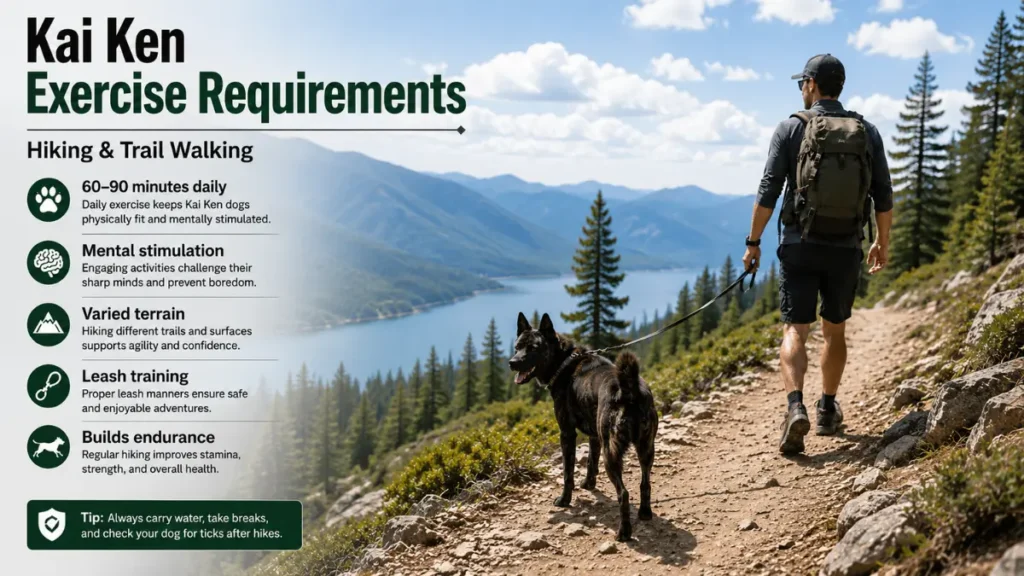
The Kai Ken is an athletic working breed that was developed to travel across steep mountain terrain while tracking game over long distances. Although most modern Kai Ken live as companion dogs, their physical and mental needs remain shaped by that working heritage. Simply providing a backyard is rarely enough to keep this breed healthy and well-balanced.
A Kai Ken thrives when both its body and mind are challenged. Daily exercise helps maintain healthy muscles, joints, cardiovascular fitness, and body weight, while mental stimulation satisfies the breed’s natural curiosity and problem-solving instincts.
Without enough activity, many Kai Ken don’t become “bad dogs”—they simply create their own entertainment, which may include:
- Digging
- Chewing household items
- Escaping fenced areas
- Chasing wildlife
- Excessive alert barking
- Restlessness indoors
In most cases, these behaviors are signs that the dog’s needs are not being fully met rather than evidence of poor temperament.
Daily Exercise Needs
Most healthy adult Kai Ken benefit from 60–90 minutes of combined physical activity each day, although the exact amount varies based on age, health, fitness, weather conditions, and individual personality.
Rather than completing one long workout, many owners find it more effective to divide exercise into two or three sessions throughout the day.
A balanced weekly routine might include:
| Activity | Benefit |
|---|---|
| Brisk walks | Daily physical exercise and routine |
| Hiking | Builds endurance while satisfying natural exploration instincts |
| Structured play | Burns energy while strengthening the owner-dog relationship |
| Fetch in a secure area | Encourages movement and engagement |
| Nature walks on a long line | Allows safe exploration and scent investigation |
The objective isn’t simply to tire the dog—it is to provide varied activities that satisfy both physical and behavioral needs.
Exercise by Life Stage
Exercise should always match the dog’s age and physical condition.
Puppies
Growing puppies benefit from frequent, short play sessions rather than prolonged or repetitive high-impact exercise. Excessive jumping or forced running may place unnecessary stress on developing joints.
Healthy Adults
Adult Kai Ken generally enjoy more demanding activities such as hiking, longer walks, tracking games, and canine sports.
Senior Dogs
Older dogs often remain active but usually benefit from shorter, lower-impact sessions that prioritize mobility and comfort over intensity.
Adjusting exercise throughout the dog’s life helps reduce injury risk while maintaining long-term fitness.
Mental Stimulation
Physical exercise alone rarely satisfies an intelligent breed like the Kai Ken.
Because the breed was developed to make independent decisions while hunting, mental challenges are just as important as daily walks. A dog that receives plenty of exercise but little mental engagement may still become bored and develop unwanted behaviors.
Excellent enrichment activities include:
- Food puzzle toys
- Snuffle mats
- Scent work
- Hide-and-seek games
- Trick training
- Obedience practice
- Interactive feeding toys
- Scatter feeding in safe outdoor areas
Even 10–15 minutes of focused mental enrichment can provide meaningful stimulation and often leaves the dog more satisfied than additional physical exercise alone.
Why Scent Work Matters
One of the easiest ways to enrich a Kai Ken’s daily routine is by encouraging natural scenting behavior.
Instead of asking the dog to walk in a perfectly straight line for an hour, allow time to investigate interesting smells during appropriate portions of the walk. Sniffing is mentally demanding and provides valuable environmental information for dogs.
For many Kai Ken, a shorter walk with opportunities to explore can be more rewarding than a longer walk where constant heel work is expected.
Activities the Kai Ken Enjoys
Because of its athletic build and working heritage, the Kai Ken often excels in activities that combine movement with problem-solving.
Popular choices include:
- Hiking
- Nose work
- Tracking
- Agility
- Rally obedience
- Canine fitness
- Adventure walks
- Interactive retrieval games
These activities not only improve physical fitness but also strengthen communication between dog and owner.
Off-Leash Exercise
Owners are often tempted to allow off-leash freedom because the Kai Ken appears attentive and intelligent.
However, intelligence should never be confused with guaranteed recall.
Even a well-trained Kai Ken may instinctively pursue wildlife if something suddenly triggers its prey drive. For this reason, off-leash exercise should generally be limited to securely fenced areas where the dog cannot chase animals or reach nearby roads.
Using a long training line during hikes and recall practice offers many of the same benefits while providing an additional level of safety for both the dog and local wildlife.
Meeting a Kai Ken’s exercise needs is about far more than simply burning energy. As a breed developed to work independently across challenging terrain, the Kai Ken benefits most from activities that engage both its body and mind. Repeating the same walk every day may provide physical exercise, but regularly introducing new routes, safe places to explore, and scent-based activities often provides far greater mental enrichment.
Owners should also remember that exercise requirements naturally change throughout a Kai Ken’s life. Puppies need short, controlled activity that supports healthy growth without placing unnecessary stress on developing joints, while healthy adults usually thrive with longer walks, hiking, structured play, and other physically demanding activities. As dogs enter their senior years, maintaining regular movement remains important, but lower-impact exercise and a pace suited to the individual dog often become more appropriate than prolonged or strenuous activity.
Consistency is usually more beneficial than occasional intense exercise. A predictable daily routine that combines physical activity, mental stimulation, training, and adequate rest helps many Kai Ken remain confident, well-mannered, and easier to live with over the long term. Rather than focusing solely on the length of a walk, owners should aim to provide a balanced routine that supports both physical fitness and emotional well-being.
Kai Ken Training
Training a Kai Ken is often described as both rewarding and humbling.
This breed is highly intelligent and capable of learning new behaviors quickly, but it was never developed to follow commands without thought. Its history as an independent mountain hunting dog continues to influence how it approaches learning today.
Owners who understand this difference usually enjoy training far more than those expecting immediate obedience.
A successful training program focuses on building trust, maintaining consistency, and giving the dog clear reasons to cooperate rather than relying on force or repetition alone.
Trainability
The Kai Ken is highly intelligent, but intelligence should not be confused with automatic obedience. Unlike breeds that were developed primarily to work under constant human direction, the Kai Ken was expected to think independently while hunting. As a result, it often evaluates situations before responding rather than reacting immediately to every command.
This doesn’t make the breed stubborn. Instead, it means training works best when the dog understands why a behavior is worthwhile.
Successful owners focus on:
- Consistency rather than repetition.
- Motivation rather than force.
- Building trust before expecting reliability.
- Keeping training sessions enjoyable and mentally engaging.
Positive reinforcement—including treats, praise, toys, and play—consistently produces better long-term results than punishment or intimidation.
What This Means for Owners
Many first-time Kai Ken owners become frustrated because the breed doesn’t always respond with the same eagerness as highly handler-focused breeds.
In reality, once trust is established, many Kai Ken become exceptionally reliable learners. The key is recognizing that this breed values partnership over unquestioning obedience.
Puppy Training
Training should begin the day your Kai Ken puppy comes home. Early experiences have a lasting influence on behavior, confidence, and communication throughout adulthood.
Rather than trying to teach dozens of commands immediately, concentrate on essential life skills.
Early priorities include:
- Name recognition
- House training
- Crate training
- Loose-leash walking
- Sit
- Come
- Leave It
- Calm handling for grooming and veterinary care
Young puppies have short attention spans, so several brief sessions each day are usually more productive than one long lesson.
Every training session should end with success. Finishing while the puppy is still engaged helps maintain enthusiasm for future learning.
Socialization
Socialization is one of the most important investments you can make during a Kai Ken’s first year.
Contrary to popular belief, socialization does not mean encouraging your puppy to greet every person or play with every dog.
The real goal is to help the puppy remain calm, confident, and adaptable in unfamiliar situations.
Gradually introduce your puppy to:
- Adults of different ages
- Respectful children
- Friendly, vaccinated dogs
- Various outdoor environments
- Household noises
- Car rides
- Veterinary clinics
- Grooming equipment
- Different walking surfaces
Each new experience should be positive and carefully managed.
Rushing the process or overwhelming the puppy with too many new situations at once can reduce confidence instead of building it.
Owner Tip
Quality matters far more than quantity.
Ten positive experiences create far more lasting confidence than fifty stressful ones.
Recall Training
Reliable recall is one of the most valuable skills any Kai Ken can learn—but it is also one of the most challenging because of the breed’s hunting instincts.
Even a well-trained Kai Ken may choose to pursue wildlife if a rabbit suddenly runs across its path.
That doesn’t necessarily indicate poor training. It reflects generations of instinctive hunting behavior.
To build the strongest possible recall:
- Begin training in securely fenced areas.
- Use a long training line outdoors.
- Reward every successful return generously.
- Practice regularly in different environments.
- Never punish the dog after it comes back, even if it took longer than expected.
Many experienced owners continue using a leash or long line in open public spaces throughout the dog’s life because management is often more reliable than trusting instinct alone.
Common Training Challenges
Most Kai Ken owners encounter similar challenges during adolescence and early adulthood. Understanding these behaviors before they appear makes them much easier to manage.
Common challenges include:
- Becoming distracted by wildlife
- Losing interest in repetitive training
- Remaining cautious around unfamiliar people
- Testing boundaries during adolescence
- Becoming bored without regular mental stimulation
These behaviors are rarely signs of dominance or defiance.
More often, they indicate that the dog needs clearer communication, greater motivation, additional enrichment, or more consistent practice.
Avoid viewing training as something that ends after puppyhood.
For the Kai Ken, learning is a lifelong process. Continuing to practice obedience, introduce new activities, and reinforce good habits throughout adulthood helps maintain confidence, strengthens the relationship between owner and dog, and prevents many common behavior problems before they begin.
Grooming Needs
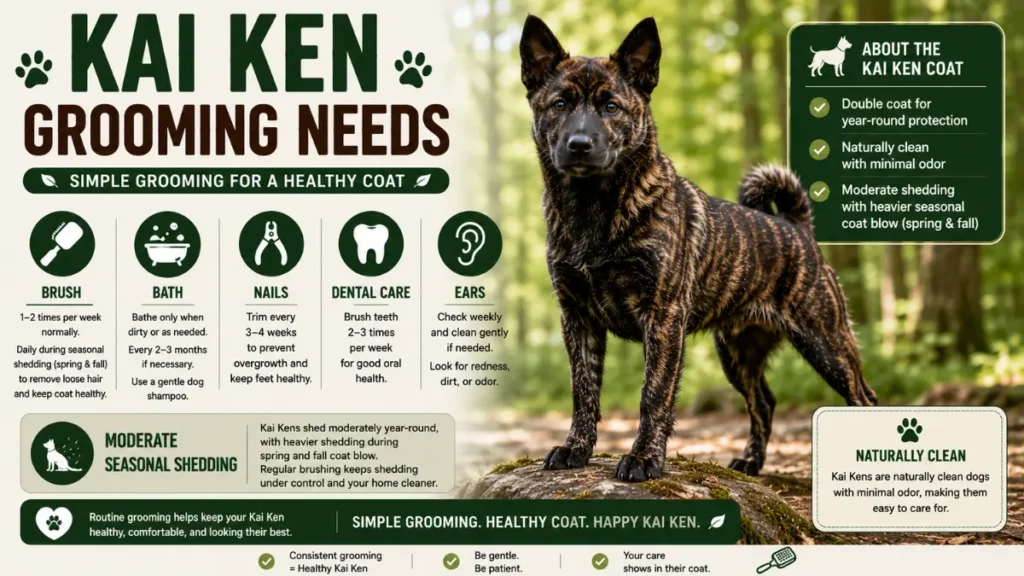
Despite its striking appearance, the Kai Ken is relatively low maintenance compared with many other double-coated breeds. Its coat naturally resists dirt and weather, allowing owners to maintain it with a straightforward grooming routine rather than frequent professional care.
Routine grooming is about more than appearance. Regular brushing, nail care, dental hygiene, and skin checks help detect minor issues early and contribute to the dog’s long-term health.
A consistent grooming routine also helps puppies become comfortable with handling, making future veterinary visits and home care significantly easier.
Shedding
The Kai Ken sheds moderately throughout the year, with noticeably heavier shedding during the seasonal coat changes that typically occur in spring and fall. During these periods, the dense undercoat loosens naturally, and owners should expect a temporary increase in loose hair around the home.
Seasonal shedding is completely normal for a double-coated breed and should not be mistaken for a health problem unless it is accompanied by symptoms such as excessive itching, bald patches, skin irritation, or sudden coat thinning.
Increasing brushing frequency during heavy shedding helps:
- Remove loose undercoat before it mats.
- Reduce hair around the home.
- Improve air circulation through the coat.
- Keep the skin cleaner and healthier.
- Make seasonal coat changes more comfortable for the dog.
Owners should never shave a Kai Ken’s double coat simply to reduce shedding. The coat provides insulation against both cold and heat, and shaving may interfere with its natural protective function.
Brushing
For most of the year, brushing once or twice each week is enough to keep the Kai Ken’s coat healthy. During seasonal shedding, increasing grooming to several sessions each week helps manage the additional loose undercoat more effectively.
Useful grooming tools include:
- Slicker brush
- Pin brush
- Undercoat rake
- Stainless-steel grooming comb
Rather than brushing as quickly as possible, use grooming sessions as an opportunity to perform a routine health check.
While brushing, look for:
- Fleas or ticks
- Skin redness or irritation
- Lumps or swelling
- Small cuts or abrasions
- Burrs, grass seeds, or plant material trapped in the coat
Finding small problems early often prevents more serious issues later.
Bathing
One advantage of the Kai Ken’s weather-resistant coat is that it generally stays clean with minimal effort.
For most healthy adults, bathing every few months—or whenever the dog becomes genuinely dirty—is usually sufficient.
Use a mild shampoo formulated specifically for dogs to preserve the coat’s natural protective oils.
Bathing too frequently may:
- Dry the skin.
- Remove beneficial natural oils.
- Dull the coat.
- Increase skin sensitivity.
If your Kai Ken enjoys hiking or exploring muddy trails, rinsing dirt from the coat with clean water is often all that’s needed between full baths.
Nail Care
Although active Kai Ken naturally wear down their nails more than many sedentary breeds, regular nail inspections are still essential.
Overgrown nails can:
- Alter normal posture.
- Reduce traction.
- Cause discomfort while walking.
- Increase the likelihood of splitting or breaking.
As a general guideline, nails should be trimmed before they become long enough to click against hard flooring during normal walking.
Introducing nail trimming during puppyhood makes future grooming significantly less stressful for both owner and dog.
Dental Care
Dental health is often overlooked, yet it plays an important role in a Kai Ken’s overall well-being.
Without regular care, plaque gradually hardens into tartar, increasing the risk of gum disease, tooth loss, pain, and chronic oral infections.
For good oral health:
- Brush your dog’s teeth several times each week using dog-safe toothpaste.
- Provide veterinarian-approved dental chews when appropriate.
- Schedule professional dental cleanings if recommended by your veterinarian.
- Monitor the mouth regularly for bad breath, broken teeth, or inflamed gums.
Small amounts of preventive care performed consistently are usually far more effective than treating advanced dental disease later.
Ear Care
Although the Kai Ken’s upright ears allow good airflow, they should still be checked regularly as part of routine grooming. Upright ears generally trap less moisture than floppy ears, but they are not maintenance-free.
Watch for signs such as:
- Redness
- Swelling
- Unpleasant odor
- Excessive wax
- Discharge
- Sensitivity when touched
If cleaning is necessary, use only products recommended by your veterinarian and avoid inserting cotton swabs deep into the ear canal, as this can push debris farther inside or damage delicate tissues.
Developing a consistent grooming routine from an early age offers benefits beyond keeping the coat clean. Regular handling helps a Kai Ken become more comfortable with routine care, making future nail trimming, ear checks, veterinary examinations, and other necessary procedures significantly less stressful. Short, positive grooming sessions also allow owners to notice gradual changes that might otherwise go unnoticed, such as new skin lumps, coat thinning, parasites, or minor injuries.
Seasonal shedding is another good opportunity to perform a more thorough physical inspection while brushing. Running your hands over the dog’s entire body allows you to check for cuts, embedded plant material, ticks, or areas of tenderness, particularly after hiking or spending time in wooded environments. Detecting these small issues early often prevents them from developing into larger health concerns.
Although the Kai Ken’s coat is naturally low maintenance, consistency remains more important than frequency. A simple routine followed throughout the year is generally more beneficial than infrequent, intensive grooming sessions. Combined with proper nutrition and regular preventive healthcare, routine grooming supports both the dog’s appearance and its overall long-term well-being.
Nutrition and Feeding
Good nutrition supports every stage of a Kai Ken’s life—from healthy growth during puppyhood to maintaining muscle, energy, coat quality, immune function, and overall health in adulthood.
Rather than searching for a single “best” food, focus on choosing a complete and balanced diet that matches your dog’s individual needs. Those needs change over time and should be evaluated according to:
- Age
- Activity level
- Body condition
- Overall health
- Veterinary recommendations
No single feeding plan works for every Kai Ken. A highly active hiking companion will often require different calorie intake than a senior dog with lower daily activity, even if both weigh the same.
As your dog’s lifestyle changes, its nutrition should evolve as well.
Puppy Nutrition
Kai Ken puppies grow rapidly during their first year, making proper nutrition especially important.
A quality puppy food formulated for growth provides nutrients that support:
- Healthy bone development
- Muscle growth
- Brain development
- Immune system function
Young puppies usually eat several smaller meals throughout the day before gradually transitioning to fewer meals as they mature. Fresh, clean drinking water should always be available.
More important than following a strict feeding schedule is monitoring healthy growth. Puppies should develop steadily without becoming either overweight or excessively thin.
Balanced growth during the first year lays the foundation for long-term health and mobility.
Adult Nutrition
Healthy adult Kai Ken generally do well on a complete and balanced dog food that matches their age, activity level, and overall health. Because this breed is naturally lean and athletic, maintaining ideal body condition is usually more important than choosing a specific brand.
Instead of relying solely on the feeding guide printed on the package, monitor your dog’s body condition regularly and adjust portions as needed.
Factors that influence daily food requirements include:
- Activity level
- Age
- Metabolism
- Body condition
- Reproductive status
- Veterinary recommendations
A Kai Ken that hikes several times each week may require significantly more calories than one living a relatively sedentary lifestyle.
Owner Tip
Measure meals rather than estimating portions.
Even small daily overfeeding can gradually lead to unhealthy weight gain over time, while consistent portion control makes it much easier to maintain ideal body condition.
Senior Nutrition
As Kai Ken enter their senior years, nutritional needs often change.
Many older dogs become less active, which means continuing the same feeding routine used during adulthood may gradually lead to excess weight. At the same time, maintaining lean muscle becomes increasingly important.
Many senior dogs benefit from diets formulated to support:
- Joint health
- Healthy digestion
- Muscle maintenance
- Cognitive function
- Healthy body weight
Regular veterinary examinations become especially valuable during this stage of life. Changes in appetite, body weight, drinking habits, or digestive health should never be dismissed as simply “old age” without veterinary evaluation.
Weight Management
Maintaining a healthy weight is one of the simplest—and most effective—ways to support a Kai Ken’s long-term health.
Excess body fat increases stress on the joints, reduces stamina, and may contribute to the development or progression of several chronic health conditions. Conversely, dogs that are significantly underweight may lack adequate muscle mass and energy reserves.
To help maintain an ideal body condition:
- Measure meals instead of free-feeding.
- Limit unnecessary high-calorie treats.
- Adjust food intake when activity levels change.
- Provide regular daily exercise.
- Monitor body condition every month.
- Schedule routine weight checks during veterinary visits.
Rather than aiming for a specific number on the scale, focus on keeping your Kai Ken lean, muscular, and physically fit throughout its life.
Beyond choosing a complete and balanced diet, owners should remember that good nutrition is an ongoing process rather than a one-time decision. A Kai Ken’s dietary needs naturally change throughout its life, and factors such as activity level, seasonal exercise, aging, and overall health may all influence how much food it needs. Periodically reassessing your dog’s body condition and adjusting portions accordingly is often more effective than relying on the same feeding routine year after year.
Whenever you need to change your Kai Ken’s food, make the transition gradually over several days to help reduce the risk of digestive upset. During this period, monitor appetite, stool quality, energy levels, and overall condition to ensure the new diet is well tolerated. Introducing any new food slowly also makes it easier to identify potential sensitivities if they occur.
Treats should be viewed as training tools rather than a significant part of the daily diet. While rewards play an important role in positive reinforcement training, excessive treats can gradually increase calorie intake and make maintaining a healthy body condition more difficult. Fresh, clean drinking water should also be available at all times, particularly after exercise, hiking, training sessions, or during hot weather when active dogs lose more fluids.
Finally, remember that no feeding guide can replace regular observation of your individual dog. Routine veterinary checkups, combined with ongoing monitoring of body condition, muscle tone, and weight, allow nutritional adjustments to be made before small changes develop into long-term health concerns. This proactive approach supports not only a healthy weight but also long-term mobility, energy levels, and overall well-being throughout every stage of a Kai Ken’s life.
Kai Ken Health Issues
The Kai Ken is generally regarded as a healthy breed with a relatively long lifespan. However, like every dog breed, it can develop inherited conditions as well as illnesses acquired during life. Responsible breeding, preventive healthcare, and regular veterinary examinations remain essential for maintaining long-term health.
Because the Kai Ken is relatively rare outside Japan, published health research is more limited than it is for many popular breeds. A smaller number of published studies does not mean the breed is free of health concerns—it simply means less large-scale data is available.
For prospective owners, this makes choosing a responsible breeder even more important.
Expected Lifespan
Most Kai Ken live 12–15 years, although individual longevity depends on many factors beyond genetics alone.
Important influences include:
- Genetics
- Nutrition
- Healthy body weight
- Regular exercise
- Preventive veterinary care
- Dental health
- Overall lifestyle
With consistent care and responsible breeding, many Kai Ken remain active, mobile, and mentally engaged well into their senior years.
Rather than focusing only on lifespan, owners should also aim to maximize healthspan—the number of years the dog remains healthy, comfortable, and capable of enjoying everyday activities.
Health Screening
One of the most important decisions prospective owners make happens before the puppy ever comes home.
Choosing a breeder who performs appropriate health evaluations helps reduce the likelihood of inherited health problems and supports the long-term welfare of the breed.
Responsible breeders should be willing to discuss:
- Health testing performed on breeding dogs.
- The medical history of their breeding lines.
- Temperament of the parents.
- Why specific breeding pairs were selected.
- Veterinary care provided to puppies.
Health screening should never be viewed as a guarantee that a puppy will remain disease-free. Instead, it is a responsible breeding practice that helps reduce avoidable genetic risk.
Conditions Owners Should Screen For
Health recommendations continue to evolve as new information becomes available. Rather than looking for breeders who simply claim their dogs are “healthy,” ask what evaluations they perform and why.
Depending on current veterinary recommendations and breeding practices, health assessments may include evaluations related to:
- Hip health
- Eye health
- Elbow health
- Heart health
- Patellar (kneecap) health
- Thyroid function when appropriate
Documentation is generally more valuable than verbal assurances. Responsible breeders are usually willing to explain both the strengths and limitations of the health testing they perform.
Preventive Care
Preventive healthcare is one of the most effective ways to help a Kai Ken live a long, healthy life.
A comprehensive preventive care plan includes:
- Routine veterinary examinations.
- Recommended vaccinations.
- Year-round parasite prevention where appropriate.
- Regular dental care.
- Maintaining a healthy body weight.
- Daily exercise.
- Ongoing mental enrichment.
Owners should also become familiar with changes that may indicate illness.
Seek veterinary advice promptly if your Kai Ken develops symptoms such as:
- Persistent limping
- Unexplained weight loss
- Repeated vomiting
- Ongoing loss of appetite
- Difficulty breathing
- Significant behavioral changes
- Sudden lethargy
Many medical conditions are easier to treat when identified early. Regular observation at home, combined with preventive veterinary care, gives your dog the best opportunity for a long and healthy life.
While responsible breeding helps reduce the risk of inherited health conditions, no breeder can guarantee that a dog will remain free of illness throughout its lifetime. Genetics are only one part of the picture. Daily care, balanced nutrition, maintaining a healthy body weight, regular exercise, dental hygiene, parasite prevention, and timely veterinary attention all contribute to a Kai Ken’s long-term health and overall quality of life.
Owners should also become familiar with what is normal for their individual dog. Subtle changes in appetite, water intake, energy level, mobility, or behavior are often easier to recognize at home than during an annual veterinary visit. Monitoring these everyday changes and discussing them promptly with your veterinarian can help identify potential health concerns before they become more serious.
Routine wellness examinations remain valuable even when a Kai Ken appears healthy. Preventive visits allow veterinarians to monitor body condition, detect age-related changes, review nutrition, assess dental health, and recommend appropriate preventive care based on the dog’s age and lifestyle. Building a consistent partnership with your veterinarian is one of the most effective ways to support your Kai Ken’s health throughout every stage of its life.
Kai Ken Puppy Guide
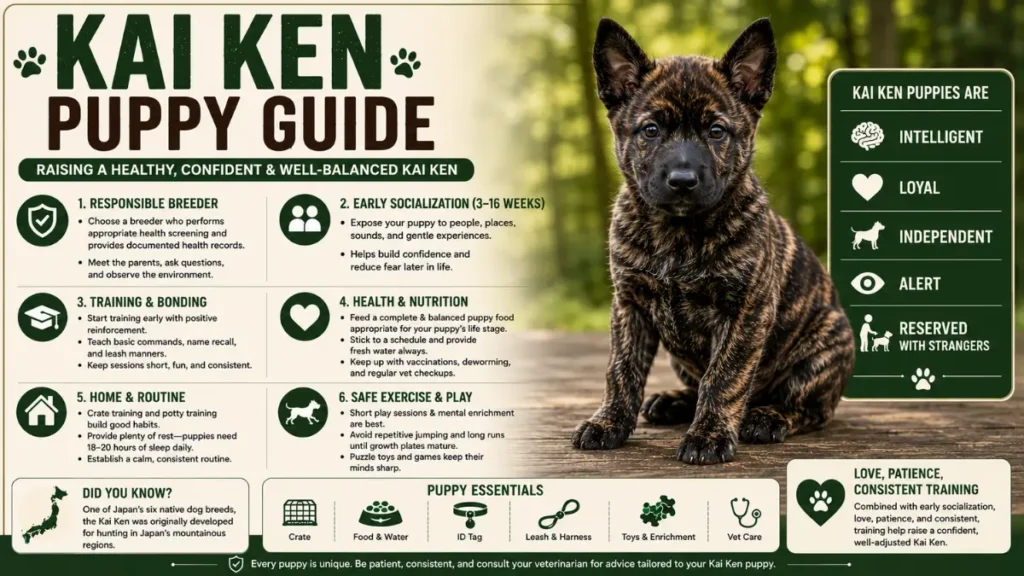
Bringing home a Kai Ken puppy is exciting, but it also comes with long-term responsibilities. Because this breed is relatively rare, many prospective owners spend months researching breeders, joining waiting lists, and preparing their homes before a puppy becomes available. That extra preparation is worthwhile. The decisions you make before your puppy arrives often have a greater impact on its future behavior than the first training session ever will.
The Kai Ken matures into a confident and loyal companion when its early experiences are carefully managed. Rushing the process—or choosing a puppy based only on availability—can create avoidable challenges later.
Choosing a Responsible Breeder
Finding the right breeder is one of the most important investments you can make in your dog’s future health and temperament.
Responsible breeders aim to preserve the breed rather than simply produce puppies. They carefully evaluate breeding dogs, prioritize stable temperaments, complete appropriate health testing, and begin early socialization long before puppies leave for their new homes.
Questions worth asking include:
- What health testing has been completed on both parents?
- What are the parents’ temperaments like?
- How are the puppies socialized before going home?
- What veterinary care have the puppies received?
- Do you provide lifetime support for owners?
- What happens if I can no longer keep the dog?
A responsible breeder should welcome thoughtful questions rather than discourage them.
Warning Signs to Watch For
Be cautious if a breeder:
- Always has multiple litters available.
- Refuses to discuss health testing.
- Focuses primarily on marketing or rare colors.
- Cannot explain the temperament of the parents.
- Pressures buyers to make quick decisions.
- Offers little or no support after the sale.
Because Kai Ken are uncommon, waiting several months for a well-bred puppy is usually a better decision than purchasing the first available dog.
If you’re open to an adult dog, breed-specific rescue organizations may occasionally have Kai Ken or Kai Ken mixes looking for homes, although availability is generally limited.
Preparing Your Home
Preparing your home before your puppy arrives helps reduce stress during the first few weeks and allows you to focus on building trust instead of rushing to buy supplies.
Essential items include:
- Properly sized crate
- Comfortable bed
- Food and water bowls
- High-quality puppy food
- Adjustable collar
- Well-fitted harness
- Standard leash
- Identification tag
- Safe chew toys
- Interactive puzzle toys
- Basic grooming supplies
Puppy-proof your home just as carefully as you would for a young child.
Remove or secure:
- Electrical cords
- Toxic plants
- Household cleaners
- Human medications
- Small swallowable objects
- Loose garbage
- Foods that are unsafe for dogs
Creating a safe environment from the beginning reduces the risk of accidents and allows your puppy to explore confidently.
The First Week at Home
The first week is about helping your puppy feel secure—not teaching dozens of commands.
Everything is unfamiliar: the home, smells, routines, people, and sleeping environment.
During this period, focus on:
- Establishing a predictable daily routine.
- Beginning house training immediately.
- Introducing the crate positively.
- Keeping early experiences calm and encouraging.
- Allowing the puppy to rest frequently.
- Building trust through gentle handling.
Avoid overwhelming your puppy with too many visitors or unfamiliar environments during the first few days. Confidence grows through positive experiences, not constant exposure.
First-Year Expectations
The first year is a period of rapid physical and behavioral development. Experiences during this stage often influence confidence, social skills, and learning throughout adulthood.
Your priorities should include:
- Consistent house training.
- Early socialization.
- Reward-based obedience training.
- Routine veterinary care.
- Vaccinations and parasite prevention.
- Confidence-building experiences.
- Plenty of supervised play.
- Adequate sleep and recovery.
Many owners focus heavily on teaching commands while overlooking confidence building.
For the Kai Ken, both are equally important.
A puppy that learns to calmly navigate new environments, recover from unexpected situations, and trust its owner often develops into a far more stable adult than one that simply knows a long list of commands.
Caring for Adult and Senior Kai Ken
A Kai Ken’s needs naturally evolve throughout life. While its intelligence, loyalty, and athletic ability remain defining characteristics, exercise routines, nutrition, healthcare, and daily management should adapt as the dog matures.
Providing age-appropriate care helps maintain mobility, confidence, and overall quality of life from adulthood through the senior years.
Adult Care
Healthy adult Kai Ken thrive on consistency and purpose.
A well-balanced daily routine should include:
- Regular physical exercise
- Mental enrichment
- Ongoing positive reinforcement training
- Complete and balanced nutrition
- Routine grooming
- Preventive veterinary care
- Meaningful interaction with family
Although the breed is known for its independent personality, most Kai Ken prefer being included in everyday family life rather than spending long periods isolated outdoors or alone inside the home.
Continuing training beyond puppyhood is equally important.
Practicing obedience, introducing new skills, hiking, participating in scent work, or exploring new environments keeps both the dog’s mind and body active while strengthening the relationship between owner and companion.
Senior Care
As Kai Ken enter their senior years, gradual changes in energy level, mobility, hearing, or vision may become more noticeable. While many remain active well into old age, they often benefit from small adjustments to their daily routine rather than dramatic lifestyle changes.
Senior care should focus on preserving comfort, mobility, and quality of life.
Key priorities include:
- Maintaining a healthy body weight
- Providing moderate daily exercise
- Supporting joint health through appropriate veterinary care
- Offering comfortable, well-padded bedding
- Scheduling more frequent wellness examinations
- Monitoring changes in appetite, drinking habits, vision, hearing, and behavior
- Continuing gentle mental enrichment
Growing older does not mean a Kai Ken loses its desire to learn or explore. Many senior dogs continue enjoying slower walks, scent games, and short training sessions that keep both body and mind engaged.
What This Means for Owners
Age-related changes usually happen gradually. Because owners see their dogs every day, subtle declines can be easy to overlook.
Regular veterinary checkups, combined with careful observation at home, make it easier to identify changes early and adjust your dog’s routine before small problems become major ones.
Pros and Cons
Every breed has strengths and challenges. Understanding both before bringing home a Kai Ken helps set realistic expectations and improves the likelihood of a successful long-term relationship.
| Pros | Cons |
|---|---|
| Deeply loyal to its family | Strong prey drive requires responsible management |
| Highly intelligent and quick to learn | Independent personality may challenge inexperienced owners |
| Naturally athletic and agile | Needs consistent daily exercise and mental stimulation |
| Moderate grooming requirements | Early socialization is essential |
| Usually quiet indoors | Rare breed with limited puppy availability |
| Generally healthy when responsibly bred | Better suited to experienced or highly committed owners |
| Medium size fits many active households | Recall may remain unreliable around wildlife |
The Kai Ken’s greatest strengths often come from the same qualities that create its biggest challenges.
For example:
- Independence allows confident decision-making but can make training more demanding.
- Strong hunting instincts contribute to athletic ability but require careful leash management.
- Loyalty creates deep family bonds but often comes with natural reserve toward strangers.
Whether these characteristics are advantages or disadvantages depends largely on your expectations and lifestyle.
Is the Kai Ken Right for You?
Choosing a dog should always begin with lifestyle compatibility, not appearance alone.
The Kai Ken can become an exceptional lifelong companion, but only when its instincts, temperament, and daily needs align with what an owner can realistically provide.
The Kai Ken May Be an Excellent Match If You:
- Enjoy hiking, camping, or other outdoor activities.
- Can provide 60–90 minutes of daily exercise.
- Appreciate intelligent, independent dogs.
- Prefer a loyal companion over an overly social breed.
- Are committed to ongoing training and socialization.
- Understand the responsibilities of long-term dog ownership.
Owners with these lifestyles often appreciate the Kai Ken’s calm confidence, working ability, and strong bond with its family.
The Kai Ken May Not Be the Best Choice If You:
- Want a low-energy companion.
- Expect perfect off-leash reliability.
- Spend long hours away from home every day.
- Prefer a dog that eagerly greets every stranger.
- Keep several small pets without a realistic management plan.
- Are unwilling to invest time in training and mental enrichment.
Choosing a breed that naturally fits your lifestyle is one of the best ways to prevent behavioral problems and ensure both owner and dog enjoy a fulfilling relationship.
Lifestyle Match Checklist
Before bringing home a Kai Ken, honestly ask yourself the following questions:
- Can I provide at least 60–90 minutes of daily exercise?
- Am I prepared to continue training throughout my dog’s life?
- Do I understand how to manage prey drive safely?
- Can I commit to early and ongoing socialization?
- Am I comfortable living with an independent-thinking breed?
- Have I researched responsible breeders or reputable rescue organizations?
- Can I provide the long-term financial commitment required for veterinary care, nutrition, grooming, and emergency expenses?
If you answered “yes” to most of these questions, the Kai Ken is more likely to fit your lifestyle.
If several answers are “no,” it may be worth considering a breed whose needs better match your current circumstances. Choosing the right breed from the beginning is far kinder than struggling with an unsuitable match later.
Common Mistakes New Owners Make
Even dedicated owners can face challenges when raising a rare working breed. Understanding the most common mistakes can help prevent many behavior problems before they develop.
Waiting Too Long to Socialize
Some owners avoid introducing puppies to new experiences because they worry about overwhelming them.
In reality, gradual, positive exposure during puppyhood helps build confidence and reduces the likelihood of fear-based behaviors later in life.
Underestimating Exercise Needs
A quick walk around the neighborhood is rarely enough for an intelligent working breed.
Without sufficient physical activity and mental enrichment, many Kai Ken create their own entertainment through:
- Digging
- Chewing
- Escaping
- Chasing wildlife
- Persistent alert barking
Meeting the breed’s daily needs is usually far more effective than trying to correct behaviors that develop because those needs were ignored.
Ignoring Mental Stimulation
Physical exercise alone does not satisfy the Kai Ken.
Activities such as scent work, puzzle feeders, obedience practice, trick training, and problem-solving games help channel the breed’s intelligence into productive outlets while strengthening the relationship between owner and dog.
Trusting Recall Too Early
Many owners overestimate recall reliability after only a few successful training sessions.
Because the Kai Ken retains strong hunting instincts, even well-trained dogs may chase wildlife unexpectedly.
Using secure fencing and long training lines during recall practice is usually a safer long-term strategy than assuming instinct will never override training.
Choosing a Breeder Based Only on Availability
Because Kai Ken puppies are uncommon, buyers sometimes feel pressured to reserve the first available puppy.
However, waiting for a breeder who prioritizes:
- Health testing
- Stable temperament
- Ethical breeding practices
- Early puppy socialization
- Lifetime owner support
is almost always a better long-term decision than purchasing quickly from an unknown source.
A well-bred puppy provides a stronger foundation for health temperament, and lifelong companionship than convenience alone.
Frequently Asked Questions
Is a Kai Ken a good family dog?
Yes—for the right family.
A well-socialized Kai Ken can become an outstanding companion for active households that understand the breed’s physical and mental needs. It is typically loyal, affectionate with trusted family members, and calm inside the home once its daily exercise and enrichment requirements have been met.
However, the Kai Ken is not the ideal choice for every family. It generally does best with owners who:
- Enjoy an active lifestyle.
- Can provide consistent training.
- Understand the importance of early socialization.
- Respect the breed’s naturally reserved personality.
Families looking for a highly social, low-energy dog may find another breed a better fit.
Are Kai Ken dogs aggressive?
No.
A properly bred and well-socialized Kai Ken is generally reserved rather than aggressive. It often prefers observing unfamiliar people before deciding whether interaction is necessary, which is consistent with the breed’s historical role as an independent working dog.
Like any breed, poor breeding, inadequate socialization, fear, or inappropriate handling can contribute to behavioral problems. These issues are not unique to the Kai Ken.
Most well-adjusted individuals display:
- Calm confidence
- Good environmental awareness
- Controlled behavior around strangers
- Strong loyalty toward their family
Do Kai Ken dogs shed?
Yes.
The Kai Ken has a double coat that sheds moderately throughout the year, with noticeably heavier seasonal shedding during spring and fall as the undercoat changes.
Routine brushing helps:
- Remove loose hair.
- Reduce shedding around the home.
- Keep the coat healthy.
- Improve air circulation through the undercoat.
Owners should expect seasonal shedding as a normal part of living with a double-coated breed.
Are Kai Ken easy to train?
The Kai Ken is highly intelligent, but it is not an automatically obedient breed.
Because it was developed to work independently, training requires patience, consistency, and positive reinforcement rather than repetitive drilling or harsh corrections.
Owners who focus on building trust generally achieve excellent results, while those expecting immediate compliance may find the breed more challenging.
How much exercise does a Kai Ken need?
Most healthy adult Kai Ken benefit from approximately 60–90 minutes of combined physical activity each day, along with regular mental enrichment.
An effective routine typically combines:
- Daily walks
- Hiking or outdoor exploration
- Structured play
- Training sessions
- Puzzle toys
- Scent-based activities
Mental stimulation is just as important as physical exercise for this intelligent working breed.
Can Kai Ken live in apartments?
Yes.
Apartment living is entirely possible if the dog’s exercise and enrichment needs are consistently met. The Kai Ken generally adapts well to smaller living spaces because its overall size is moderate.
The real challenge is not the size of the home but whether the owner can provide:
- Daily exercise.
- Mental stimulation.
- Training.
- Regular outdoor experiences.
An active owner in an apartment often provides a better life than an inactive owner with a large backyard.
Are Kai Ken good with cats?
Sometimes.
Many Kai Ken successfully live with cats they have been raised alongside, particularly when introductions begin during puppyhood. However, because the breed retains a natural prey drive, unfamiliar cats may still trigger chasing behavior.
Careful introductions, supervision, and realistic expectations remain essential throughout the relationship.
How rare is the Kai Ken?
The Kai Ken is considered one of the rarest Japanese dog breeds, especially outside Japan.
Because relatively few responsible breeders exist, prospective owners often spend months researching breeders and joining waiting lists before a puppy becomes available.
Its rarity also makes careful breeder selection particularly important for preserving the breed’s health and temperament.
How much does a Kai Ken puppy cost?
The purchase price of a Kai Ken puppy varies considerably depending on factors such as:
- Country and region
- Breeder reputation
- Health testing
- Pedigree
- Availability
- Import requirements, if applicable
Because availability is limited, prospective owners should avoid choosing a breeder based solely on the lowest price.
The long-term value of a responsibly bred puppy generally outweighs any short-term savings from purchasing through an unknown source.
Key Takeaways
The Kai Ken is a rare Japanese breed that combines intelligence, athleticism, loyalty, and a strong working heritage. While its striking brindle coat often attracts attention, its true strengths lie in its balanced temperament, independent thinking, and deep bond with its family.
Before bringing a Kai Ken home, remember these key points:
- The breed thrives with active, committed owners.
- Daily physical exercise and mental stimulation are essential.
- Early socialization plays a major role in developing a confident adult dog.
- Positive reinforcement produces the best training results.
- Responsible breeding and preventive healthcare help support long-term health.
- Medium size does not mean low maintenance—its working instincts remain strong.
- Understanding the breed’s personality is far more important than choosing it for appearance alone.
Ultimately, the Kai Ken is not the right dog for everyone—and that’s perfectly acceptable. The goal should never be to own a rare breed simply because it is unique. Instead, choose a dog whose temperament, exercise needs, and lifestyle requirements genuinely match your own.
For owners prepared to invest time, patience, and consistent guidance, the Kai Ken offers something truly special: a loyal, thoughtful companion whose partnership is built on trust rather than unquestioning obedience.
Continue Learning
Learning about the Kai Ken is only the beginning of responsible dog ownership. Expanding your knowledge of canine behavior, nutrition, health, and training will help you make better decisions throughout your dog’s life.
Topics worth exploring include:
- Native Japanese dog breeds
- Positive reinforcement training
- Puppy socialization
- Canine nutrition
- Grooming best practices
- Preventive veterinary care
- Choosing a responsible breeder
The more you understand your dog’s natural instincts and needs, the more rewarding your relationship is likely to become. A well-informed owner is one of the greatest contributors to a healthy, confident, and happy Kai Ken.
Frequently Asked Questions
Is a Kai Ken a good family dog?
Yes—for the right family.
A well-socialized Kai Ken can become an outstanding companion for active households that understand the breed’s physical and mental needs. It is typically loyal, affectionate with trusted family members, and calm inside the home once its daily exercise and enrichment requirements have been met.
However, the Kai Ken is not the ideal choice for every family. It generally does best with owners who:
Enjoy an active lifestyle.
Can provide consistent training.
Understand the importance of early socialization.
Respect the breed’s naturally reserved personality.
Families looking for a highly social, low-energy dog may find another breed a better fit.
Are Kai Ken dogs aggressive?
No.
A properly bred and well-socialized Kai Ken is generally reserved rather than aggressive. It often prefers observing unfamiliar people before deciding whether interaction is necessary, which is consistent with the breed’s historical role as an independent working dog.
Like any breed, poor breeding, inadequate socialization, fear, or inappropriate handling can contribute to behavioral problems. These issues are not unique to the Kai Ken.
Most well-adjusted individuals display:
Calm confidence
Good environmental awareness
Controlled behavior around strangers
Strong loyalty toward their family
Do Kai Ken dogs shed?
Yes.
The Kai Ken has a double coat that sheds moderately throughout the year, with noticeably heavier seasonal shedding during spring and fall as the undercoat changes.
Routine brushing helps:
Remove loose hair.
Reduce shedding around the home.
Keep the coat healthy.
Improve air circulation through the undercoat.
Owners should expect seasonal shedding as a normal part of living with a double-coated breed
Are Kai Ken easy to train?
The Kai Ken is highly intelligent, but it is not an automatically obedient breed.
Because it was developed to work independently, training requires patience, consistency, and positive reinforcement rather than repetitive drilling or harsh corrections.
Owners who focus on building trust generally achieve excellent results, while those expecting immediate compliance may find the breed more challenging.
Are Kai Ken good with cats?
Sometimes.
Many Kai Ken successfully live with cats they have been raised alongside, particularly when introductions begin during puppyhood. However, because the breed retains a natural prey drive, unfamiliar cats may still trigger chasing behavior.
Careful introductions, supervision, and realistic expectations remain essential throughout the relationship.